


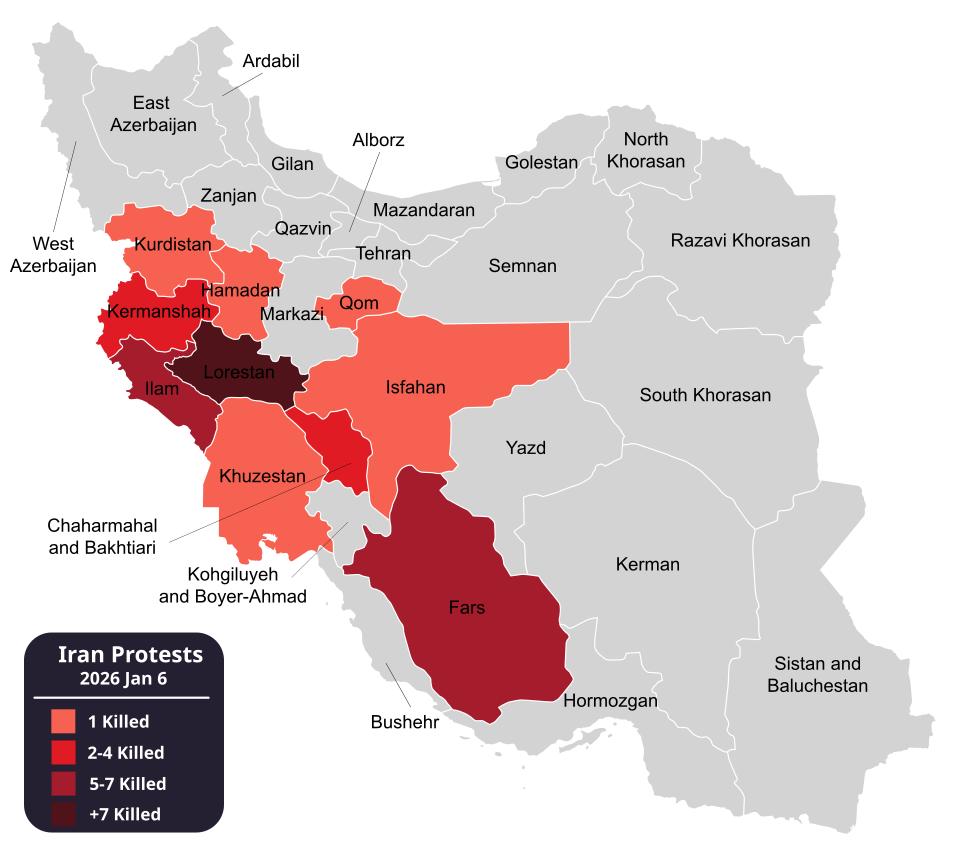
Protests in Iran have continued for a second week and show no sign of slowing down.
With more than 36 protestors killed and thousands arrested this is one of the biggest challenges to Iran’s clerical rulers since their revolution in 1979.
Demonstrations arose in the capital, Tehran, on December 28th and have since spread to 27 of Iran’s 31 provinces and over 280 locations according to the US-based Human Rights Activists News Agency (HRANA).
The most conspicuous cause of the protest is the dire economic situation in Iran. On December 28th shopkeepers and bazaar merchants shuttered their stores to protest the poor state of the economy after the Iran Rial fell to a new low, exacerbating the hyper-inflation the country was already experiencing.
The Iranian economic issues are long-standing and reflect years of sanctions as well as the corruption spread throughout the Iranian regime. The situation worsened after Iran’s ignominious defeat in the 12-day war with Israel and the U.S. in June. With inflation at around 40%, the country has been teetering on economic disaster for a while now.
But the protests are not only about economic issues. Popular uprisings in the recent past have been focused on freedom generally and the rights of women specifically. While this time it is economic issues at the forefront, those cultural issues remain salient within a populace that is chafing under religious rule. Iran’s defeat in June coupled with a crippling drought have also contributed to the unrest.
Though there have been a few dozen deaths, the regime has thus far acted with more restraint than we have seen in the past. Both the U.S. and Israel have hinted at a willingness to strike Iran militarily to either restrain the regime’s suppression of the protests and/or to facilitate regime change. Both states see the Islamic Republic as at a weak point, and Israel, in particular, seems eager to take advantage of the moment.
Regime change, however, is unlikely to occur without some sort of large-scale defection among the security forces. While there have been sporadic reports of armed protesters, Iran’s security forces remain more than capable of suppressing a poorly armed popular uprising.
We are closely watching for any signs that either political or military actors are pushing to remove Supreme Leader Ayatollah Ali Khamenei from power. Past analyses have pointed to the Islamic Revolutionary Guard Corps (I.R.G.C.) as the likeliest force to grab power from Khamenei. In recent months, however, prominent political leaders – for example, former president Hassan Rouhani – have been positioning themselves as possible alternatives.
It remains possible that some sort of opposition group will emerge from the protests as an alternative regime. However, for the moment, no opposition group has enough support or enough weapons to threaten the regime.
There is a fierce debate going on in the Iranian diaspora regarding whether or not the last Shah’s son, Reza Pahlavi, has a robust enough support base inside the country to lead the opposition. Interfor assesses that affinity for Pahlavi is, in fact, growing, largely due to the absence of other recognizable leaders. Still, Pahlavi and his supporters abroad are almost certainly inflating assessments of his support inside Iran.
Overall, we are watching two high impact possibilities:
1. Intervention/attacks from Israel and/or the US, taking advantage of the regime’s moment of weakness; and
2. Any signs of a power struggle inside the Iranian regime. Either a political or military contingent could theoretically sideline the Supreme Leader in order to negotiate a resolution with both the protesters and the U.S.
In either case, we assess that regime change is unlikely without a large-scale defection of security forces to the opposition. A useful analysis that’s been discussed among Iran watchers is that the regime is now spiritually dead. But that doesn’t mean it can’t still ruthlessly suppress opposition. Until the means of suppression at least partially switch sides, it’s hard to imagine this regime collapsing Assad-style.
All of the above notwithstanding, the likeliest outcome is still that the protests gradually fade away and the regime survives (at least for the medium term). That said, that might be more of a 75% scenario now vs. a >90% probability during past protest waves. Interfor will continue to watch the situation closely and provide insights accordingly. If you would like to discuss any particular issue please reach out to us directly at info@interfor.international.
To find out more, please reach out to info@interforinternational.com
Related Blog
VIEW ALLInterfor International‘s Weekly Security Digest – February 24, 2026
Interfor International‘s Weekly Security Digest – February 17, 2026
Interfor International‘s Weekly Security Digest – February 10, 2026
