

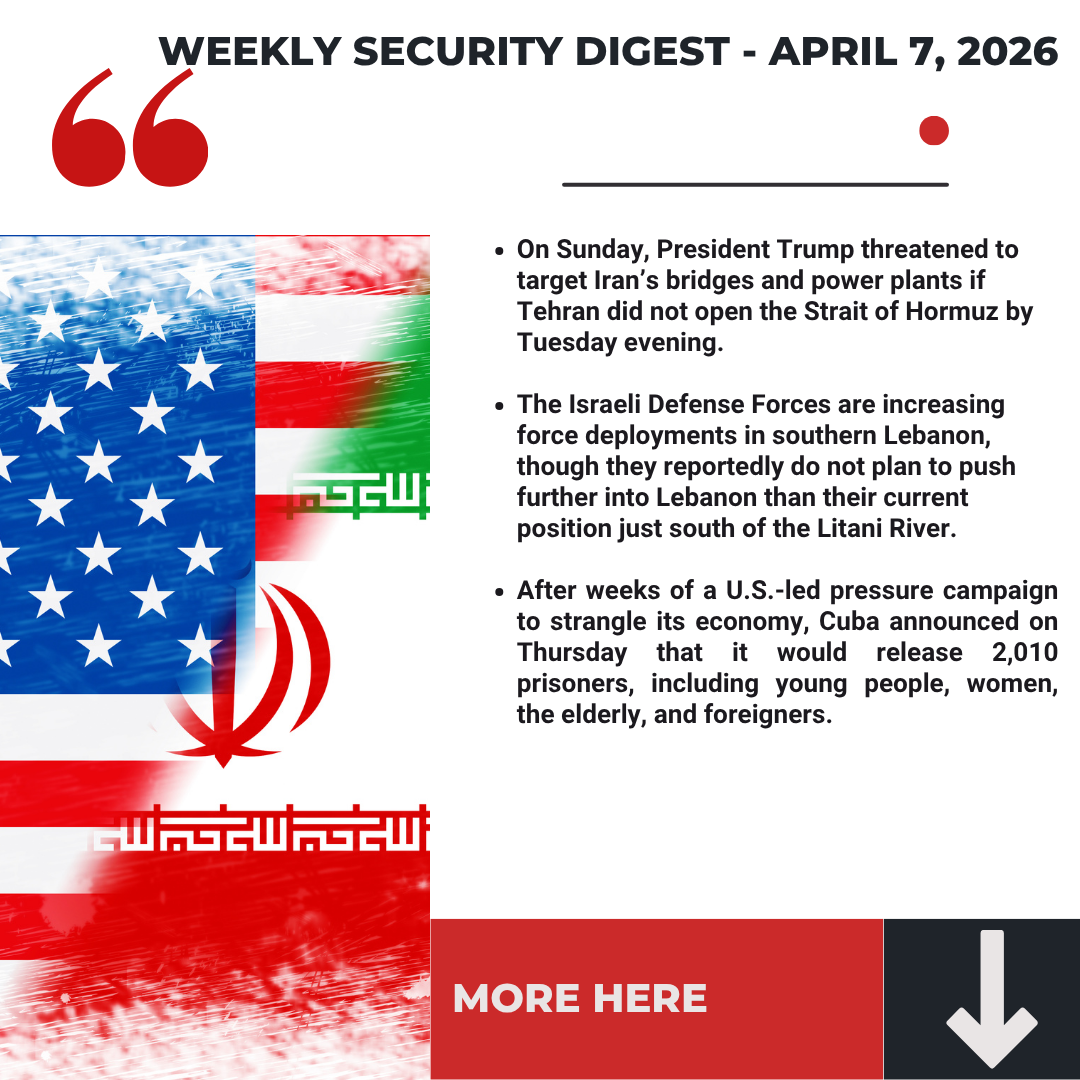
| Middle East On Sunday, President Trump threatened to target Iran’s bridges and power plants if Tehran did not open the Strait of Hormuz by Tuesday evening. Iran has rejected a temporary ceasefire proposal and is instead demanding a permanent end to hostilities, payment for reconstruction, and the lifting of sanctions. Gulf leaders are urging Trump not to agree to a deal without Iran relinquishing control over the Strait of Hormuz, while Israel will likely oppose deals that fail to address Iran’s stockpile of highly enriched uranium. For the moment, a deal between Iran and the United States is unlikely. Iran is eager to use its leverage – its effective blockade of the Strait of Hormuz – to reposition itself in the regional order and protect itself against future attacks. In order to do that, it needs a permanent ceasefire, not a temporary one. And yet, the U.S. and Iran remain very far apart on terms for a long-term ceasefire. In the coming days and weeks, we will likely see mediating countries attempt to persuade Iran to consider accepting a temporary ceasefire, while also trying to bridge the gap between U.S. and Iranian demands for a longer-term deal. President Trump has now postponed his deadline for Iran to reopen the Strait multiple times. Our assessment is that if, as is likely, no deal is struck by 8pm Tuesday, the U.S. will escalate militarily against Iran. As for what the U.S. will hit, Trump has threatened devastating strikes on power plants. This, however, is more useful as a threat than it would be as an actual attack. Limited strikes on specific infrastructure used to power Iran’s underground missile cities could serve military objectives, but broader attacks on civilian power infrastructure would draw global criticism. Importantly, even limited strikes on power infrastructure would likely draw undesirable retaliation against infrastructure targets across the G.C.C. Another possibility is that the U.S. will choose this moment to escalate with ground troops, for example, by conducting raids or other operations on Iranian islands near the Strait. Trump is emboldened following the zero-casualty ground mission that rescued the second Air Force officer from deep inside Iran over the weekend. Ground options likely hold more appeal to him in the aftermath of that mission. Iran has telegraphed that it would respond to U.S. strikes on its power plants by targeting parallel infrastructure across the Gulf States. That retaliation would impose massive costs on the Gulf, whose leaders have been urging Trump to exercise caution. If, on the other hand, the U.S. launches operations aimed at reopening the Strait of Hormuz, we might see Iran push the Houthis to target shipping in the Red Sea and constrain trade through the Bab al Mandab. → The Israeli Defense Forces are increasing force deployments in southern Lebanon, though they reportedly do not plan to push further into Lebanon than their current position just south of the Litani River. Airstrikes have increased over the past several days and have struck as far north as Beirut. The Lebanese Health Ministry reports that over 1,400 people have been killed in the current war. → On Tuesday morning, three men opened fire at police outside of the Israeli Consulate in Istanbul. One attacker was killed and two arrested. Interior Minister Mustafa Cifti posted on social media that one of the shooters was linked to an unspecified religious extremist group. The Israeli consulate was empty at the time of the incident due to preexisting security concerns for Israelis in Turkey. Turkish authorities’ investigation is ongoing. International Affairs Hungarian Prime Minister Viktor Orbán convened an emergency National Defense Council meeting following last week’s discovery of explosives near the TurkStream pipeline in neighboring Serbia, a critical route for Russian gas supplies to Hungary. The incident occurred days ahead of national elections, intensifying political tensions and causing the government to frame it as a potential threat to energy security. Although no group has claimed responsibility, the episode has intensified speculation around possible external interference in domestic Hungarian affairs. → On Sunday, Pope Leo XIV delivered his first Easter Mass address at St. Peter’s Square, calling on global leaders to choose peace and abandon conflict. The pontiff urged those “with the power to unleash wars” to pursue de-escalation, warning against growing global indifference to violence and human suffering. While avoiding direct references to specific conflicts, the address reflects the Pope’s increasingly outspoken stance on global crises, including recent criticism of the Iran conflict, and reinforces the Vatican’s emphasis on diplomacy and reconciliation. → China introduced sweeping new restrictions on civilian and recreational drone use, significantly tightening regulatory oversight in what is already the world’s largest drone market. The measures include mandatory real name registration, advance permits for most urban flights, real-time data transmission to authorities, and stricter penalties for unauthorized operations, as Beijing moves toward a near-total ban on drones within city limits. Authorities say the measures aim to enhance public safety and support the development of the “low-altitude economy,” while addressing security risks linked to drone use. → On Tuesday, suspected North Korean state-backed hackers carried out a cyber operation targeting widely used software, potentially enabling large-scale cryptocurrency theft from companies worldwide. The attack, described as a software supply-chain breach affecting thousands of firms, likely provided hackers with access to sensitive systems and credentials that they may leverage over time to steal digital assets. Experts warn that the campaign may have long-term consequences and could take months to fully assess. → After weeks of a U.S.-led pressure campaign to strangle its economy, Cuba announced on Thursday that it would release 2,010 prisoners, including young people, women, the elderly, and foreigners. Many of these prisoners are classified as “political dissidents.” The decision follows two nationwide blackouts within a week and a shrinking supply of oil, which has caused many aspects of civilian life to halt. → The Democratic Republic of Congo agreed to receive deported migrants from the U.S. under a “third-country” arrangement, marking its entry into a broader policy of relocating individuals to countries other than their origin. The Congolese government stated that the transfers, expected to begin this month, will be temporary and subject to case-by-case review. Washington will cover all logistical costs. The policy forms part of a wider deportation program that has already cost at least $40 million to relocate around 300 migrants to third countries, highlighting the significant financial scale of the initiative. |
A Note From Interfor
→ Don Aviv and Jeremy Hurewitz on Pakistan’s involvement in the Iran war for The Hill
→ Don Aviv and Sabrina Tan on the increasing threat of cyber attacks in Time Magazine
| Resources: US Department of State Travel Advisories CISA: nation-state cybersecurity threats and other resources for cybersecurity matters. |
To find out more, please reach out to info@interforinternational.com
Related Blog
VIEW ALL
Geopolitics. Global Security, & Current Events
Interfor International‘s Weekly Security Digest – April 7, 2026
Geopolitics. Global Security, & Current Events
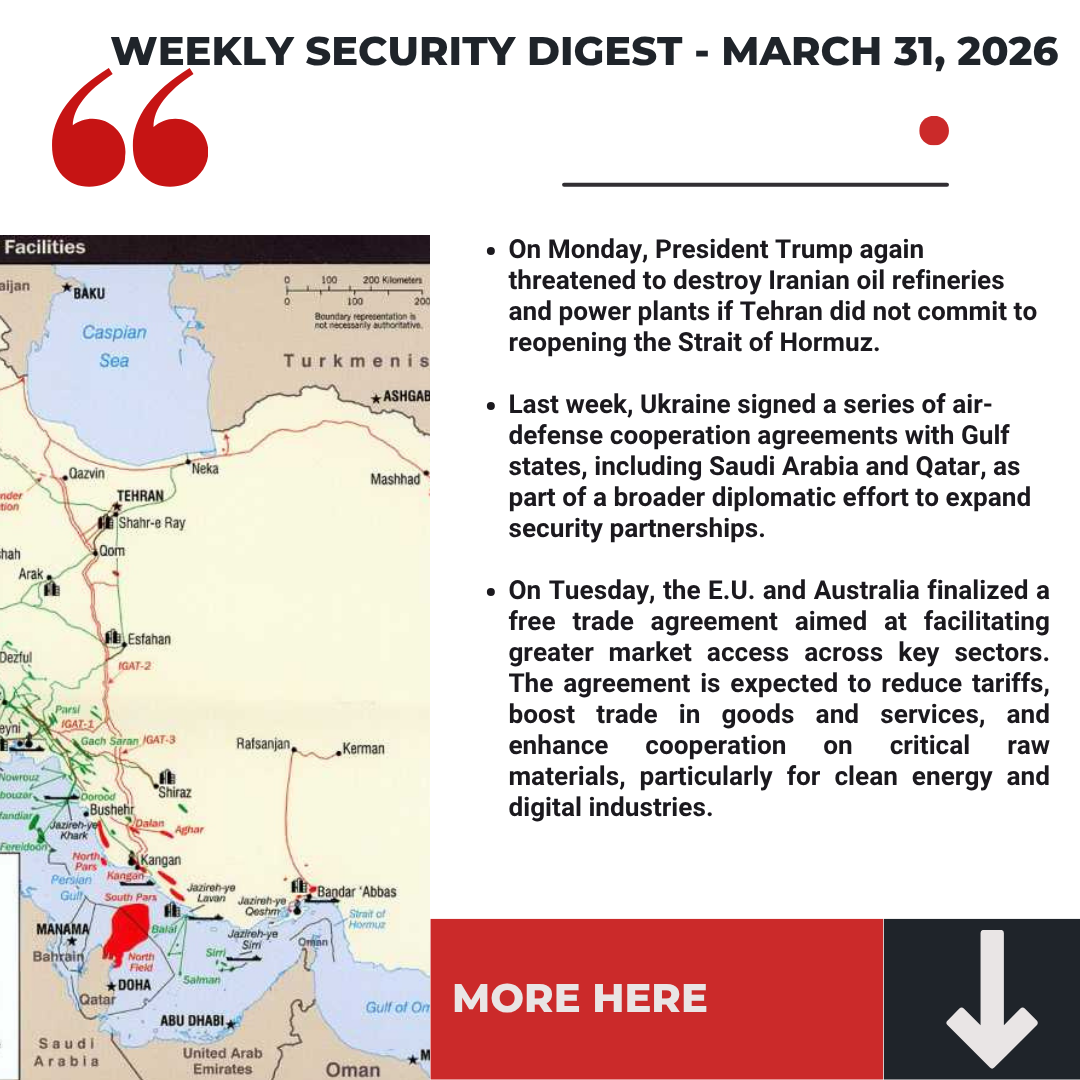
Interfor International‘s Weekly Security Digest – March 31, 2026