

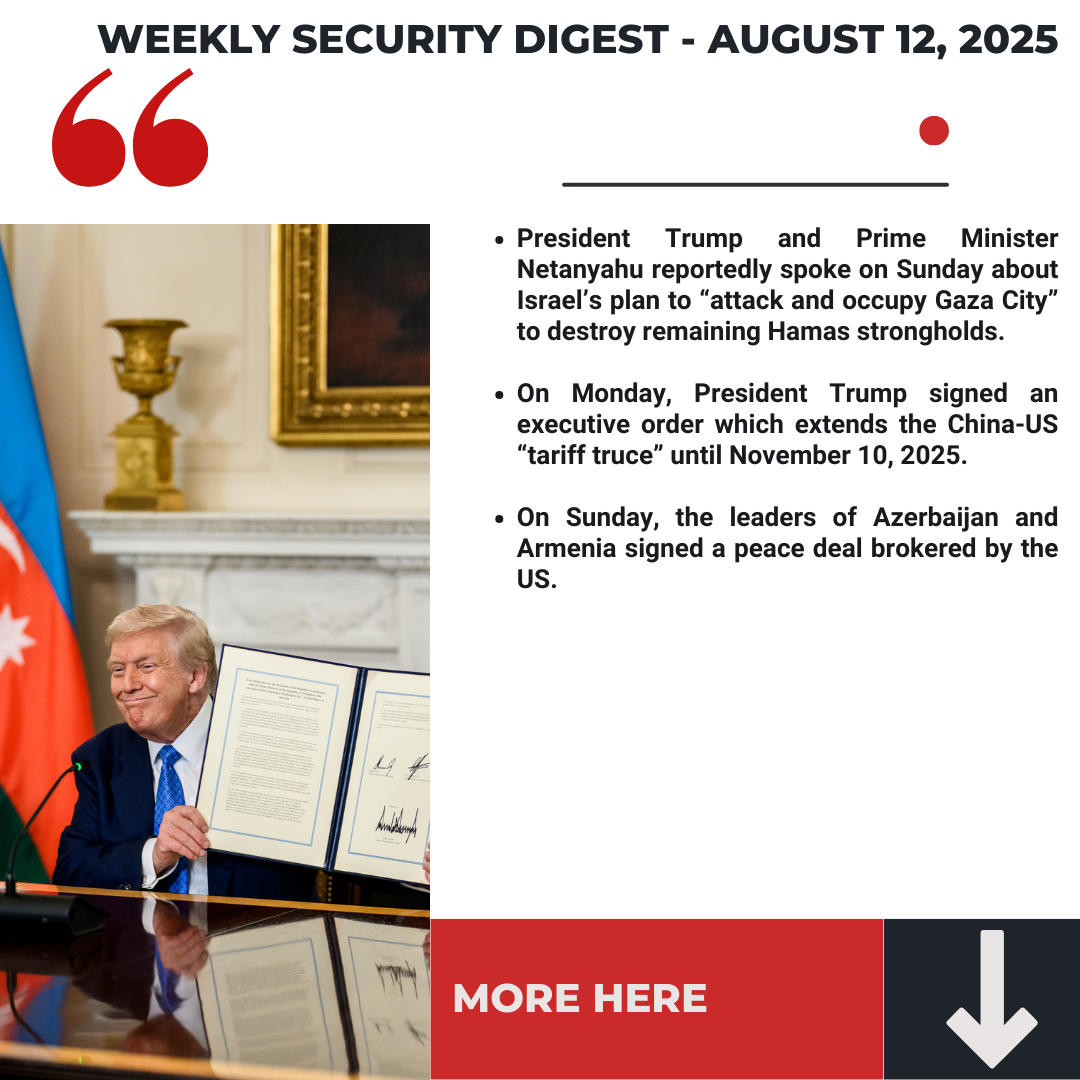
| Middle East → President Trump and Prime Minister Netanyahu reportedly spoke on Sunday about Israel’s plan to “attack and occupy Gaza City” to destroy remaining Hamas strongholds. The planning for such an operation would likely take several weeks. In the intervening period, Qatari and Egyptian mediators are reportedly attempting to expand upon the “Witkoff Proposal” which called for a 60-day temporary ceasefire. Other reports suggest that the US and Qatar are working on a proposal for an “all or nothing” deal to end the conflict. Meanwhile, Israel’s plan to move deeper into Gaza has been condemned by international humanitarian groups and many within Israel who are concerned for the well-being of the hostages. The Israeli government has walked back some of its remarks regarding “conquering” Gaza. Typical of Israeli politics, Netanyahu’s remarks in English differ significantly from his Hebrew-language statements on this topic. In short, Netanyahu and his team have begun to frame new Gaza operations as a threat to encourage Hamas to return to the negotiating table, rather than a cemented plan to reinvade Gaza City. That said, Netanyahu is still highly dependent on his right flank to stay in power, which means that any hawkish proposal, even if initially only floated as a threat, has the potential to become reality if actors like Itamar Ben Gvir and Bezalel Smotrich apply enough pressure on the PM. → Iranian state police announced that they had arrested approximately 21,000 “suspects” during the Israel-Iran war in June. Spokesperson, Gen. Saeed Montazeralmahdi, did not specify for what these individuals were arrested for, though hundreds are accused of espionage and illegal filming. Since June, Iran has executed at least seven men accused of spying for Israel. Iran has been aggressively arresting suspects since the war to try to root out Israeli intelligence penetration of the Iranian defense and intelligence establishment. Much of this crackdown has focused on ethnic and religious minorities and seems to be based on limited (or nonexistent) evidence. Still, 21,000 suspects arrested in the middle of a 12-day Israeli onslaught feels like a significant exaggeration, likely intended to persuade Iranians that the regime is back in control and any Israeli intelligence access within the country has been stamped out. International Affairs → On Tuesday, the Independent Investigative Mechanism for Myanmar (IIMM), a UN commission, stated they found evidence of “systematic torture” by Myanmar security forces in detention facilities. The IIMM’s report reportedly identifies several high-level commanders as perpetrators. The Myanmar military has denied allegations of torture and other atrocities in the past. The IIMM, formed in 2018, claims to have faced significant obstruction from the current Myanmar government, particularly since the country’s 2021 military coup. → Over the past several days, Russian forces have reportedly made territorial gains in eastern Ukraine near Dobropillia. Ukrainian-run DeepState, a Russia-Ukraine war mapping platform, claimed that the surge was likely an attempt to take more of the Donetsk region while Ukrainian manpower runs low. President Trump and President Putin are scheduled to meet again to discuss a deal in Alaska on Friday. Greater Russian control of parts of the Donetsk could give Putin increased leverage in talks this week. → On Monday, President Trump signed an executive order which extends the China-US “tariff truce” until November 10, 2025. This follows bilateral talks in Sweden in July. Further negotiations are expected to expand focus beyond tariffs to include issues such as Chinese involvement in fentanyl trafficking, Chinese purchases of Russian and Iranian oil, and US semiconductor sales to China. → On Sunday, the leaders of Azerbaijan and Armenia signed a peace deal brokered by the US. The conflict, which began shortly after the fall of the USSR, centers on a territorial dispute over the Nagorno-Karabakh region. The peace deal focuses on the construction of a corridor across southern Armenia connecting Azerbaijan to Nagorno-Karabakh. The US will have exclusive “development” rights to the land around this corridor. Iran has voiced concern that a US-linked corridor close to the Iranian border could serve as platform for the US to advance its interests and counter Iran’s in the region. Cyber → On Tuesday, a group of Republican Senators petitioned the Department of Commerce to investigate whether US use of Chinese Ai system DeepSeek poses data security risks. The Senators’ request follows investigations into other Chinese-owned technology companies, such as TikTok. The overarching concern of these investigations is whether compromising information regarding economic or national security concerns is easily accessible by China via US use of Chinese applications. |
| Resources: US Department of State Travel Advisories CISA: nation-state cybersecurity threats and other resources for cybersecurity matters. Check out our newly enhanced media hub. See Interfor’s analysis of the shooting at 345 Park Avenue in Manhattan here. See our most recent talk on the rise of ideological violence in the United States and how corporate security professionals are meeting the challenge, featuring former Director of the U.S. Secret Service, Mark Sullivan. Our latest analysis looks at the Israel-Iran conflict; beyond the headlines. See also our second interview with Tom Hardin, one of the most active informants in securities fraud history. |
To find out more, please reach out to info@interforinternational.com
Related Blog
VIEW ALL
Geopolitics. Global Security, & Current Events
Interfor International‘s Weekly Security Digest – March 10, 2026

Geopolitics. Global Security, & Current Events
Interfor International‘s Weekly Security Digest – March 3, 2026