


| Middle East → On Sunday, Israeli Prime Minister Netanyahu requested a formal pardon from President Isaac Herzog, in connection with his corruption trial. Herzog has said publicly that he will deliberate based on “the good of the country,” rather than “violent discourse.” Many Israelis are against an unconditional pardon. Opposition leader Yair Lapid proposed that, in exchange for a pardon, Netanyahu should be forced to admit guilt and leave public life. Netanyahu’s political allies are advocating for the pardon and even suggesting that President Trump may step in to apply pressure, following the U.S. president’s remarks in favor of a pardon during his trip to Israel in October. → According to Gaza’s Health Ministry, the Gaza war’s death toll has now passed 70,000. The Health Ministry, which is part of Hamas’s government structure, has been criticized for not separating combatants from civilians in its casualty reporting. Intermittent violence has continued under the ceasefire, causing the deaths of over 300 Palestinians and drawing attention to the ceasefire’s failure to advance beyond its limited first phase. At the same time, there has been no progress toward the disarmament of Hamas, a key component required in future phases of the ceasefire. As of now, there is broad pessimism surrounding the ceasefire; it may not fully collapse, but few expect it to move beyond Phase 1 in the near term. Hamas appears dedicated to asserting its authority, and Israel remains highly risk-averse when it comes to security issues in the Strip. Simultaneously, the U.S. and its regional partners have encountered obstacles in finalizing the makeup of the multinational implementation force. Since the ceasefire began, we have seen clearly that Trump and his team’s engagement in the peace process was essential to seeing it progress. However, these days Trump’s foreign policy team is spread thin; his lead Gaza ceasefire negotiator is currently in Russia meeting with Putin regarding the Ukraine war, and his Secretaries of State and Defense are focused on Venezuela. As of now, we see few reasons to be optimistic about the situation in Gaza, but we are watching closely for any indications of progress or deterioration. → Following Syrian President Ahmed al-Sharaa’s recent visit to the White House, President Trump has reportedly asked Israeli Prime Minister Netanyahu to stop striking inside Syria. The IDF has conducted periodic raids and airstrikes in Syria for several months against a variety of targets. However, these strikes may undermine President Trump’s own strategy for the region, which includes a stable Syrian central government, a strong U.S.-Syrian relationship, and, ideally, rapprochement between Syria and Israel. Interfor assesses that Netanyahu may be slow to heed Trump’s pressure on this point. The two are now negotiating priorities across so many fronts – the Gaza ceasefire, Trump’s support for Netanyahu’s pardon, future actions against Iran, the Lebanon ceasefire, normalization with Saudi Arabia, etc. Netanyahu may believe that he can get away with occasionally going against Trump’s wishes in Syria, provided the two leaders still have higher priorities to cooperate on. The red line for the White House is likely Israeli actions that significantly threaten to destabilize Syria’s new government, vs. contained activities near the border. International Affairs → On Thursday, President Trump claimed that the U.S. was shutting down Venezuelan airspace and would soon increase attacks on drug boats in the Caribbean. To date, President Trump has not taken direct military action against Venezuela, though the U.S. military has targeted alleged Venezuela-linked drug trafficking vessels in the Caribbean, despite questions around the strategic value and legality of those strikes. A recent airstrike allegedly targeting the survivors of an already disabled vessel has drawn considerable controversy. → On Tuesday, Russian President Putin will meet with U.S. Envoy Steve Witkoff to discuss Trump’s proposed plan to end the war with Ukraine. The plan was recently revised by a U.S. and Ukrainian team to better incorporate Ukraine’s interests, though Ukraine and its European allies remain concerned about the extent of concessions to Russia. Simultaneously, French President Macron is encouraging European leaders to push forward with their own security guarantee for Ukraine. → President Trump pardoned former Honduran President Juan Orlando Hernandez on Tuesday, releasing him from a 45-year prison sentence for trafficking cocaine into the U.S. President Trump claimed that he pardoned Hernandez because “the people of Honduras really thought he was set up.” This pardon is drawing criticism, given Trump’s simultaneous anti-drug military campaign in the Caribbean, which his administration claims is linked to a criminal cartel led by Venezuelan President Nicolás Maduro. → Late last week, a suicide bomber attacked a Pakistani military base near the border with Afghanistan. Pakistani President Asif Ali Zardari publicly blamed the Taliban. Though the suicide attack was carried out by a lone aggressor, the incident has inflamed already tense relations between Pakistan and Afghanistan. The Pakistani government is also deporting Afghan immigrants en masse, including those whose lives could be threatened by the Taliban if forced to return to Afghanistan. U.S. → On Wednesday, Rahmanullah Lakanwal, an Afghan asylee, shot two National Guard members near the White House, killing one and severely wounding another. Lakanwal was taken into custody at the scene. Investigations into Lakanwal’s potential motive are still ongoing. Lakanwal was reportedly a member of Afghanistan’s so-called “Zero Units,” which were elite CIA-backed intelligence and counterterrorism teams that targeted Taliban, Islamic State, and narcotrafficking operations before the U.S. withdrawal. Cyber → On Monday, Swiss and German authorities announced that they successfully shut down cryptomixer.io, a bitcoin mixing platform often used for money laundering. The platform anonymized transactions by breaking large amounts of bitcoin into small groups and mixing them with other users’ funds. |
| Resources: US Department of State Travel Advisories CISA: nation-state cybersecurity threats and other resources for cybersecurity matters. |
To find out more, please reach out to info@interforinternational.com
Related Blog
VIEW ALL
Geopolitics. Global Security, & Current Events
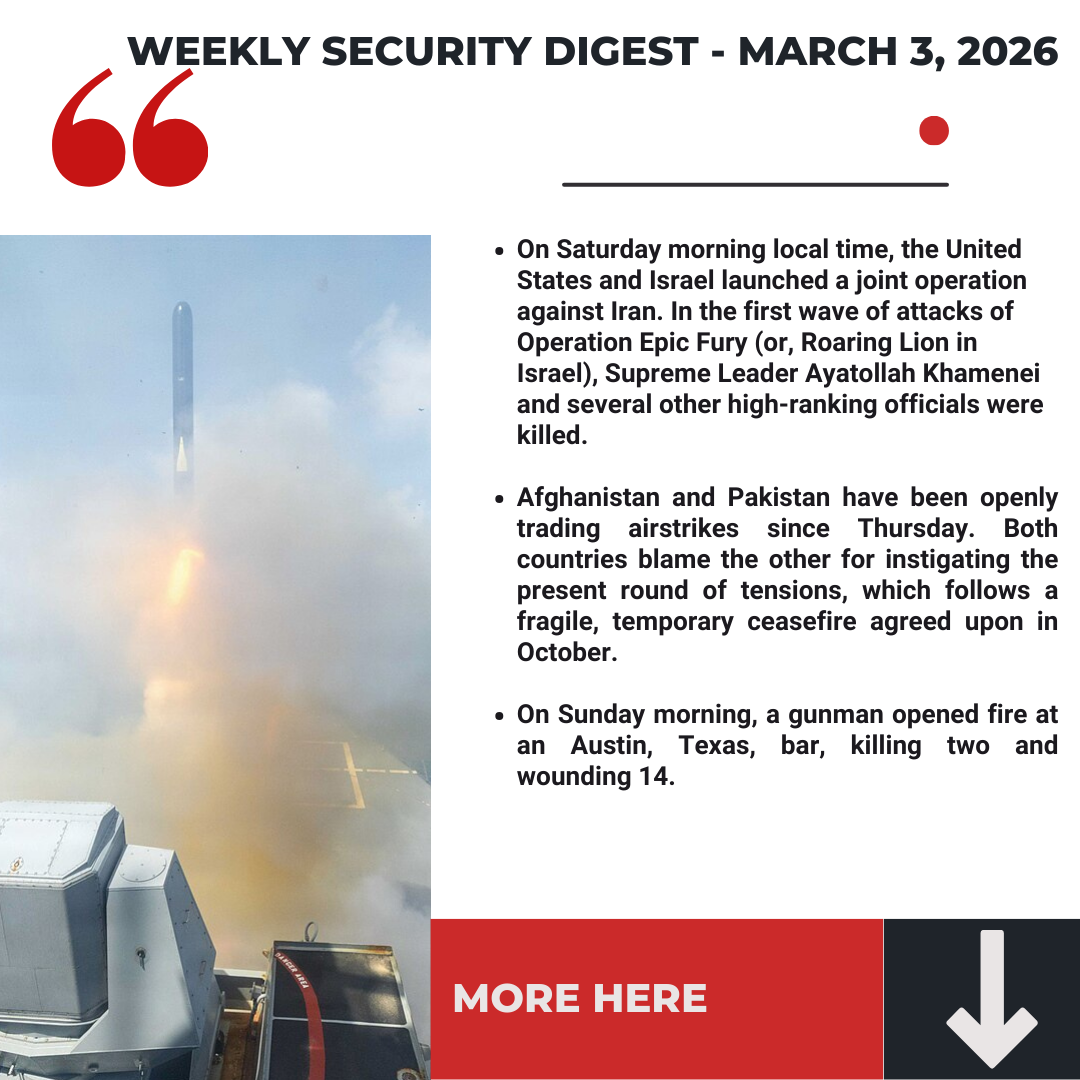
Interfor International‘s Weekly Security Digest – March 3, 2026

Geopolitics. Global Security, & Current Events
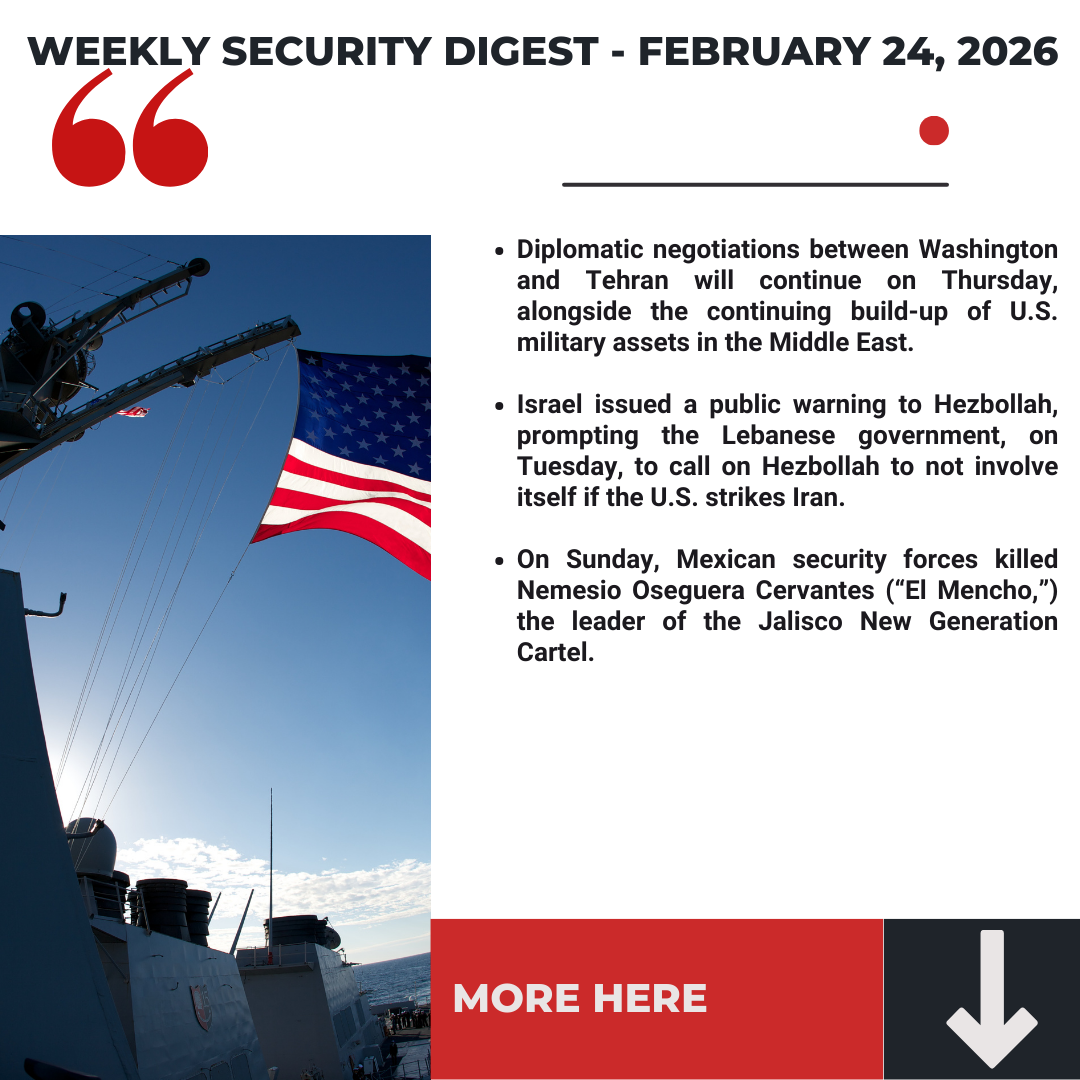
Interfor International‘s Weekly Security Digest – February 24, 2026