



| Middle East → The U.S. and Iran attended negotiations in Oman last Friday, aimed at averting military confrontation and resolving regional tensions. Talks are expected to continue, but the gap between the two parties remains substantial. The U.S. has asked for dramatic concessions from Iran on nuclear issues, its support for proxy groups, and its ballistic missile program. The Islamic Republic wants to limit negotiations to the nuclear file, and even there, its representatives have expressed no willingness to concede at the scale the U.S. has demanded. Meanwhile, Israeli Prime Minister Benjamin Netanyahu is expected to advocate against a limited deal and in favor of military action during a meeting with President Trump in Washington tomorrow. Based on the extremely limited potential for a mutually acceptable agreement, Interfor assesses that diplomatic efforts are unlikely to conclude successfully in the near term. Typically, we would expect two parties this far apart to end negotiations and revert to military confrontation. For the moment, however, both parties seem to be in no rush to pursue that option. The appearance of ongoing and productive negotiations could allow both parties to continue to prepare for war and for the Islamic Republic to continue to quell popular resistance. Still, with each coming day the U.S. has more military assets in the region positioned to attack the Islamic Republic and defend against Iranian counterattack. If talks collapse, particularly if they collapse in a way that Trump perceives as a personal affront, the U.S. president could, in fact, authorize immediate military action. We are closely watching U.S. allies and their advocacy for and against an attack on Iran. Up until now, Saudi Arabia, Qatar, Oman, and Turkey have had Trump’s ear, seemingly successfully dissuading him from imminent attack on at least one occasion. But, as President Trump and his team come to understand the difficult, maybe impossible road to a diplomatic agreement, he may be more amenable to lobbying from Israel, which wants to encourage a U.S. attack. → On February 19, President Trump is scheduled to host a Board of Peace meeting in Washington to plan and fundraise for Gaza’s reconstruction. Israeli Prime Minister Netanyahu will already be in the U.S. and is likely to attend the meeting, though Israel has not signed off on the charter yet. Currently, a technocratic Palestinian government is operating from Egypt, though there has been negligible tangible progress toward demilitarizing Hamas. International Affairs → For the first time since the 1970s, a formal nuclear arms control treaty between the U.S. and major nuclear powers is not in place. The U.S. and Russia are negotiating a new arms control treaty, following the expiration of the New Strategic Arms Reduction Treaty (New S.T.A.R.T.) on February 5. The agreement governed 85% of the world’s nuclear warheads. According to U.S. officials, both nations agreed to operate “in good faith” until a new treaty is signed, though the process may take months. The day after New S.T.A.R.T. expired, U.S. Under Secretary of State for Arms Control and International Security Thomas DiNanno accused China of conducting secret nuclear tests in violation of the Comprehensive Nuclear-Test-Ban Treaty. → The U.S. gave Ukraine and Russia until June to agree to a ceasefire. President Volodymyr Zelenskyy announced that they will likely hold the next round of negotiations in Florida next week. The key disagreement remains control of the Donbas. Despite ongoing negotiations, Russian forces continue to strike Ukrainian energy targets. → Several high-profile figures in the U.K. have been implicated in the Epstein Files, including Prince Andrew and a longtime political ally of Prime Minister Keir Starmer, Peter Mandelson. In response, Starmer’s Chief of Staff, Morgan McSweeney, resigned, citing damage to the party and national politics. Starmer now faces accusations that he and his staff either failed to properly vet Mandelson or hired him knowing of his connection to Epstein. → The Allied Democratic Forces (A.D.F.), an Islamic State-backed rebel group in eastern Congo, killed at least 20 civilians in an attack on a local village this past weekend. This is the latest attack by the A.D.F., who have targeted several villages since the start of 2026. The A.D.F. is part of a larger network of Islamic State-associated armed groups in sub-Saharan Africa; these groups routinely target civilians in Congo, Mozambique, Nigeria, and other nearby countries. → On Sunday, the Cuban government announced that airplanes could no longer refuel at nine Cuban airports as the country moves to safeguard its remaining oil supplies. In late January, President Trump signed an executive order promising to impose tariffs on any country providing oil to Cuba. Cubans are already reporting power outages and difficulties obtaining emergency services. There has been no official indication of how long the embargo on Cuban oil will continue. The Mexican navy has dispatched two ships to Cuba with humanitarian relief supplies. |
A Note From Interfor
→ Interfor’s team provides suggestions on social media risk management in our blog post here.
| Resources: US Department of State Travel Advisories CISA: nation-state cybersecurity threats and other resources for cybersecurity matters. |
To find out more, please reach out to info@interforinternational.com
Related Blog
VIEW ALL
Geopolitics. Global Security, & Current Events
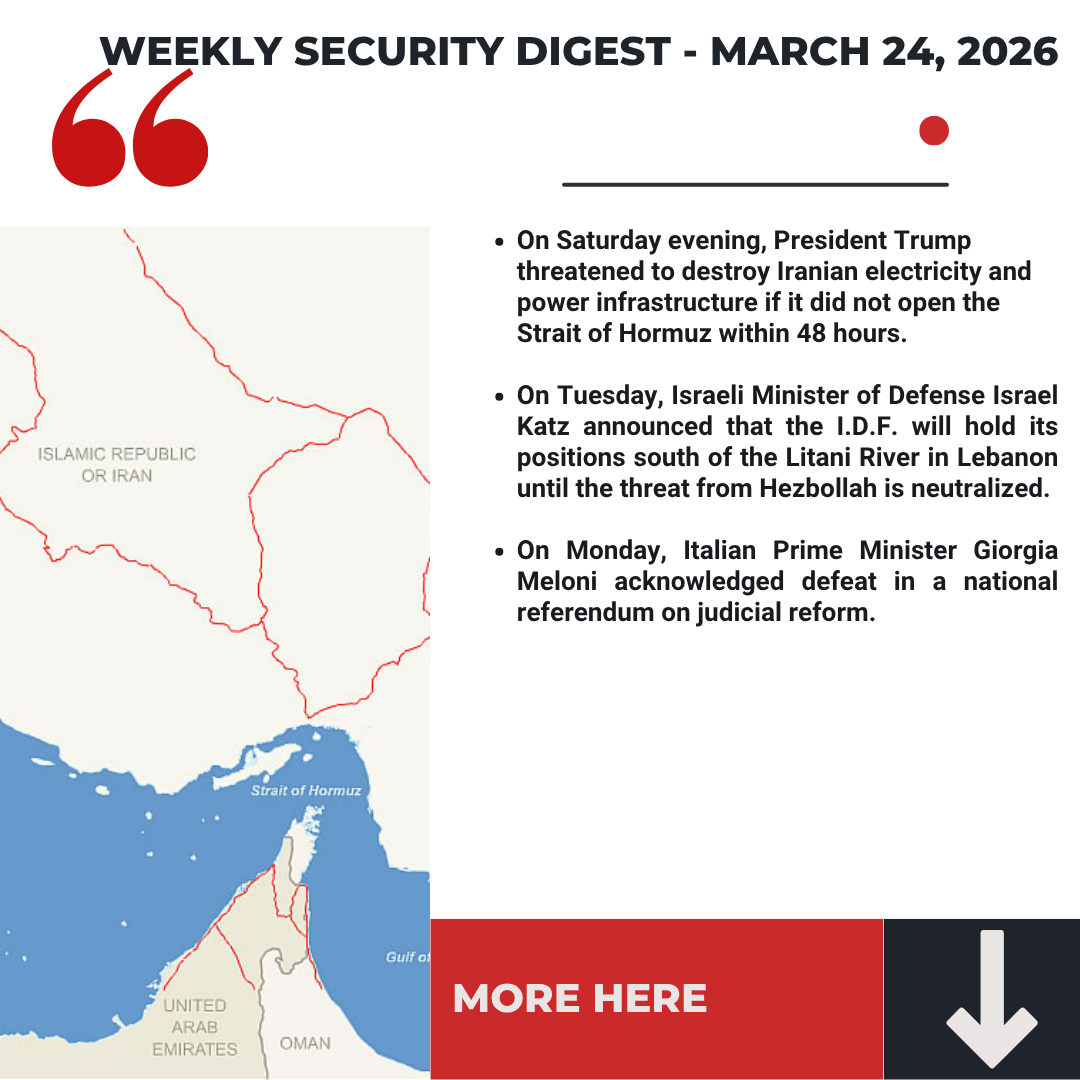
Interfor International‘s Weekly Security Digest – March 24, 2026
Geopolitics. Global Security, & Current Events
Interfor International‘s Weekly Security Digest – March 17, 2026
Geopolitics. Global Security, & Current Events
Interfor International‘s Weekly Security Digest – March 10, 2026
