


| Middle East → On Friday, Turkey is expected to host a diplomatic meeting in Istanbul to facilitate U.S.-Iran de-escalation. White House Envoy Steve Witkoff and Iranian Foreign Minister Abbas Araghchi will meet as part of direct negotiations between Iran and the U.S. This meeting follows a gradual U.S. military buildup in the Middle East over the last several weeks and represents a step back from rising expectations of an American military operation targeting Iran’s regime. The U.S. is reportedly asking for the Islamic Republic to give up all in-country enrichment capabilities, while also cutting off its support for regional proxy groups and capping its ballistic missile arsenal. As of now, it appears possible that Iran could make some nuclear concessions, but analysts are doubtful that a deal meeting all U.S. demands will emerge. President Trump has again stepped back from launching an attack on the Islamic Republic and opted to give negotiations a chance. Interpretations of his decision vary, but broadly we assess that Trump remains unprepared to authorize the kind of large-scale military action necessary to drive the regime meaningfully toward collapse. Such an operation would take weeks (or more) and would put U.S. and allied interests in the crosshairs of a potentially large Iranian counterattack. Still, the Islamic Republic is at its weakest point in decades. Extended negotiations could enable it to further fortify itself against attack and even to refill its coffers (the value of the rial is likely to rise alongside the perceived probability of a deal). Even if the U.S. and Iran do agree to terms on Friday, it will almost certainly be a high-level framework, with technical details to be refined over the coming days, weeks, and months. The Islamic Republic could intentionally play for time, indicating flexibility now only to walk away from the table six months from now, with global attention elsewhere and the regime’s vulnerabilities newly patched. The tens of millions of Iranians who oppose their government are again accusing the U.S. of betraying them. While the Islamic Republic has been repressive for decades, its massacre of an estimated tens of thousands of Iranians last month exhausted its remaining popular legitimacy. Moreover, in orienting these negotiations around Iran’s nuclear program, support for proxies, and ballistic missile arsenal, without mentioning human rights or political reform, the U.S. has further disappointed a population desperate for change. Of course, Trump could still launch an attack. In fact, some analysts still see military confrontation as probable, or even inevitable, citing the high likelihood that Iran will refuse to make necessary concessions in negotiations. It is even possible that the U.S. is pursuing negotiations, knowing that they will fail, to provide a stronger justification for military action. That said, Trump wants a low-risk, high-visibility victory. While a diplomatic victory would have a more limited impact than a successful military operation, it is easier to spin than a complex, costly, and protracted war. → On Monday, Israel reopened the Rafah Crossing between Gaza and Egypt on a limited basis, allowing some Palestinians to leave or return to the Strip. The decision follows the return of the last deceased Israeli hostage from Gaza, which allowed the ceasefire agreement to progress to Phase 2. The Israeli military retains control of the Crossing, with Egyptian authorities providing names for the I.D.F. to vet prior to re-entry into Gaza. International Affairs → On Monday, Donald Trump announced that the U.S. and India would strengthen bilateral trade in exchange for India halting its purchases of Russian oil. Instead, India agreed to import American, and potentially Venezuelan, oil. The agreement is part of President Trump’s wider efforts to dissuade global partners from buying Russian oil, which partially funds their war effort in Ukraine. → Last week at Davos, President Trump appeared to back down from his push to acquire Greenland and officially announced the Board of Peace for Gaza, while financial leaders argued that the world order was shifting. World Trade Organization Chief Ngozi Okonjo-Iweala remarked that while uncertainty remained high, it also presents an opportunity for leaders to strengthen ties to non-U.S. allies. → Last week, Panama’s High Court ruled that CK Hutchison, a Hong Kong conglomerate contracted to control two ports on the Panama Canal, violated the Panamanian constitution. The ports are important strategic assets for China and the U.S. and carry nearly $300 billion in U.S. container trade annually. The Chinese Foreign Ministry rejected the court’s ruling and asserted that it would take “all necessary measures” to secure Chinese strategic interests. → On Sunday, Elon Musk announced that SpaceX prevented Russia from using Starlink to attack Ukraine. Musk and Ukrainian Defense Minister Mykhailo Fedorov began working together last week when Russian use of the technology was first detected. Musk legally cannot allow Russia to use Starlink due to U.S. sanctions, though the technology is widely used in Ukraine. Parts of the military and some civilian areas use it to replace damaged internet infrastructure. → Recently released Epstein Files documents suggest that Crown Princess Mette-Marit of Norway and Sarah Ferguson, a member of the British royal family, held close ties with Jeffrey Epstein. Some Norwegians already doubt Princess Mette-Marit’s suitability to remain Crown Princess. She is one of several high-profile figures whose personal emails with Epstein were released this week. → Immigration and Customs Enforcement (I.C.E.) officers will be on the ground at the Winter Olympics in Italy, sparking anger from some Italians who argue that Prime Minister Meloni should refuse to allow them entry. I.C.E. will be involved on an advisory basis and will not be patrolling, and core security operations remain under Italian authorities. |
A Note From Interfor
→ Interfor’s team provides suggestions on social media risk management in our blog post here.
| Resources: US Department of State Travel Advisories CISA: nation-state cybersecurity threats and other resources for cybersecurity matters. |
To find out more, please reach out to info@interforinternational.com
Related Blog
VIEW ALL
Geopolitics. Global Security, & Current Events
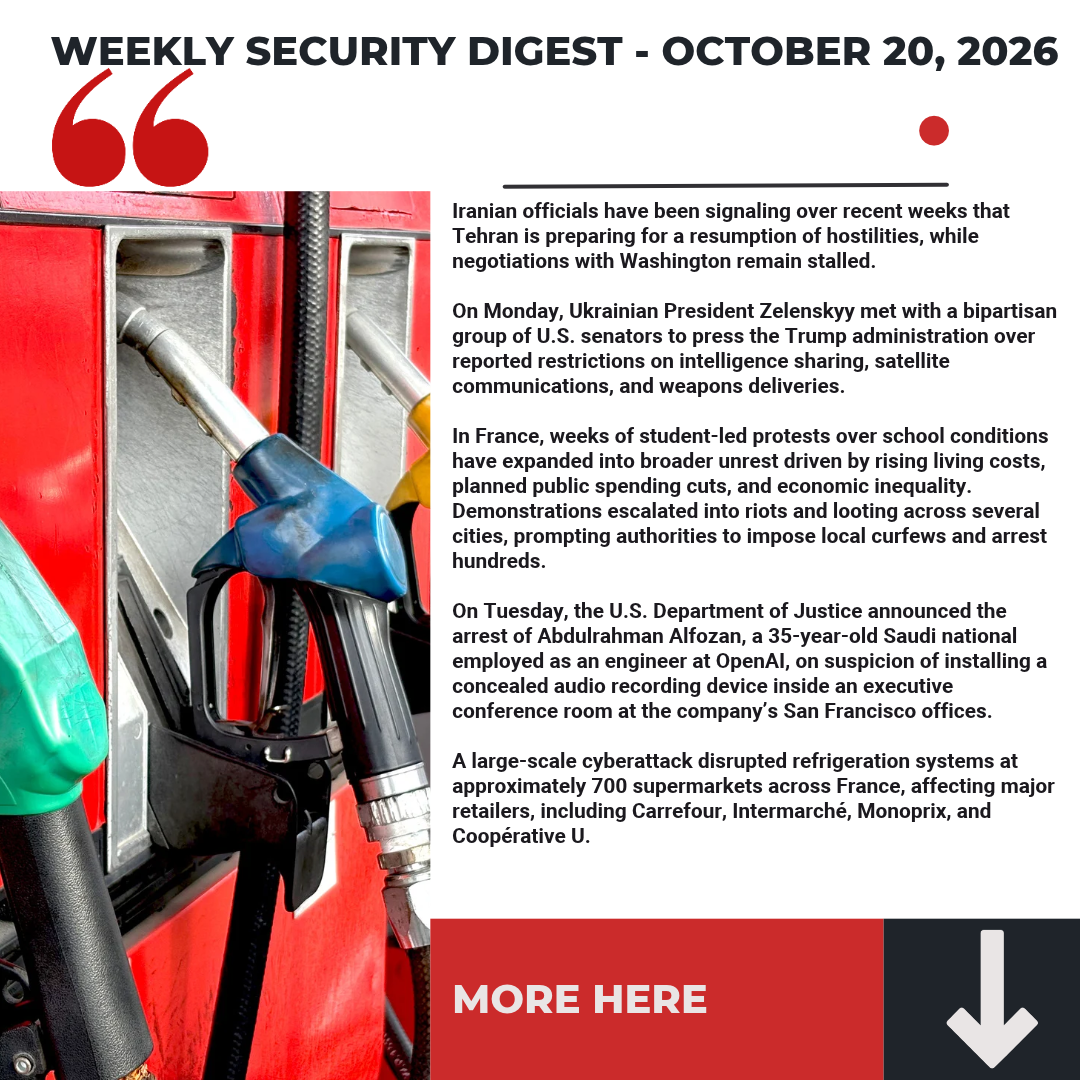
Interfor International‘s Weekly Security Digest – October 20, 2026
Geopolitics. Global Security, & Current Events
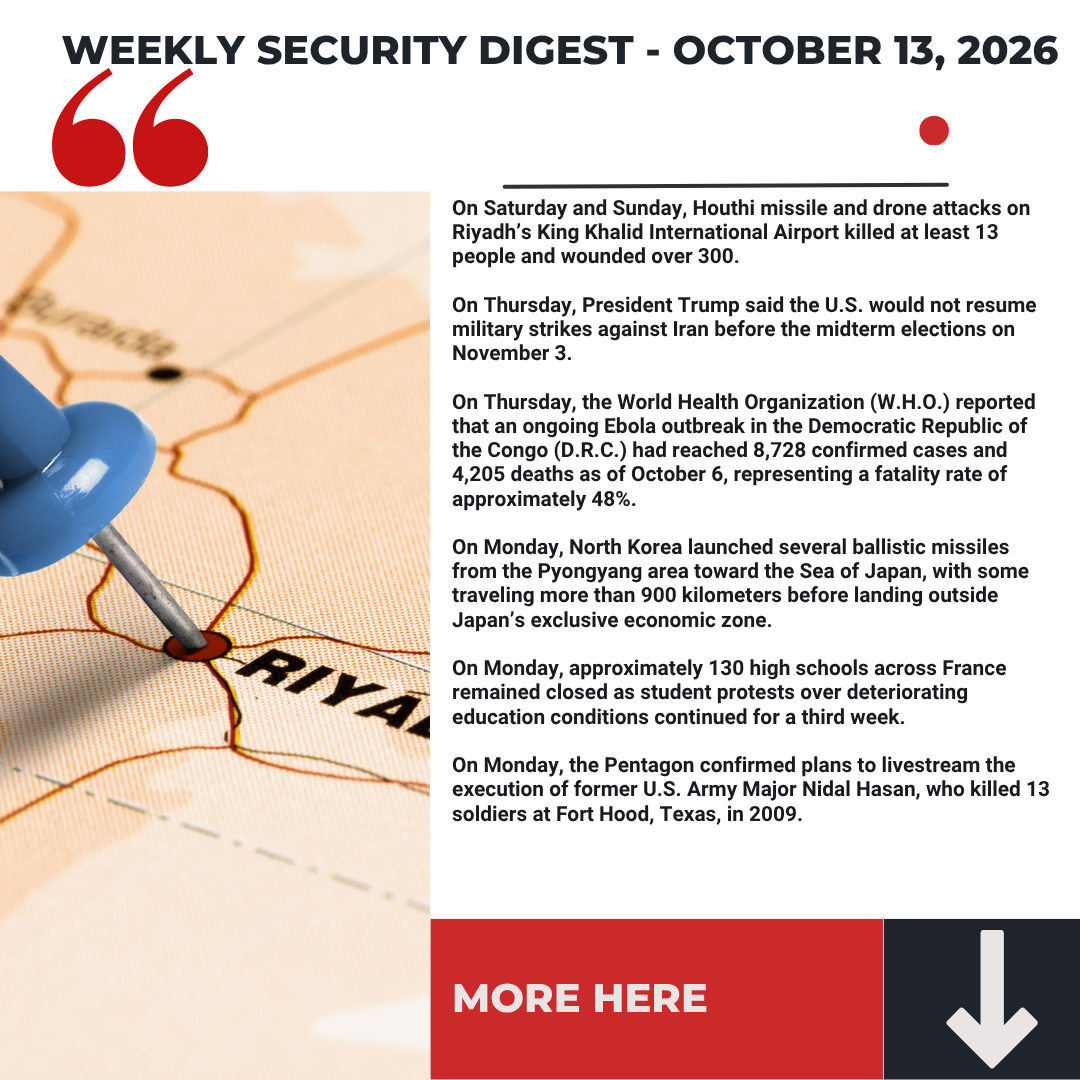
Interfor International‘s Weekly Security Digest – October 13, 2026
Geopolitics. Global Security, & Current Events
Interfor International‘s Weekly Security Digest – October 6, 2026