


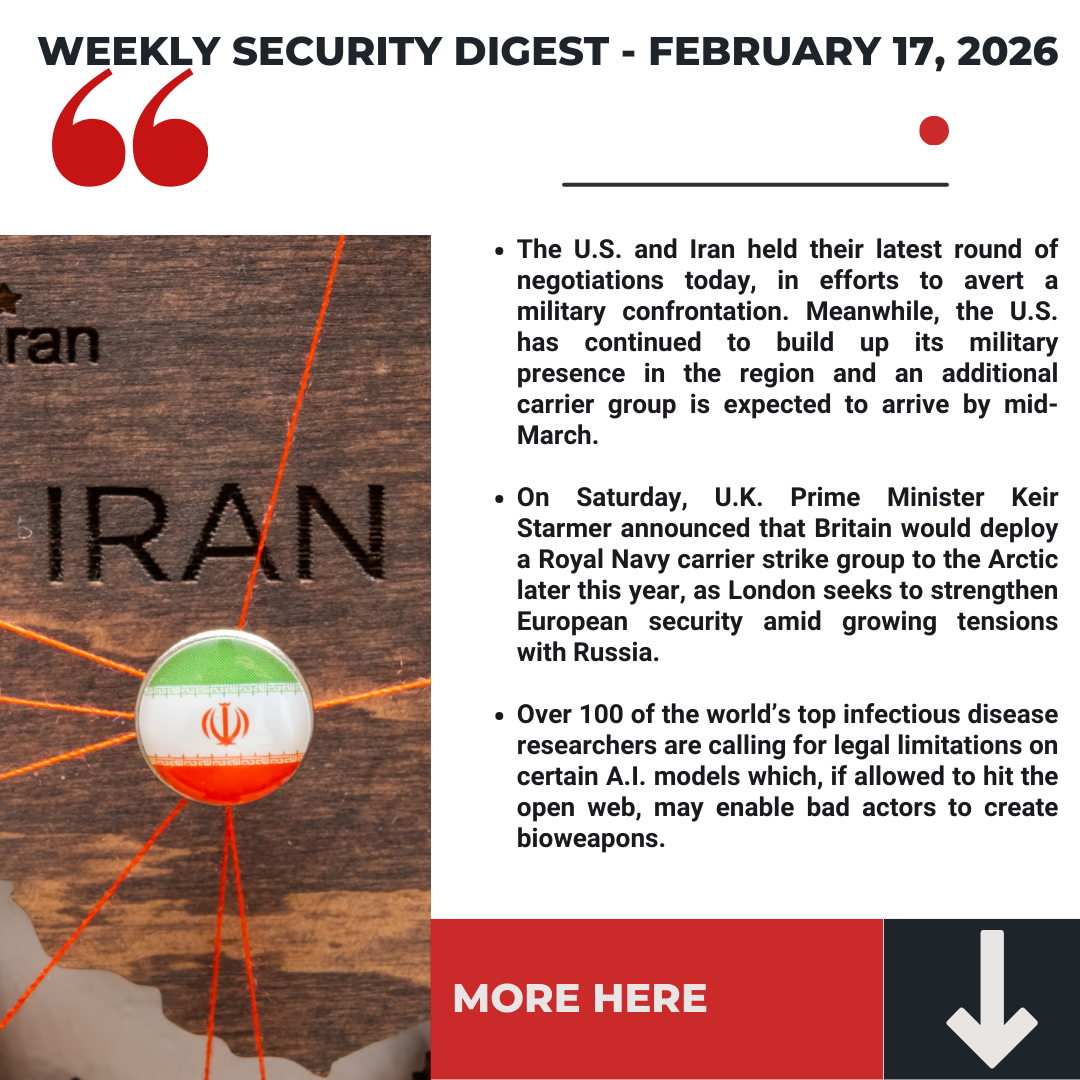
| Middle East → The U.S. and Iran held their latest round of negotiations today, in efforts to avert a military confrontation. Meanwhile, the U.S. has continued to build up its military presence in the region and an additional carrier group is expected to arrive by mid-March. Iran, for its part, is conducting naval exercises in the Strait of Hormuz and threatening to sink American ships. As of now, it still appears unlikely that the U.S. will extract satisfactory concessions from Iran across its nuclear and non-nuclear demands. Rumors are circulating regarding potential Iranian nuclear concessions, but as of yet the Islamic Republic has indicated no flexibility on eliminating its support for proxy organizations around the region or accepting limits on its ballistic missile program. The still accelerating build-up of U.S. military assets in the region is certainly intended to increase pressure on Iran in the hopes that it will facilitate a deal. However, given the obstacles to achieving an agreement, the military build-up is more likely to feed escalation risk than it is to support a peaceful resolution to the conflict. At the same time, we are seeing the Islamic Republic draw from its typical playbook, hedging the negotiation process with escalatory signals. For example, timing its naval exercise in the Strait of Hormuz for the same day as U.S.-Iran talks is certainly intentional. → On Thursday, President Trump will convene the Board of Peace in Washington, D.C. for its inaugural meeting. He is expected to announce approximately $5 billion in member contributions toward Gaza’s reconstruction. International Affairs → On Saturday, U.K. Prime Minister Keir Starmer announced that Britain would deploy a Royal Navy carrier strike group to the Arctic later this year, as London seeks to strengthen European security amid growing tensions with Russia. Speaking at the Munich Security Conference, Starmer warned that Europe must be prepared to defend itself and reduce its reliance on U.S. military power, highlighting the strategic importance of sustained transatlantic cooperation amid ongoing geopolitical tensions linked to the shifts in U.S. policy and renewed debates over Greenland’s security. → Two years after the death of the Russian opposition leader, Alexei Navalny, in an Arctic prison, the case continues to cast a long shadow over Russia and Europe. European leaders assert that Navalny was poisoned with dart frog toxin, based on a recent joint analysis into Navalny’s sudden death. Despite intensified international criticism, the Kremlin denies any responsibility. → South Africa and China have signed a new trade partnership that will grant zero-tariff access for South African exports to the Chinese market, significantly deepening economic ties between the two countries. The deal seeks to diversify South Africa’s trade partners amid rising global protectionism and higher U.S. tariffs, drawing increased Chinese investment in sectors such as mining, renewable energy, and technology. → On Friday, at the second Italy – Africa Summit in Ethiopia, Italian Prime Minister Giorgia Meloni pledged to deepen cooperation with African countries by building on the Mattei Plan. The Plan, launched in 2024, is a broad cooperation strategy blending investment, development, and migration-related goals. According to Ethiopian Prime Minister Abiy Ahmed, the partnership provides a bridge between Africa and Europe, and its success must be based on mutual respect and shared goals, not traditional aid. United States → Over 100 of the world’s top infectious disease researchers are calling for legal limitations on certain A.I. models which, if allowed to hit the open web, may enable bad actors to create bioweapons. They argue that such data should be treated with the same protections as individual medical information, protected under a structure akin to H.I.P.A.A. While no credible threats have been detected to date, these researchers caution that failing to regulate A.I. trained on genetics and virology carries serious risks. |
A Note From Interfor
→ Interfor’s team provides suggestions on social media risk management in our blog post here.
→ Here is what we are listening to this week: Xi Purged His Top General—What It Means for Taiwan (w/ Evan Osnos) | The Long Game Podcast
| Resources: US Department of State Travel Advisories CISA: nation-state cybersecurity threats and other resources for cybersecurity matters. |
To find out more, please reach out to info@interforinternational.com
Related Blog
VIEW ALL
Geopolitics. Global Security, & Current Events
Interfor International‘s Weekly Security Digest – February 17, 2026
Geopolitics. Global Security, & Current Events
Interfor International‘s Weekly Security Digest – February 10, 2026

Geopolitics. Global Security, & Current Events
Interfor International‘s Weekly Security Digest – February 3, 2026
