


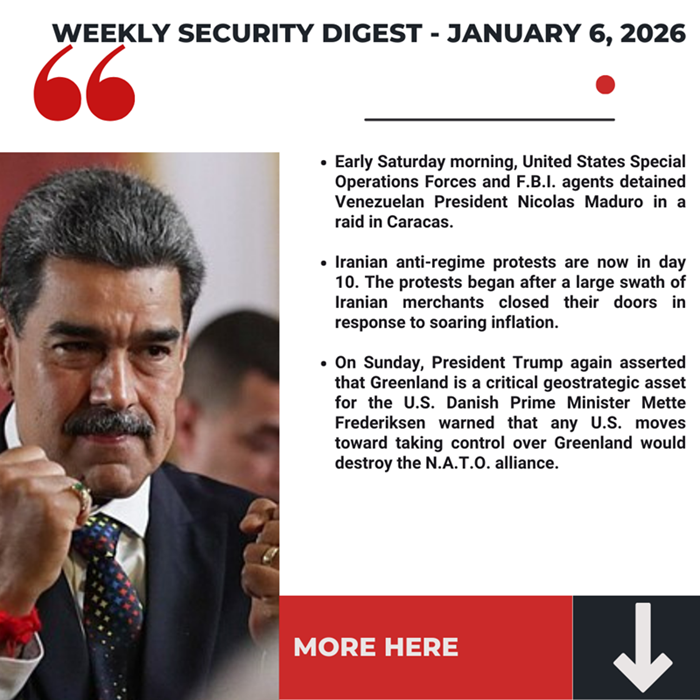
| Venezuela: Maduro Captured→ Early Saturday morning, United States Special Operations Forces and F.B.I. agents detained Venezuelan President Nicolas Maduro in a raid in Caracas. The Drug Enforcement Agency has Maduro and his wife in custody. They pleaded not guilty to narcoterrorism charges in U.S. federal court on Monday. In his absence, officials swore in Venezuelan Vice President Delcy Rodriguez as interim President. Since Saturday, Rodriguez has both condemned the Trump administration’s actions and offered to work with the U.S. on “an agenda of cooperation.” Trump, in turn, threatened a second military attack should she refuse to cooperate. Maduro’s capture caught the world by surprise, and responses have ranged from sharp accusations to loud praise of Trump (albeit at times sycophantic). From Interfor’s perspective, two things are simultaneously true:1. It remains unclear why removing Maduro suddenly became an urgent U.S. priority. Yes, he participates in some element of the drug trade, but Venezuela is not significantly driving the influx of fentanyl into the U.S. Yes, Venezuela is closely allied with Iran, Russia, and Cuba, but it is not as though the U.S. was facing an imminent “Cuban missile crisis” scenario.2. The means aside, Maduro’s removal from power was in the U.S. interest (even if it was not exactly critical). That said, it remains to be seen if President Rodriguez will actually shift Venezuelan policy to benefit the U.S. While Rodriguez is viewed as pro-industry – in particular the oil industry – she will likely face internal challenges when it comes to reducing Venezuelan security and intelligence cooperation with Iran, Russia, and Cuba (per Trump’s demands). In other words, while no one should mourn Maduro’s exit, we do not yet know if what comes next will be meaningfully better. Middle East → Iranian anti-regime protests are now in day 10. The protests began after a large swath of Iranian merchants closed their doors in response to soaring inflation. Security forces have arrested nearly 1,000 protesters and killed at least 20 across at least 26 provinces. In response, President Trump issued a warning on social media that if security forces killed protesters, Iran would “get hit very hard.” Both the U.S. and Israel have hinted at a willingness to strike Iran militarily to either restrain the regime’s suppression of the protests and/or to facilitate regime change. Both states see the Islamic Republic as at a weak point, and Israel, in particular, seems eager to take advantage of the moment. Regime change, however, is unlikely to occur without some sort of large-scale defection among the security forces. While there have been sporadic reports of armed protesters, Iran’s security forces remain more than capable of suppressing a poorly armed popular uprising. We are closely watching for any signs that either political or military actors are pushing to remove Supreme Leader Ayatollah Ali Khamenei from power. Past analyses have pointed to the Islamic Revolutionary Guard Corps (I.R.G.C.) as the likeliest force to grab power from Khamenei. In recent months, however, prominent political leaders – for example, former president Hassan Rouhani – have been positioning themselves as possible alternatives. It remains possible that some sort of opposition group will emerge from the protests as an alternative regime. However, for the moment, no opposition group has enough support or enough weapons to threaten the regime. There is a fierce debate going on in the Iranian diaspora regarding whether or not the last Shah’s son, Reza Pahlavi, has a robust enough support base inside the country to lead the opposition. Interfor assesses that affinity for Pahlavi is, in fact, growing, largely due to the absence of other recognizable leaders. Still, Pahlavi and his supporters abroad are almost certainly inflating assessments of his support inside Iran. → Over the last two weeks, the Saudi-Emirati competition for control over southern Yemen has intensified. Last month, the U.A.E.-backed Southern Transitional Council (S.T.C.) took control of much of southern Yemen, at the expense of the Saudi-backed government of Yemen. In response, two weeks ago, Saudi Arabia bombed an Emirati arms shipment and since then, the S.T.C. and Saudi-backed National Shield Forces (N.S.F.) have been in open conflict in southern Yemen. The tensions in southern Yemen reflect a growing rivalry between the U.A.E. and Saudi Arabia. The U.A.E. is pursuing, more than ever, its own foreign policy, separate from the rest of the Gulf Cooperation Council (G.C.C.), aimed at suppressing Islamist movements and growing Emirati political and economic influence throughout the region. The Emiratis are willing to temporarily upset regional stability in order to advance this agenda. The Saudis, on the other hand, are prioritizing stability, even if it means partnering with imperfect governments around the region. In the past, the Saudis would have lined up alongside the U.A.E. to oppose Islamist organizations. Now, in Yemen, for example, the Saudis are willing to support a Muslim Brotherhood-affiliated political party in Yemen in order to end a war on their border and to align with the Trump administration’s region-wide peace agenda. Over the last two weeks, we have seen the Saudis show how far they are willing to go to protect the status quo in Yemen, even if it means approaching direct confrontation with the Emiratis. → On Monday, the U.S. mediated talks between Israel and Syria to reduce tensions on their shared border. Syrian officials aim to regain sovereignty over territory in western Syria, which the I.D.F. has controlled since the fall of Bashar al-Assad. Israeli officials argue that regional demilitarization and protection of the Druze community must precede any military withdrawal. → On December 26, Israel became the first country to formally recognize Somaliland as an independent state. Somaliland, a breakaway region in northern Somalia, declared independence in 1991 and has since operated with significant autonomy. Most Arab League and African Union Commission nations condemned Israel’s move and voiced support for the government of Somalia, though notably the U.A.E. did not join their statement. Israel’s recognition of Somaliland serves multiple strategic purposes. First of all, Somaliland’s geographic position in proximity to Yemen could offer Israel a forward-deployed base from which to threaten the Houthis and any other adversarial groups. Israel’s move also fits with recent Emirati actions in the region. The U.A.E. is now supporting separatist factions with an anti-Islamist orientation in Yemen, Sudan, and Libya. The UAE’s abstention from the condemnation is telling. Combined with Emirati normalization with Israel, analysts are beginning to speculate that one or more of these hypothetical new states could partner or normalize ties with Israel. In other words, the U.A.E. and Israel may be in the early stages of introducing an alternative regional order to the one supported by the Saudis and Turks – one that would see the Abraham Accords grow to include U.A.E.-aligned anti-Islamist governments. International Affairs → On Sunday, President Trump again asserted that Greenland is a critical geostrategic asset for the U.S. Danish Prime Minister Mette Frederiksen warned that any U.S. moves toward taking control over Greenland would destroy the N.A.T.O. alliance. French, German, Polish, and British officials likewise expressed solidarity with Denmark. → On Sunday, South Korean President Lee Jae Myung met with Chinese President Xi Jinping in Beijing to discuss strengthening bilateral ties. Both North Korea and Taiwan were on the agenda. This is Lee and Xi’s second meeting since November, as China seeks warmer regional ties amid tension with Japan. → On Tuesday, President Zelenskyy will meet with members of the Coalition of the Willing, European leaders willing to deploy troops or assist militarily to ensure Ukrainian security in the event of a ceasefire with Russia. Zelenskyy has argued that the Ukrainian military will stand down only if British and French peacekeepers are deployed to the Donetsk region. The remaining members of the coalition are not required to do so. Russia and Ukraine have yet to reach a ceasefire; at the moment, Russia is not even participating in the U.S. and Europe-facilitated talks with Ukraine. |
A Note From Interfor
→ On the one-year anniversary of the French Quarter Attack, please find a note from Interfor’s CEO, Don Aviv.
| Resources: US Department of State Travel Advisories CISA: nation-state cybersecurity threats and other resources for cybersecurity matters. |
To find out more, please reach out to info@interforinternational.com
Related Blog
VIEW ALL
Geopolitics. Global Security, & Current Events
Interfor International‘s Weekly Security Digest – February 24, 2026
Geopolitics. Global Security, & Current Events
Interfor International‘s Weekly Security Digest – February 17, 2026
Geopolitics. Global Security, & Current Events
Interfor International‘s Weekly Security Digest – February 10, 2026
