


2025 got started violently and stayed that way.
One year ago I wrote a piece in the Wall Street Journal about the bloody New Orleans attack by an Islamic extremist that took place on New Years Day and how it could have been prevented. As another new year dawns, I am struck by how political violence feels more prevalent since that horrible New Years Day in the French Quarter. Stopping such attacks as they proliferate is harder than it was a year ago.
A look at the data on crime in America has some interesting contradictions that are illuminating about our society’s relationship with political violence.
Overall, violent crime in America continues to go down after a spike during the Covid-19 pandemic. Looking at the entire first year of the pandemic, FBI data reported 22,134 murders nationally, an increase of approximately 34 percent from 16,669 in 2019, which was the sharpest increase the Bureau’s statistics have recorded over one year. But the FBI reported that murder rates had gone down by 12 percent in 2023 and in 2024 the U.S. had 16,700 murders, back to its pre-pandemic level.
Yet the public perception is that violent crime is increasing. During the 2024 election campaign the Pew Research Center reported that 58 percent of Americans believed that crime should be a top priority for the U.S. government. Of course, public sentiment is typically a lagging indicator behind hard data, but Americans have good reason to feel violence is a major issue despite data indicating that rates of it are going down.
Pew reported in October that in a survey of 3,445 U.S. adults 85% said politically motivated violence is increasing. This was consistent between those identifying as Democrat or Republican. Parsing data on political violence can be challenging because one agency might call a certain act political violence and another would call it terrorism. Was the assassination in D.C. in May of two individuals who worked at the Israeli embassy political violence or terrorism? Or was it still another category – hate crime?
The point of the Pew survey was that Americans understand that whatever you call these acts they are part of an era of ideological violence we are living through, and no end is in sight.
The New Orleans attack on New Years Day and the Bondi Beach attack in Australia only a few weeks ago at the end of a bloody 2025 were both inspired by the ideology of the Islamic State. Only a few years ago foreign policy analysts were asking if the term the Global War on Terror could be retired after years of impactful counterterrorism actions. But the attacks of 10/7 by Hamas in Israel and the subsequent war in Gaza has shown that Islamic extremism is not close to being extinguished. To the contrary, what we have seen is new challenges arising in Western societies, where the discourse on the conflict between the Israelis and Palestinians has been perverted by disinformation. Enemies of the West – such as China, Russia, and Iran – have actively embraced information warfare to increase extremism through platforms like Tik Tok (which is, of course, controlled by China) to erode the cohesiveness of Western societies and weaken them. Sadly, it is working.
The Charlie Kirk assassination generated massive outrage from conservative voices and condemnation of left-wing extremism, but right-wing violence has been responsible for approximately 75% of the fatalities in domestic terrorism since 2001. Yet it is easy to see how left-wing violence related to antisemitism and anti-government extremism is growing.
Even seemingly sacred aspects of our political life have been targeted for violence. During the 2024 election cycle, nearly half of all states reported threats against election workers, including death threats, doxing, and intimidation. Then there is, of course, the January 6th insurrection, which in many ways the country hasn’t recovered from.
The U.S. government unfortunately often feels more like part of the problem rather than the solution. Immigration was a key concern in the most recent presidential election, but the Trump administration has gone further than many of its supporters even wanted them to. ICE raids throughout the country have created huge blowback and anger with extremist groups plotting violence as a result.
The FBI is the main law enforcement agency the public looks to when it comes to political violence. But the Bureau has been upended, its priorities shifted from counterterrorism and combatting domestic extremism to a focus on immigration and the President’s personal vendettas. At a crucial time of tension it is led by someone many believe is unqualified for the job, Kash Patel, who certainly hasn’t distinguished himself thus far. The FBI deserves credit for foiling another ISIS-inspired New Year’s Day attack, but it’s recent track record remains concerning.
Ultimately in times of turbulence the American public looks to the White House to try to sooth the nation and bring us together. Unfortunately, President Trump seems to make America’s problems with violence worse. His shockingly cruel social media posts and racist comments add fuel to the fire of the divisive state of America. Sadly, in many ways President Trump is the personification of the ideological extremism that is underlying America’s continued problems with political violence.
To find out more, please reach out to info@interforinternational.com
Related Blog
VIEW ALLInterfor International‘s Weekly Security Digest – September 15, 2026
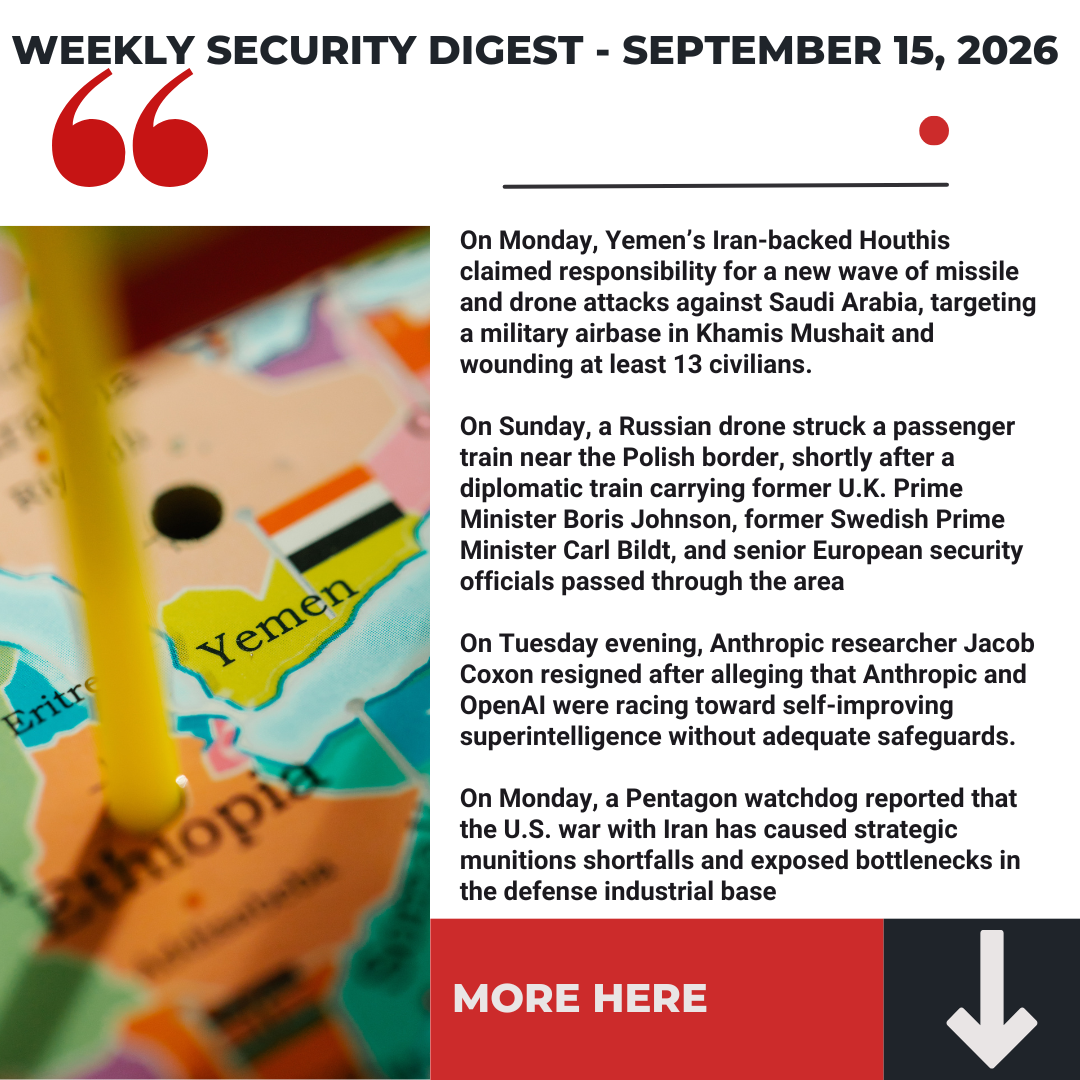
Interfor International‘s Weekly Security Digest – September 8, 2026