


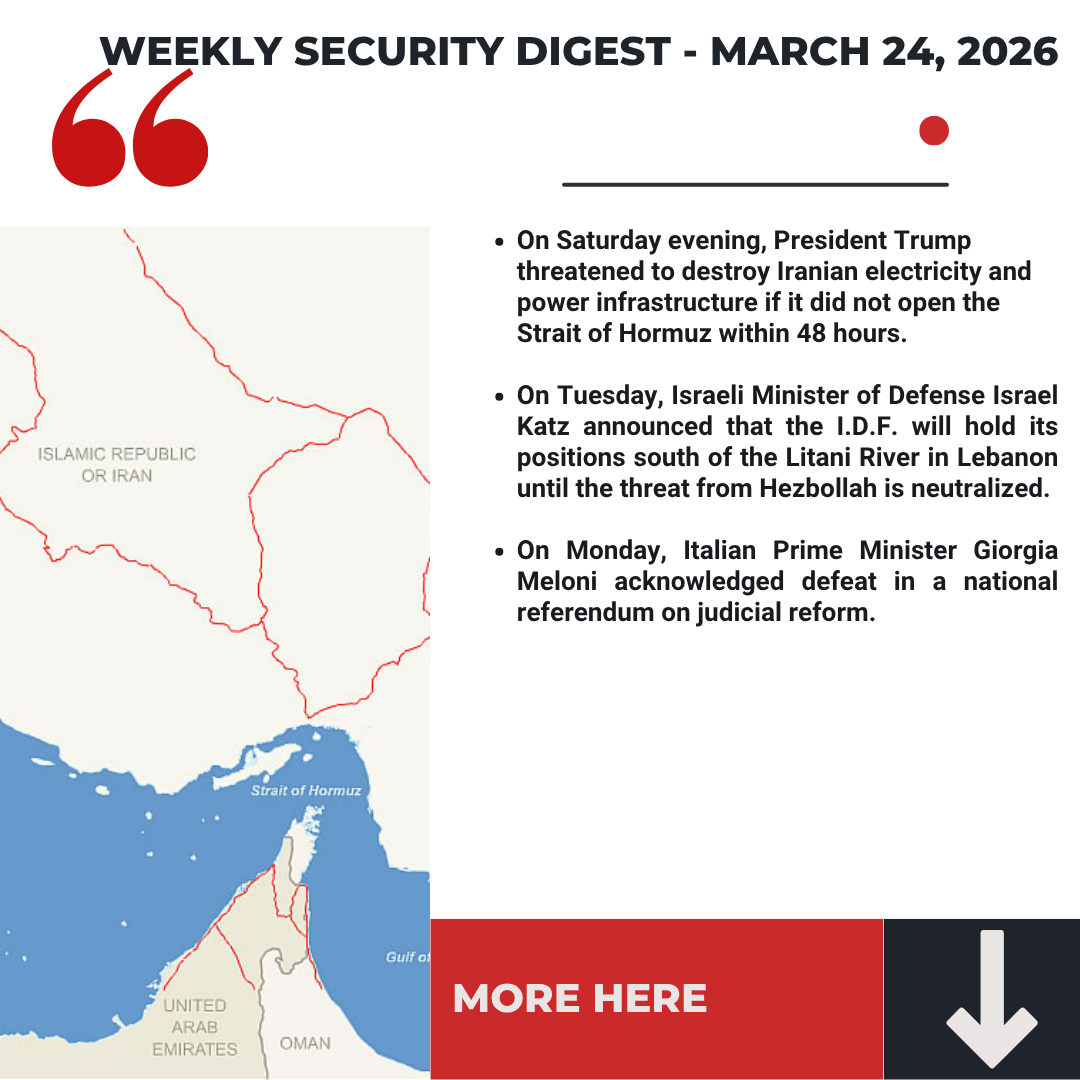
| Middle East → On Saturday evening, President Trump threatened to destroy Iranian electricity and power infrastructure if it did not open the Strait of Hormuz within 48 hours. This threat caused immediate concern among the Gulf States, who warned Trump that Iranian retaliation on their infrastructure would be devastating. Yesterday, President Trump walked back the threat, claiming that the U.S. is currently negotiating with top Iranian officials. Iran denies that it has engaged in talks. It remains unclear what, if any, genuine space for diplomacy exists here. U.S. demands continue to focus on harsh constraints on Iran’s nuclear program, elimination of its support for regional proxies, and a low cap on its ballistic missile arsenal. Meanwhile, Iran’s objectives have expanded. As of now, the Islamic Republic is successfully playing its ace card with its restriction of trade via the Strait of Hormuz, and unless the U.S. and its allies can beat back and degrade that Iranian capability, the Islamic Republic only stands to gain by continuing to apply pressure. The regime’s goal is no longer just to survive. It now believes it can make strategic gains, securing itself against further U.S. and Israeli attacks and establishing itself as the preeminent military power in the Gulf. Beyond the lack of overlap in negotiating positions, there is also a monumental lack of trust that will be difficult, if not impossible, to overcome. The U.S. has now launched surprise attacks on Iran twice during past rounds of negotiations, with reports suggesting that the U.S. may have deliberately used diplomacy as a smokescreen to enable preparation for war. Iran’s leadership has little to no faith in the U.S. as a trustworthy negotiating partner and would likely prefer to call the U.S. bluff on moving to break the Islamic Republic’s hold on the Strait. With all of this in mind, Trump’s move toward diplomacy could yet again be a stall tactic, enabling ground forces and firepower to reach the region to support operations aimed at breaking Iranian control over the Strait. It also serves to temporarily soften the market impact of restricted oil and gas flows, while the U.S. builds global confidence in its ability to break the blockade. → Reports suggest Trump’s team may be trying to negotiate with Mohammad Bagher Qalibaf, Iran’s current speaker of parliament, who previously served as an I.R.G.C. general and mayor of Tehran. Qalibaf has served as a key behind-the-scenes operator since Iranian military leadership thinned out during the war last June and is now suspected of being a de facto leader of Iran’s war effort. Some have pitched Qalibaf as a possible transitional leader for the Islamic Republic. He sits at the intersection of the I.R.G.C.’s military and economic power, the country’s political leadership, and the Supreme Leader’s office. Many view Qalibaf as pragmatic, based on his leadership of Tehran as mayor, and corrupt, given how much wealth he is suspected of accumulating in his decades as a regime insider. Trump’s team may see Qalibaf as a viable negotiating partner precisely for these reasons. And yet, Qalibaf is a hardline conservative who serves, in effect, as the political front for the I.R.G.C. It is not impossible that he could lead the regime toward some kind of feigned moderation in a scenario where the I.R.G.C.’s capabilities are massively degraded, and Iran is without leverage. And yet, we are not in that scenario. The Islamic Republic has immense leverage in its control over the Strait of Hormuz and its enduring capability to threaten the Gulf States with missiles and drones. The I.R.G.C., as Qalibaf’s primary constituency, is almost certainly in no mood to make compromises. → On Tuesday, Israeli Minister of Defense Israel Katz announced that the I.D.F. will hold its positions south of the Litani River in Lebanon until the threat from Hezbollah is neutralized. The statements follow continued rocket and drone attacks on northern Israeli towns. For its part, the Lebanese government declared Iran’s ambassador to Lebanon “persona non grata,” a highly notable signal of the government’s increasingly firm political stance against Hezbollah and Iran. International Affairs → On Monday, Italian Prime Minister Giorgia Meloni acknowledged defeat in a national referendum on judicial reform. Meloni’s judicial reform agenda sought to restructure the judiciary and redefine the relationship between judges and prosecutors, but faced strong criticism from opponents that her policies would concentrate too much power in the government’s hands. The outcome raises questions over the administration’s capacity to advance institutional reforms and highlights divisions within Italian public opinion on judicial independence and governance. → During a diplomatic visit last week, Kenyan Foreign Minister Musalia Mudavadi announced that citizens recruited to fight for Russia in Ukraine will be granted amnesty upon their return, following talks in Moscow to address illegal enlistment. Nairobi confirmed that Moscow agreed to halt further recruitment, after recruiters drew an estimated 252 Kenyans into the conflict, often under false employment promises. Authorities also secured provisions allowing those unwilling to continue fighting to return home, amid growing concerns over the exploitation of African nationals in foreign conflicts. → Japan announced its largest-ever release of oil from national strategic reserves, with Prime Minister Sanae Takaichi confirming that the government will make up to 80 million barrels available to domestic refiners in response to disruptions in global energy markets. The move follows escalating tensions in the Middle East and the restriction of tanker traffic through the Strait of Hormuz. The measure, combined with fuel subsidies and earlier releases from private stockpiles, endeavors to stabilize domestic energy supply and mitigate price pressures. → On Monday, Hong Kong amended its national security law to enable police access to suspects’ electronic devices. This marks an expansion of Hong Kong’s national security law, introduced by Beijing in 2020 following pro-democracy protests in the enclave. Individuals who refuse to comply could face up to one year in prison and financial penalties, while providing false or misleading information may result in longer jail terms. The changes drew attention as part of Hong Kong’s ongoing efforts to strengthen national security provisions, and raised concerns among critics over their potential impact on civil liberties and privacy. → A meningitis outbreak in the U.K. has raised public health concerns with 15 confirmed and 12 suspected infections and at least two deaths linked to a cluster in Canterbury. The outbreak prompted a large-scale response, including mass vaccination and antibiotic distribution campaigns for thousands of students and close contacts. Similarly, authorities in France reported a fatal meningitis case in a workplace setting and stressed that there is no confirmed link to the U.K. outbreak. |
A Note From Interfor
→ Suggestions on social media risk management in our blog post here.
→ Thoughts on a changing Thailand – read our blog post here.
| Resources: US Department of State Travel Advisories CISA: nation-state cybersecurity threats and other resources for cybersecurity matters. |
To find out more, please reach out to info@interforinternational.com
Related Blog
VIEW ALL
Geopolitics. Global Security, & Current Events
Interfor International‘s Weekly Security Digest – March 24, 2026
Geopolitics. Global Security, & Current Events
Interfor International‘s Weekly Security Digest – March 17, 2026
Geopolitics. Global Security, & Current Events
Interfor International‘s Weekly Security Digest – March 10, 2026
