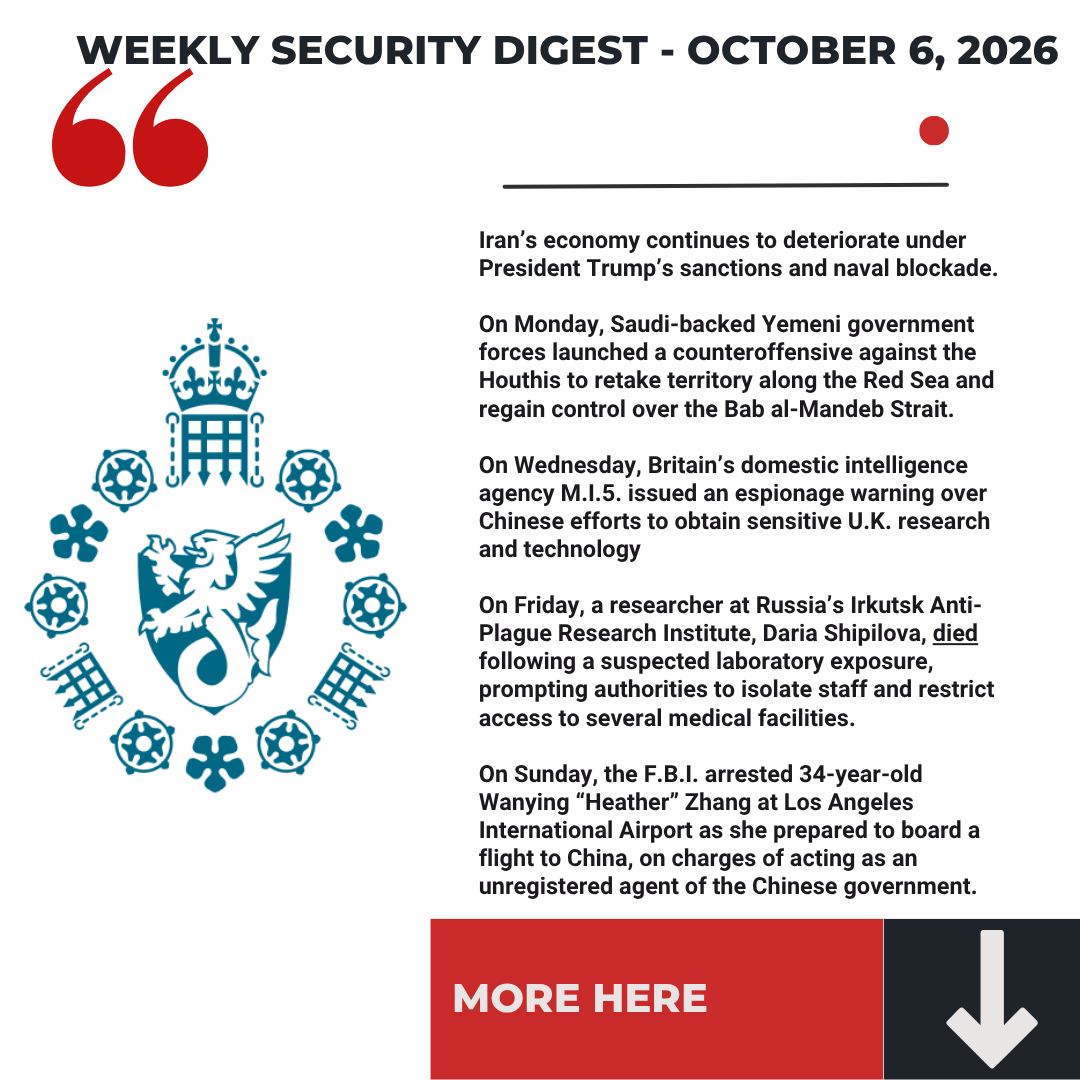


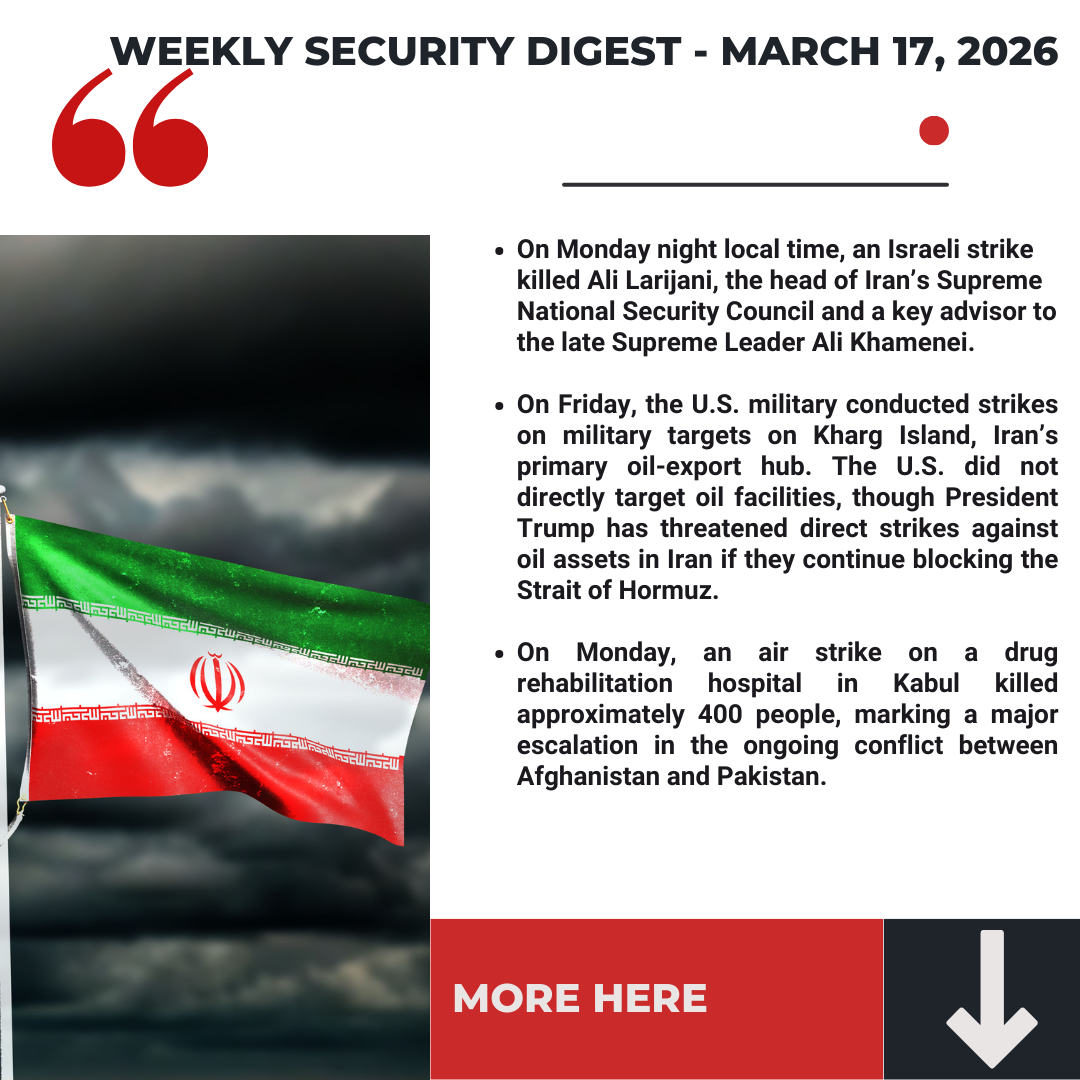
| Middle East → On Monday night local time, an Israeli strike killed Ali Larijani, the head of Iran’s Supreme National Security Council and a key advisor to the late Supreme Leader Ali Khamenei. Last night’s strikes also killed the Head of the Basij, Gholamreza Soleimani. Over the past several days, additional U.S. and Israeli forces struck several defense facilities and airbases in Iran as part of an ongoing effort to degrade Iran’s capacity to launch counterattacks against Israel and Gulf allies. Larijani has long been a key power broker in Iranian politics. In recent months, he has both led regime strategy during the crackdown on protests in January and, reportedly, unsuccessfully advocated against the I.R.G.C.-supported election of Mojtaba Khamenei as Supreme Leader. Some may say he would have served as a moderating influence on the new leadership in the future, or, at least, that he could have bridged divides between I.R.G.C. and civilian leadership. In any case, Larijani’s death will likely further concentrate power in the hands of the I.R.G.C. Still, many Iranians may see Larijani’s death as justice for the tens of thousands of protesters killed in January. This, plus the strike killing the head of the Basij, could help to realign the US and Israeli attacks with Iranian anti-regime sentiment. And yet, killing Larijani makes diplomatic engagement with Iran’s new leaders more challenging. Larijani was overseeing the recent U.S.-Iran talks and was one of the only civilian leaders left capable of preaching pragmatism to the new I.R.G.C.-dominated leadership. → On Friday, the U.S. military conducted strikes on military targets on Kharg Island, Iran’s primary oil-export hub. The U.S. did not directly target oil facilities, though President Trump has threatened direct strikes against oil assets in Iran if they continue blocking the Strait of Hormuz. The U.S. is also sending additional assets to the region, including the U.S.S. Tripoli, to safeguard commercial vessels in the region. → President Trump called for allied nations to send warships to guard the Strait of Hormuz Saturday, as global oil costs continue to rise. On Monday, several E.U. countries ruled out immediate participation in a naval mission, rebuffing President Trump’s request for military support. Spain, Germany, and Italy emphasized the need to avoid escalation and prevent involvement in a broader conflict. The U.K., however, is reportedly considering sending resources to the region, reflecting growing transatlantic tensions over the conflict in the Gulf. → This week, the Israeli Defense Forces announced “targeted ground operations against key targets” in southern Lebanon. As part of the expanded ground offensive, which aims to secure a broader “forward defensive” position, the I.D.F. moved west to the Litani River, meeting resistance from Hezbollah fighters at several key villages. According to Lebanese sources, the fighting has displaced approximately 800,000 from areas of southern Lebanon since March 2. International Affairs → On Monday, an air strike on a drug rehabilitation hospital in Kabul killed approximately 400 people, marking a major escalation in the ongoing conflict between Afghanistan and Pakistan. Islamabad has denied striking civilian infrastructure, stating its operations were aimed at militant sites linked to cross-border attacks. The incident drew international concern, with growing fears of a broader regional conflict following weeks of escalating cross-border strikes and retaliatory actions. → Belgian Prime Minister Bart De Wever triggered political tensions after calling for the E.U. to consider “normalizing” relations with Russia as part of a broader strategy to end the war in Ukraine and address energy challenges. His remarks, which contrasted with the bloc’s firm support for Ukraine, were quickly challenged by Belgian Foreign Minister Maxime Prévot and other officials, who reaffirmed their commitment to maintaining pressure on Russia. This response underscores growing sensitivities within E.U. states over long-term Russia policy. De Wever’s statements may have been in response to strains on energy markets due to the war with Iran; stronger relations with Russia would provide Europe with alternative energy sources should the Middle East become unreliable. → Over the weekend, Vietnam and China held their first ministerial-level “3+3” strategic dialogue, bringing together senior officials responsible for diplomacy, defense and public security in a move aimed at deepening bilateral coordination. The meetings focused on strengthening political and security cooperation, enhancing coordination on regional and international issues, and expanding collaboration in areas such as trade, investment and technology. → On Wednesday, South Africa deployed soldiers to parts of Johannesburg to support police in combating escalating gang violence and illegal mining, marking the first major implementation of President Cyril Ramaphosa’s strategy to use the military against organized crime. Authorities say the measure will restore public safety and strengthen law enforcement capacity. → On Wednesday, Senegal’s parliament approved new legislation increasing penalties for homosexuality, extending prison sentences to between five and ten years and introducing additional provisions criminalizing the financing of LGBTQ+ activities. Lawmakers passed the bill with near-unanimous support. Prime Minister Ousmane Sonko is expected to approve the bill as part of his government’s broader conservative policy agenda in the country. |
A Note From Interfor
→ Interfor’s team provides suggestions on social media risk management in our blog post here.
→ Steve Romano, former FBI Chief Hostage Negotiator and Interfor Academy member, and Jeremy Hurewitz, Head of Interfor Academy, wrote about the kidnapping of Nancy Guthrie in Newsweek.
→ Thoughts on a changing Thailand – read our blog post here.
| Resources: US Department of State Travel Advisories CISA: nation-state cybersecurity threats and other resources for cybersecurity matters. |
To find out more, please reach out to info@interforinternational.com
Related Blog
VIEW ALL
Geopolitics. Global Security, & Current Events
Interfor International‘s Weekly Security Digest – October 20, 2026
Geopolitics. Global Security, & Current Events
Interfor International‘s Weekly Security Digest – October 13, 2026
Geopolitics. Global Security, & Current Events
Interfor International‘s Weekly Security Digest – October 6, 2026