

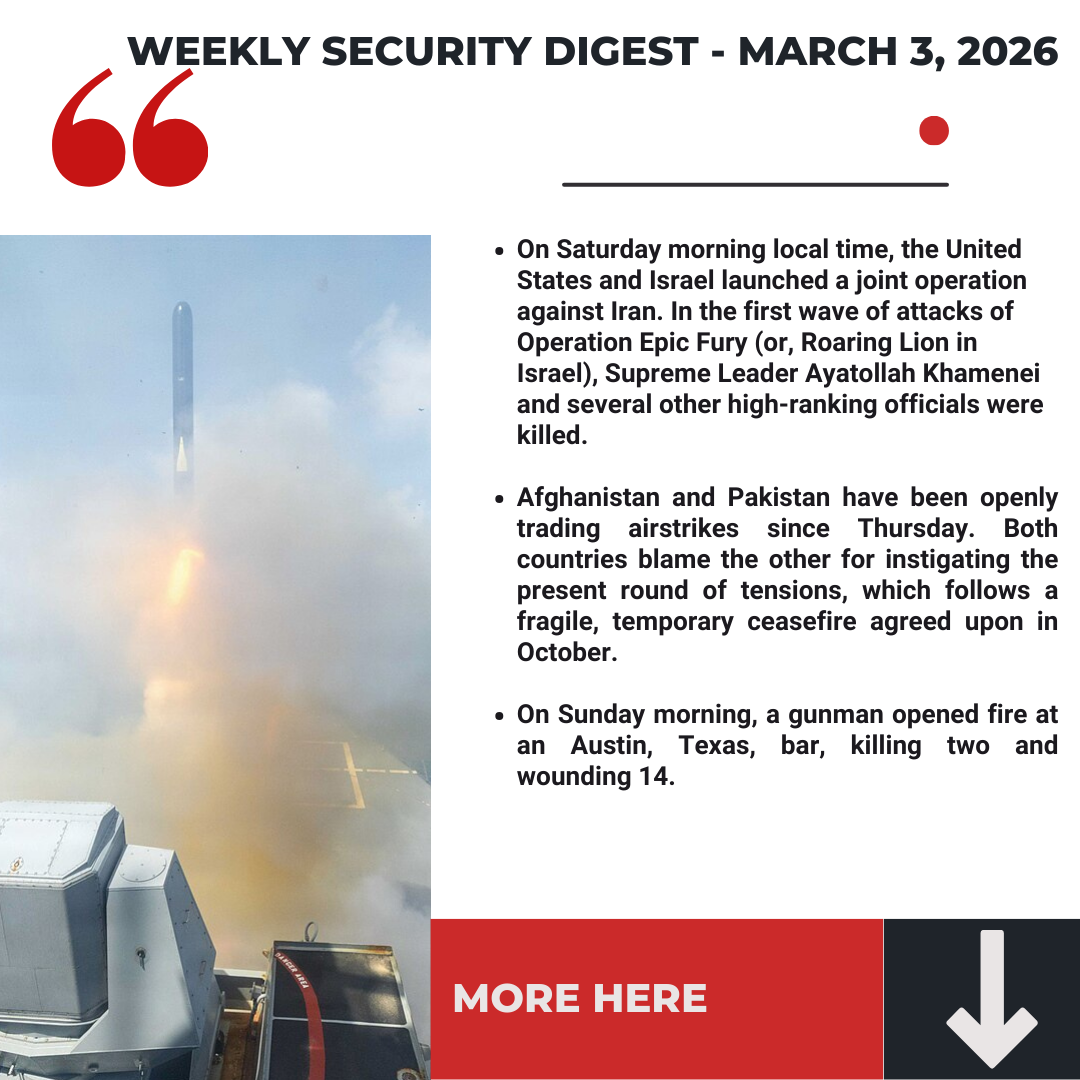
| Middle East → On Saturday morning local time, the United States and Israel launched a joint operation against Iran. In the first wave of attacks of Operation Epic Fury (or, Roaring Lion in Israel), Supreme Leader Ayatollah Khamenei and several other high-ranking officials were killed. Tehran launched hundreds of drones and missiles in a multi-front retaliation, targeting Israel, the Gulf Cooperation Council states, and American military bases and assets in the region. Iranian projectiles have targeted military installations, civilian and residential areas, and energy infrastructure, prompting several Gulf countries to close their airspace and initiate defensive operations against Iran and raising global concerns about the price of oil and the stability of world trade through the Strait of Hormuz. On Monday, President Trump estimated that the war could continue for 4-5 weeks. President Trump has signaled that the U.S. and Israel are pushing for regime change, or at least significant moderation, in Iran. Consequently, what we are seeing is a very broad set of strikes on regime, military, and nuclear targets. U.S. and Israeli strikes have targeted everything from senior-level intelligence officials in Tehran to I.R.G.C.-linked police and border control units in northwest Iran. The latter set of strikes is likely intended to reduce the regime’s ability to suppress protests and to enable armed Kurdish groups to cross from Iraq to drive armed resistance. Still, the prospects for regime change remain opaque. Collapsing the Islamic Republic from the air is not impossible, but imposing a stable new government likely is. Many have been surprised by the extent of Iran’s targeting of the Gulf States. Even Oman, always a neutral mediator, even now pushing diplomacy, was targeted. The longer the conflict drags on, the more damage the strikes will do to the Gulf States’ prized reputation for safety and security. Iran’s hope has been that the Gulf, concerned about losing its place as a hub for international business due to an elevated perception of insecurity, would pressure the U.S. to bring the war to a close. Thus far, Iran’s strikes have had the opposite effect; there is even speculation that Saudi Arabia may itself attack Iran directly in retaliation for recent strikes on its territory. → Early Tuesday morning, local time, two Iranian drones hit the U.S. Embassy in Riyadh, causing limited structural damage and no injuries. U.S. diplomatic outposts across the Gulf are warning staff to shelter in place and leave the country if possible. Though the Iranian response has been more limited than expected, several Gulf states, primarily the United Arab Emirates, are sustaining high levels of drone attacks. → On Sunday, Hezbollah launched several missiles into northern Israel in response to the killing of Iranian Supreme Leader Ayatollah Khamenei, breaking the ceasefire brokered in 2024. The Israel Defense Forces (I.D.F.) conducted retaliatory strikes in Beirut and southern Lebanon in the early hours of Monday morning. Israeli ground forces have now crossed into southern Lebanon, with the Lebanese military withdrawing from positions in the south to avoid confrontation with the I.D.F. Lebanese leadership has been careful to blame Hezbollah primarily for the resumption of conflict, while also condemning Israeli strikes in Lebanon. International Affairs → For their part, European Union leaders have condemned Tehran’s actions as disproportionate and expressed readiness to take coordinated defensive measures to protect European interests and allies in the region. France, Germany, and the United Kingdom reported that Tehran targeted some of their bases and forces in the Gulf, prompting commitments to reinforce regional defense cooperation and support maritime security efforts. → Afghanistan and Pakistan have been openly trading airstrikes since Thursday. Both countries blame the other for instigating the present round of tensions, which follows a fragile, temporary ceasefire agreed upon in October. Islamabad claims that Taliban-led Afghanistan is advancing the agenda of terror groups in the region (namely al-Qaeda and the Islamic State) and acting as a proxy for Indian interests, which Kabul denies. Military installations and government facilities have been targeted on both sides, with some preliminary reports of civilian casualties. Interfor Academy member and former head of the CIA’s Counterterrorism Center, Bob Grenier, provides the following additional context on the violence between Afghanistan and Pakistan: With the launch of Operation Ghazab Lil Haq and its declaration of “open war” on Afghanistan in late February, Pakistan has raised its conventional military response to cross-border attacks by the Pakistani Taliban (T.T.P.) to a qualitatively new level. Pakistan is launching artillery and air strikes against Afghan military targets well within the interior of Afghanistan, to which the Afghan Taliban is responding with drone strikes and small-unit attacks on border outposts. These are the culmination of growing Pakistani frustration with the Taliban’s failure to control T.T.P. cross-border terrorist attacks, which have steadily increased since the Taliban takeover of Afghanistan in August 2021. The Taliban’s ability to control the T.T.P. would be limited under the best of circumstances; its refusal to take any effective action reflects both ideological and domestic political considerations. Despite growing Pakistani pressure, Taliban policy is unlikely to change. → On Wednesday, Hungarian Prime Minister Viktor Orbán ordered increased security measures around critical energy infrastructure, alleging that Ukraine and its allies are deliberately blocking deliveries of Russian oil through the Druzhba pipeline. Budapest announced the deployment of additional security forces to protect power plants and distribution facilities. Orbán recently strengthened his anti-Ukraine campaign in an effort to secure votes from conflict-averse Hungarians. → South African President Cyril Ramaphosa authorized the deployment of the military to support police operations in parts of the Western Cape, Gauteng, and Eastern Cape, to combat escalating gang violence and illegal mining activities. The government described the move as a targeted and temporary measure to reinforce law enforcement capacity in high-crime areas and restore public safety. → On Sunday, armed assailants targeted villages in Abienmon County, in South Sudan’s Ruweng Administrative Area, killing approximately 170 people in a large-scale attack. The early-morning assault is the latest escalation in tensions between government and opposition forces. Riek Machar, leader of the opposition forces, was removed from government for “alleged subversion.” Machar denies responsibility for the violence. → Indian Prime Minister Narendra Modi and Israeli Prime Minister Benjamin Netanyahu agreed to deepen cooperation in defense, technology, and strategic industries on Thursday. Israel also agreed to allow 50,000 Indian workers to enter the country over the next five years. The two nations have been strengthening ties for several years, with significant potential for technological advancement. United States → On Sunday morning, a gunman opened fire at an Austin, Texas, bar, killing two and wounding 14. The F.B.I. is investigating the incident as a potential terrorist attack. Authorities identified the shooter, who was killed by police at the scene, as Ndiaga Diagne. Officials have emphasized that while there are indicators suggesting possible ideological elements, the investigation is ongoing and investigators have made no final determination. |
A Note From Interfor
→ Interfor’s team provides suggestions on social media risk management in our blog post here.
→ Thoughts on a changing Thailand – read our blog post here.
| Resources: US Department of State Travel Advisories CISA: nation-state cybersecurity threats and other resources for cybersecurity matters. |
To find out more, please reach out to info@interforinternational.com
Related Blog
VIEW ALL
Geopolitics. Global Security, & Current Events
Interfor International‘s Weekly Security Digest – March 3, 2026

Geopolitics. Global Security, & Current Events
Interfor International‘s Weekly Security Digest – February 24, 2026