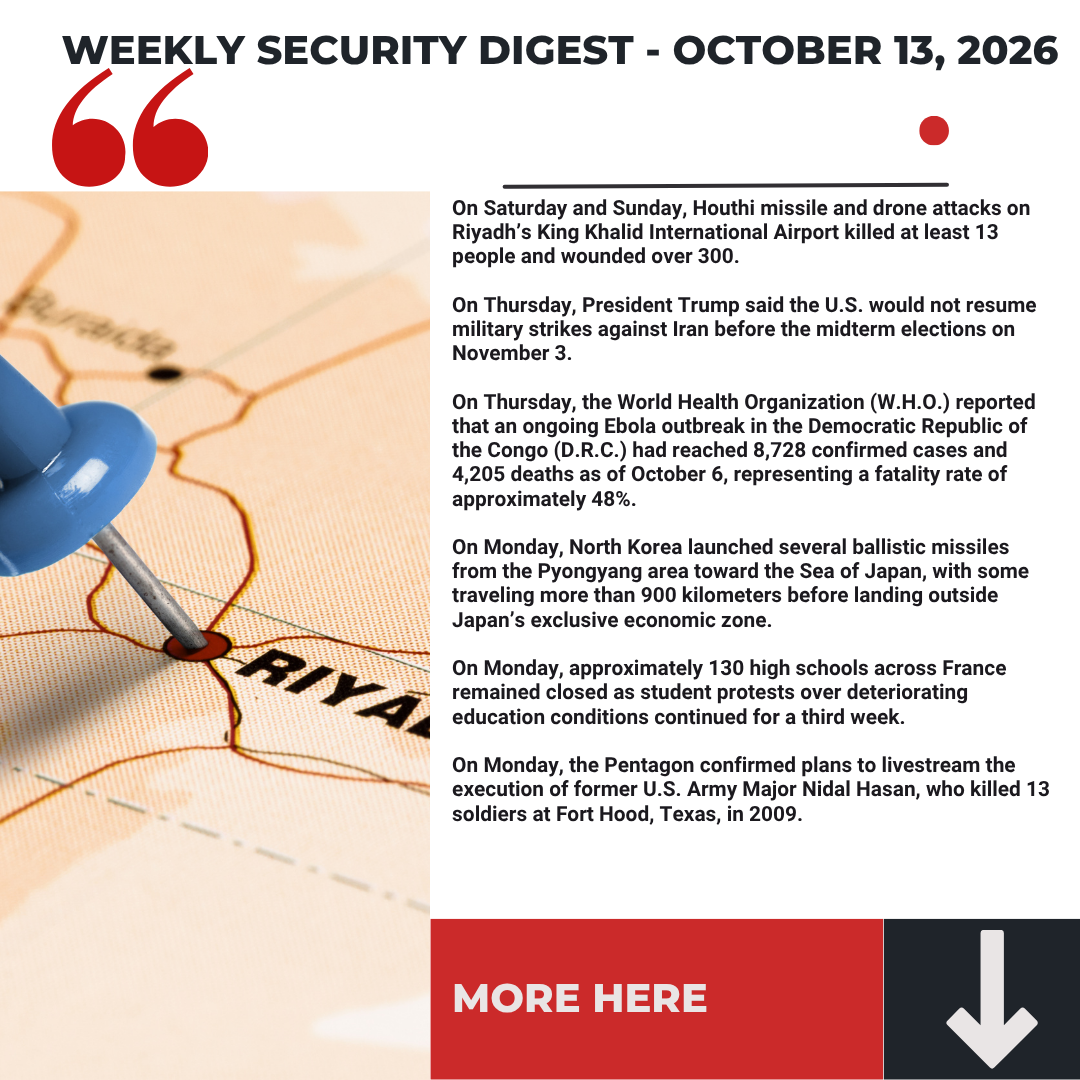


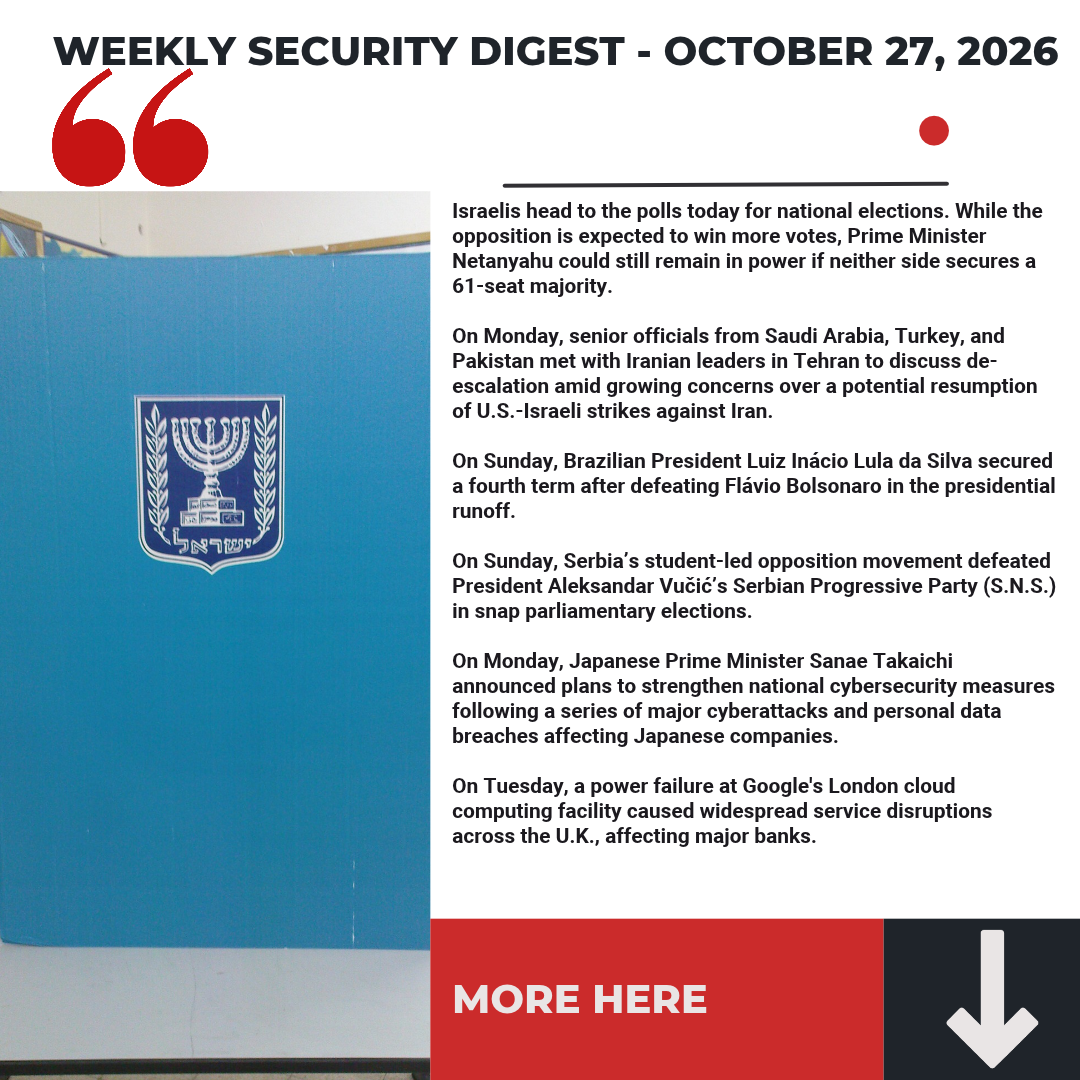
| Middle East → Israelis head to the polls today for national elections. While the opposition is expected to win more votes, Prime Minister Netanyahu could still remain in power if neither side secures a 61-seat majority. Gadi Eisenkot leads the primary opposition parties and has been doing well in the polls. However, Netanyahu has defied projections at several previous elections. Notably, even if Netanyahu leaves office, his replacement will likely still be an Iran hawk who is willing to work with President Trump to continue the war effort. Much attention has focused on Netanyahu’s rumored efforts to launch some sort of military escalation before the election to either delay the vote or swing it in his favor. At the same time, speculation is rife that Trump plans to launch new strikes against Iran after the U.S. election. If the opposition leads but has fewer than 61 seats after today’s election, there is a scenario where Netanyahu stays in office long enough for Trump to launch a new military operation against Iran. In that case, we would likely see Netanyahu try to use that escalation to argue against a change in leadership in Israel.. → On Monday, senior officials from Saudi Arabia, Turkey, and Pakistan met with Iranian leaders in Tehran to discuss de-escalation amid growing concerns over a potential resumption of U.S.-Israeli strikes against Iran. The meeting marked the first high-level contact between Tehran and the three members of the newly formed Mecca Alliance since Iran-backed Houthi rebels escalated attacks on Saudi targets. Discussions reportedly focused on regional security and establishing a framework for de-escalation. However, in the longer term, Gulf states may be seeking assurances of regional stability should the U.S. order the majority of its troops to leave the Middle East. We expect an acceleration of regional diplomatic contacts as the U.S. election, and a possible resumption of U.S. strikes on Iran, approaches. A U.S.-Iran agreement remains hard to imagine in the near term, but Qatar and Pakistan will likely make a last push for a fresh proposal to be considered before the U.S. opts to escalate. International Affairs → On Sunday, Brazilian President Luiz Inácio Lula da Silva secured a fourth term after defeating Flávio Bolsonaro in the presidential runoff, receiving 51.79% of the vote compared with Bolsonaro’s 48.21%, a margin of 4.4 million votes. Lula overturned a narrow first-round defeat, benefiting from increased voter turnout as abstention fell from 21.08% to 19.21%. Following the announcement, Bolsonaro refused to concede and said his legal team would seek to annul the results, alleging that a court decision to extend voting hours had unfairly altered the electoral process. The dispute could trigger legal challenges and further political tensions. → On Sunday, Serbia’s student-led opposition movement defeated President Aleksandar Vučić’s Serbian Progressive Party (S.N.S.) in snap parliamentary elections. With 97% of polling stations counted, preliminary results showed the Student List securing 52.7% of the vote, compared with 39.2% for the S.N.S., prompting Vučić to concede defeat. The opposition movement emerged following the November 2024 collapse of a railway station canopy in Novi Sad that killed 16 people, triggering prolonged anti-government demonstrations over alleged corruption and negligence. Thousands of supporters celebrated across Belgrade, while European officials welcomed the result as an opportunity to advance Serbia’s E.U. accession process. → On Saturday, Typhoon Champi brought destructive winds and heavy rainfall to the northeastern coast of Taiwan, resulting in one fatality and more than 500 injuries. Wind gusts reached approximately 141 mph in coastal areas, leaving more than 288,000 households without electricity. Authorities reported 259 flight cancellations and extended school and office closures across northern and central Taiwan, including Taipei. As the storm weakened and moved north toward China’s eastern coast and southern Japan, Chinese authorities deployed emergency personnel, evacuated more than 2,000 island visitors, and suspended ferry services and offshore construction activities. → Over the weekend, widespread demonstrations across France, Italy, Albania, Spain, and Portugal prompted heightened security measures and clashes between protesters and police, amid growing public dissatisfaction over living costs, housing, pensions, education, and government policies. In France, authorities reported approximately 2,400 arrests and nearly 1,000 security personnel injured amid nationwide unrest. In Albania, thousands of demonstrators in Tirana clashed with police during anti-government protests. In Italy, demonstrations across Milan, Rome, Turin, and other major cities resulted in hundreds of temporary detentions, with protesters throwing stones, bottles, and fireworks at police. Further demonstrations are likely in the coming weeks as economic grievances persist, increasing the risk of localized violence, transportation disruptions, and heightened security deployments in major European cities. → On Friday, the World Health Organization (W.H.O.) reported that the ongoing Ebola outbreak caused by the Bundibugyo virus has spread throughout the Democratic Republic of the Congo (D.R.C.), with additional cases being reported in Kenya and Nigeria. W.H.O. warned that difficulties identifying cases early could facilitate further regional spread, particularly given the absence of approved vaccines or specific treatments. The organization assessed the risk as very high in the D.R.C. and high in neighboring countries, while maintaining a low global risk assessment and advising against travel or trade restrictions. Cyber → On Monday, Japanese Prime Minister Sanae Takaichi announced plans to strengthen national cybersecurity measures following a series of major cyberattacks and personal data breaches affecting Japanese companies. During an emergency ministerial meeting, Takaichi said the government would consider deploying active cyber defense capabilities, including allowing police and the Self-Defense Forces to access and neutralize servers used in cyberattacks targeting critical infrastructure. The government has already begun implementing its active cyber defense framework this month, while Takaichi called for accelerated A.I.-assisted vulnerability assessments of government systems. The measures are intended to reduce Japan’s exposure to further cyberattacks, particularly those targeting financial institutions, telecommunications, and energy infrastructure. → On Tuesday, a power failure at Google’s London cloud computing facility caused widespread service disruptions across the U.K., affecting major banks. Customers of Revolut, Lloyds, HSBC, and Halifax experienced difficulties accessing accounts, making card payments, transferring funds, and withdrawing cash, while technical failures also delayed remote court hearings across England and Wales. Revolut reported disruptions to multiple services, including cryptocurrency transactions, but confirmed that customer funds and data remained secure. Google said services had been restored for most customers by mid-afternoon, while the Financial Conduct Authority and Bank of England began examining the incident’s impact on the financial sector. |
| Resources: US Department of State Travel Advisories CISA: nation-state cybersecurity threats and other resources for cybersecurity matters. |
To find out more, please reach out to info@interforinternational.com
Related Blog
VIEW ALL
Geopolitics. Global Security, & Current Events
Interfor International‘s Weekly Security Digest – October 27, 2026
Geopolitics. Global Security, & Current Events
Interfor International‘s Weekly Security Digest – October 20, 2026
Geopolitics. Global Security, & Current Events
Interfor International‘s Weekly Security Digest – October 13, 2026