

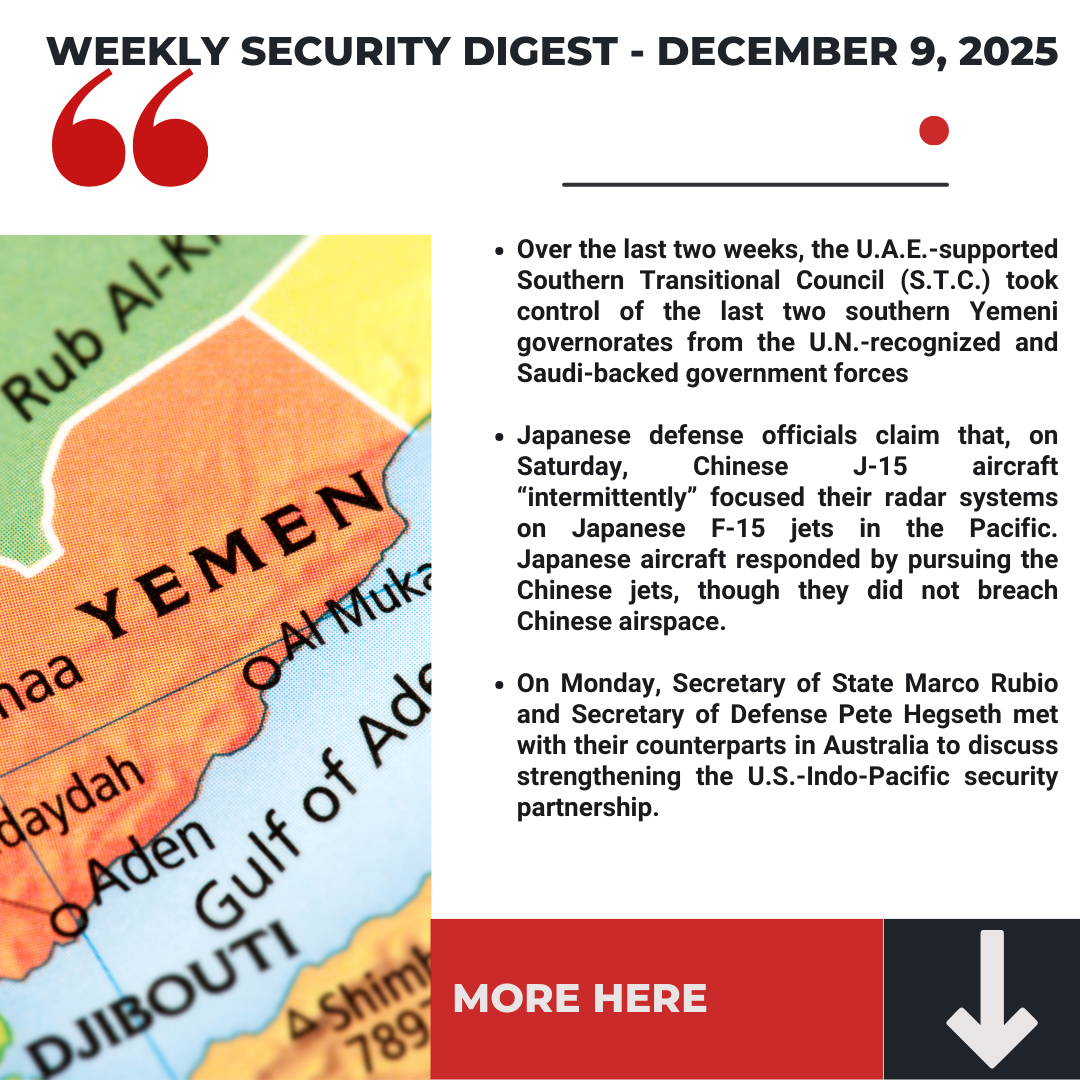
| Middle East → Over the last two weeks, the U.A.E.-supported Southern Transitional Council (S.T.C.) took control of the last two southern Yemeni governorates from the U.N.-recognized and Saudi-backed government forces. Since the Iran-backed Houthis took over Yemen’s north, the Saudi-supported Islah party and the better-armed S.T.C. have cooperated under the Presidential Leadership Council (P.L.C.), chaired by Islah President Rashad al-Alimi. Now that the S.T.C. has taken over the entire south, they may declare an independent south Yemen, contravening the U.S.- and U.N.-endorsed Saudi plan to reintegrate with the Houthi-held north to reestablish a unified Yemen. Beyond dulling hopes for a reunified Yemen, this development signals rising tensions between the U.A.E. and the Kingdom of Saudi Arabia (K.S.A.) The two Gulf nations are already supporting opposite sides in the Sudan conflict. Notably, in both cases, the U.A.E. is the one upsetting the status quo by going against not just Saudi but U.S. and U.N. objectives. From the U.A.E. perspective, the past year has seen K.S.A. and Crown Prince Mohammed bin Salman (MbS) suddenly looking like President Trump’s favorite Gulf partner. MbS’s November White House visit, in particular the announcement that the U.S. would sell F-35s to K.S.A., after declining to sell them to the U.A.E. in 2022, likely further inflamed Abu Dhabi’s insecurity about its U.S. ties. During MbS’s trip, the Saudis reportedly also pushed Trump to help end the war in Sudan, presumably by forcing the U.A.E. to rein in the Rapid Support Forces (R.S.F.). There is some speculation that the S.T.C.’s aggression in Yemen may be the Emirati response to Saudi advocacy on Sudan. → Senior officials from the U.S., Israel, and Qatar met in New York on Sunday to discuss repairing the Israeli-Qatari relationship following Israel’s strike on Hamas leaders in Doha in September. The meeting reportedly focused primarily on the next phase of the Gaza ceasefire and may mark the first in a series of trilateral efforts to oversee the process. However, Qatar’s Prime Minister Sheikh Mohammed Abdulrahman Al Thani also recently suggested that Qatar would only devote funds to humanitarian aid in Gaza, rather than funding reconstruction efforts. → Syrian President Ahmed al-Sharaa spoke at the Doha Forum this weekend, arguing that Israeli strikes in Syria have undermined his government’s attempts to resolve tensions with the Jewish state. The U.S. is currently mediating negotiations between Israel and Syria. It is likely that any bilateral agreement will stop short of a comprehensive Israel-Syria peace deal and focus exclusively on ending hostilities and establishing security for both states around their shared border. Key issues include sovereignty of the Golan Heights and the demilitarized buffer zone around it, which Israel seized following the fall of Assad. International Affairs → Japanese defense officials claim that, on Saturday, Chinese J-15 aircraft “intermittently” focused their radar systems on Japanese F-15 jets in the Pacific. Japanese aircraft responded by pursuing the Chinese jets, though they did not breach Chinese airspace. China’s Senior Colonel Wang Xuemeng decried Japan’s response as “harassment” and vowed to take additional steps to safeguard China’s security. Japanese defense authorities have been in talks with their Australian counterparts to collaborate on strengthening a regional alliance against China. The radar incident is the latest clash between China and Japan, following pro-Taiwan remarks by Japanese Prime Minister Taikachi. → European leaders met with Ukrainian President Zelenskyy on Monday in London to discuss the European Union’s continued support for Ukraine against Russian aggression. French President Macron stated after the meeting that the E.U. would provide “robust security guarantees” to Ukraine. Meanwhile, President Trump publicly criticized President Zelenskyy over the weekend for not agreeing to the current peace proposal, which reportedly includes at least partial Russian control of the Donbas. → Another round of fighting broke out on the Thai-Cambodia border on Sunday, killing dozens and forcing approximately 100,000 to flee the area. Thai Prime Minister Anutin Charnvirakul and Cambodian Senate President Hun Sen have both blamed the other side for firing the first shot and stated that their countries will continue to defend their territories. This episode is one of several violations of a ceasefire signed in October. → On Sunday, a bomb went off following a skirmish between the Congolese army (F.A.R.D.C.) and Wazalendo, a pro-government militia, in eastern Congo, killing over 30 and wounding 20. Early reports indicate that insubordination within the F.A.R.D.C. led to the fighting. Just last week, the U.S. brokered a peace agreement between the F.A.R.D.C. and M23, a Rwanda-backed rebel group. Over 100 armed groups exist in Congo, making any peace plan difficult to uphold. International militants, from Rwanda and Burundi, are also involved in the conflict, which is largely tied to control of Congo’s natural resources. → On Monday, Secretary of State Marco Rubio and Secretary of Defense Pete Hegseth met with their counterparts in Australia to discuss strengthening the U.S.-Indo-Pacific security partnership. The officials focused on advancing the Biden-era A.U.K.U.S. (Australia-United Kingdom-United States) pact to enhance Australian submarines with U.S. nuclear technology. → On Monday, Turkish President Recep Tayyip Erdogan announced that he would guarantee the continued flow of Russian gas to Hungary via the Turkstream pipeline. Hungary has long been pushing for the ability to import Russian gas, despite U.S. sanctions. |
| Resources: US Department of State Travel Advisories CISA: nation-state cybersecurity threats and other resources for cybersecurity matters. |
To find out more, please reach out to info@interforinternational.com
Related Blog
VIEW ALL
Geopolitics. Global Security, & Current Events
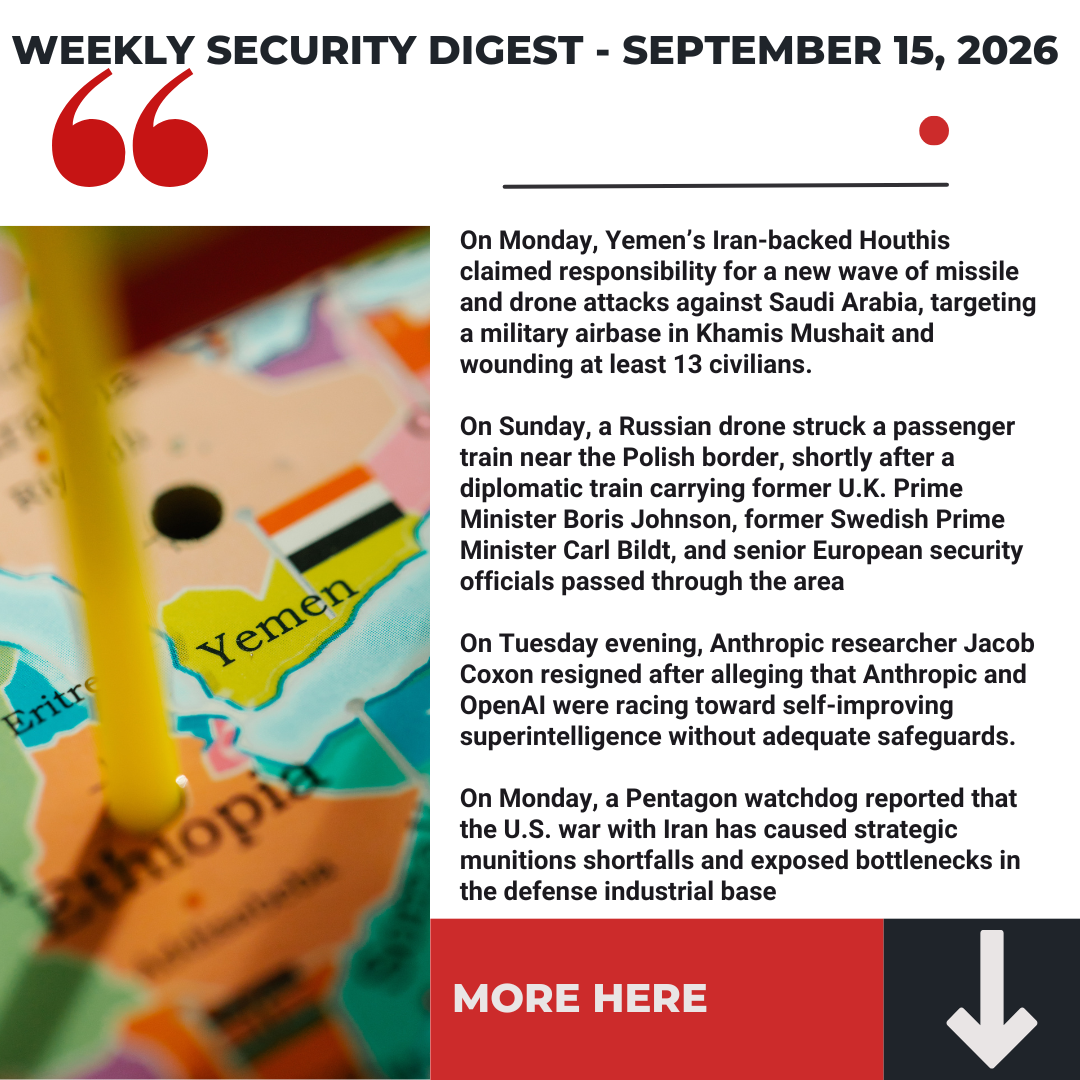
Interfor International‘s Weekly Security Digest – September 15, 2026
Geopolitics. Global Security, & Current Events
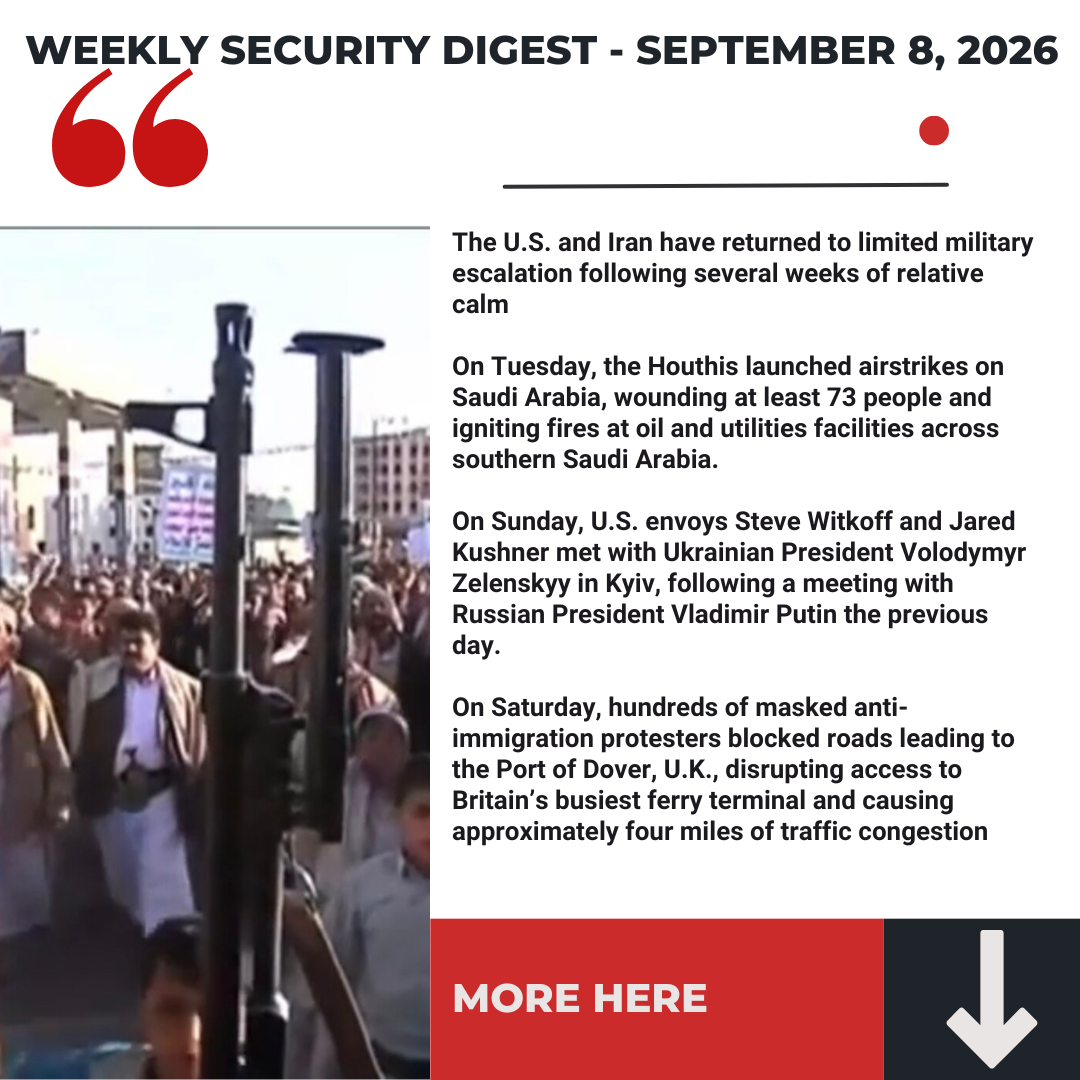
Interfor International‘s Weekly Security Digest – September 8, 2026