

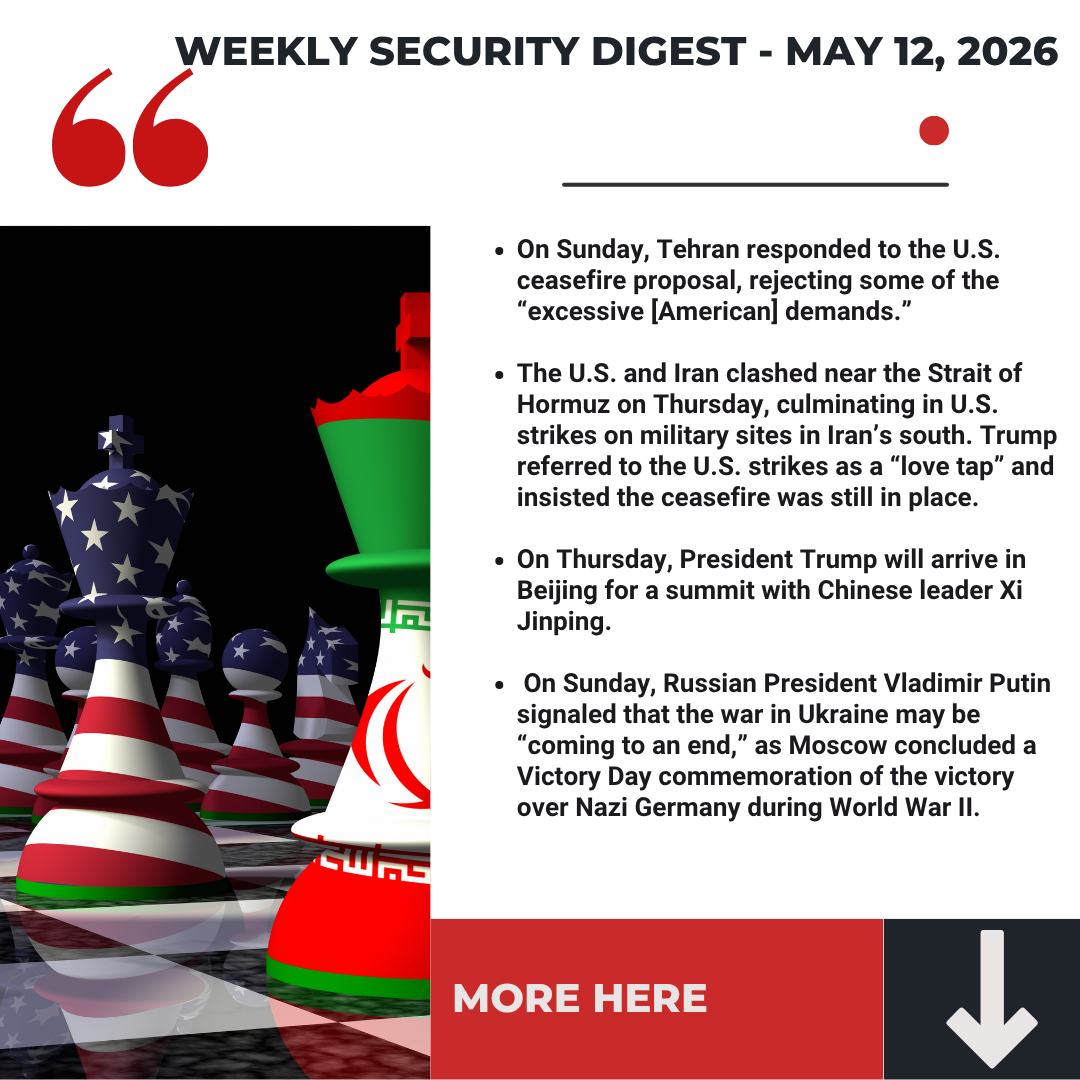
| Middle East → On Sunday, Tehran responded to the U.S. ceasefire proposal, rejecting some of the “excessive [American] demands.” The issue of enriched uranium remains a key sticking point for both parties. President Trump claims that Iran previously agreed to give up its enriched uranium, though Iran denies ever agreeing to such a deal. Trump stated on Monday that the ceasefire is “on life support” and met with his national security team to discuss diplomatic and military options. Interfor’s Analysis: Neither military action nor diplomacy offers the satisfying conclusion to the conflict Trump is hoping for. The U.S. and Iran are still far apart on a comprehensive diplomatic agreement; unless Trump is willing to start with a Hormuz-only deal, leaving nuclear and other topics for later, a broader deal is likely not imminent. Military action, on the other hand, can cause Iran more pain but is unlikely to meaningfully shift Iranian negotiating posture. In all likelihood, further U.S. and Israeli strikes would target energy and other infrastructure, hoping to further damage Iran’s economy and complicate its post-war recovery. A harder question is whether the U.S. and Israel will escalate to active efforts at regime change, supporting internal opposition, intensifying economic pressure, or other measures designed to threaten the regime’s survival rather than just its capabilities. Thus far, such efforts have not effectively driven Iran’s leadership to consider greater compromises in negotiations with the U.S. But, throughout this conflict, Trump has indicated openness to more dramatic options when told that limited actions would not move the needle. It is still possible that in a subsequent round of conflict, Trump will authorize broader escalation, for example, including a ground component. → The U.S. and Iran clashed near the Strait of Hormuz on Thursday, culminating in U.S. strikes on military sites in Iran’s south. Trump referred to the U.S. strikes as a “love tap” and insisted the ceasefire was still in place. Multiple rounds of clashes last week also saw Iran target the U.A.E. with drones. (Iran denies it fired on the U.A.E.) Alongside ongoing ceasefire discussions, the U.S. is still considering further military-supported measures to help commercial vessels transit the Strait. International Affairs → On Thursday, President Trump will arrive in Beijing for a summit with Chinese leader Xi Jinping. The summit is expected to focus on trade and investment. However, President Xi may also attempt to dissuade Trump from further arms sales to Taiwan. Secretary of State Marco Rubio affirmed U.S. support for the island last week, but Taiwanese officials are reportedly concerned that U.S. military support may be used as a bargaining chip in negotiations. In advance of President Trump’s trip, several U.S. Senators visited Taiwan to reassure their counterparts. → Backed by gunmen, a suicide bomber attacked a Pakistani security outpost in the Banru district in northwest Pakistan on Saturday. Several Pakistani police officers were killed. Ittehad-ul-Mujahideen Pakistan (I.M.P.), an offshoot of the Tehrik-e-Taliban Pakistan (T.T.P.), claimed responsibility for the attack. The Pakistani government believes that I.M.P. is a “front” for the T.T.P. and summoned an Afghan diplomat to Islamabad to push Afghanistan’s Taliban government into restraining T.T.P.-linked activity in Pakistan. → On Sunday, Russian President Vladimir Putin signaled that the war in Ukraine may be “coming to an end,” as Moscow concluded a Victory Day commemoration of the victory over Nazi Germany during World War II. Despite the suggestion that the conflict may be nearing its conclusion, Russia has not substantively shifted its strategic objectives. President Putin reiterated longstanding accusations that Western governments had provoked the war and underestimated Russia’s resilience, while emphasizing that Russian forces must remain focused on Ukraine’s “final defeat.” Meanwhile, Ukraine’s European allies are increasingly concerned that the U.S.-Iran conflict is depleting American weapons stocks and putting the Ukrainian military at a disadvantage. → On Thursday, the United Kingdom raised its terrorism threat level to “severe” following a stabbing in Golders Green, a historically Jewish neighborhood. The decision follows a string of antisemitic attacks, with 3,700 incidents recorded in 2025 alone. While Prime Minister Starmer’s government has pledged £25 million in community protection funding, it faces a credibility gap: Jewish groups and the government’s own terrorism advisor are calling the situation a national emergency, while ministers stop short of that language. The incident has alarmed European counterterrorism officials, who view it as a significant escalation in a broader pattern of attacks across the E.U. → On Tuesday, Italian authorities arrested a Chilean man in Rome accused of acting as a hit man for narcotics groups linked to the Senese clan, in an operation to prevent escalating criminal activity. Investigators allege the suspect had traveled from South America, through Spain, to carry out targeted killings connected to a broader feud between organized crime networks involved in drug trafficking, extortion and money laundering. The arrest was part of a wider anti-mafia operation that led to multiple detentions. → Argentina continues to attract heightened public health attention following a hantavirus outbreak linked to the Andes strain in the Patagonian region. Cases have already been found among passengers and staff on the MV Hondius cruise liner, as well as close contacts in Argentina and Chile, triggering cross-border monitoring and contact tracing activities. While health officials continue to emphasize that hantavirus is not easily transmitted between humans and that the overall public health risk is low, scientists warn that rising temperatures, ecological disruption, and shifting rainfall patterns may increase human exposure to infected rodents. Health authorities in the United States, Italy, Germany, the Netherlands, Switzerland, France, Cape Verde, Spain, South Africa, and the United Kingdom have reported broader hantavirus monitoring activity. → On Monday, the Philippine House of Representatives voted to impeach Vice President Sara Duterte over allegations including misuse of public funds, unexplained wealth and threats against President Ferdinand Marcos Jr. and his family. The move marks a major escalation in the political rift between the Marcos and Duterte camps ahead of the 2028 presidential election, in which Duterte remains a leading contender. The case will now proceed to the Senate for trial. Ms. Duterte’s allies retain significant influence in the upper chamber, making conviction uncertain. |
A Note From Interfor
→ Don Aviv and Jeremy Hurewitz on Pakistan’s involvement in the Iran war for The Hill
→ Don Aviv and Sabrina Tan on the increasing threat of cyber attacks in Time Magazine
| Resources: US Department of State Travel Advisories CISA: nation-state cybersecurity threats and other resources for cybersecurity matters. |
To find out more, please reach out to info@interforinternational.com
Related Blog
VIEW ALL
Geopolitics. Global Security, & Current Events
Interfor International‘s Weekly Security Digest – August 25, 2026
Geopolitics. Global Security, & Current Events
Interfor International‘s Weekly Security Digest – August 18, 2026
Geopolitics. Global Security, & Current Events
Interfor International‘s Weekly Security Digest – August 11, 2026