

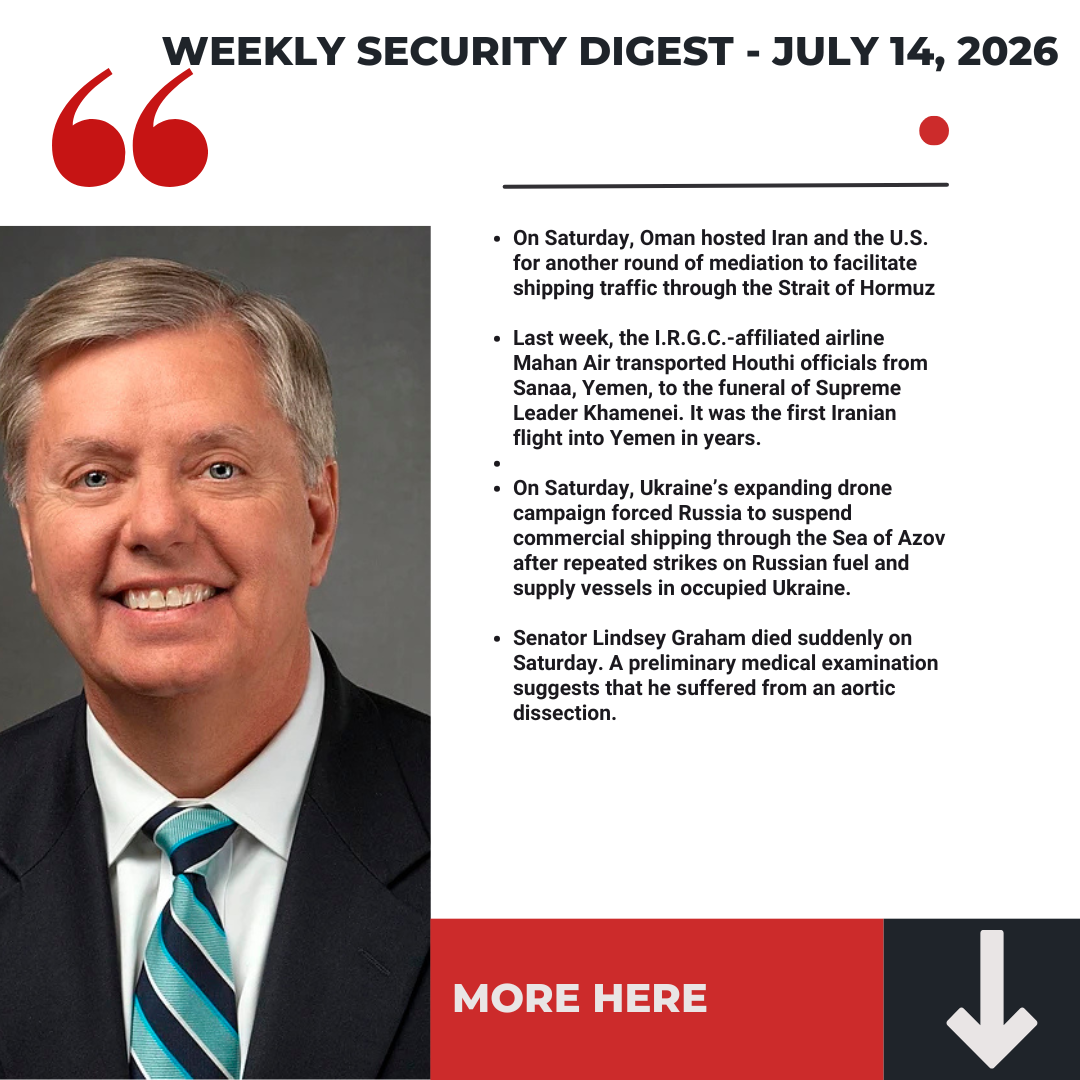
| Middle East → On Saturday, Oman hosted Iran and the U.S. for another round of mediation to facilitate shipping traffic through the Strait of Hormuz. Hours later, Iran fired on another commercial vessel in the Strait, prompting two rounds of U.S. strikes on 140 Iranian military sites. Iran declared the Strait “closed” and launched drone attacks against several Gulf states. Since Saturday, the U.S. and Iran have traded strikes in the region. President Trump promised on Monday to act as “guardian” for foreign vessels passing the Strait and will reintroduce the Iranian blockade on Tuesday afternoon. This weekend’s developments leave the M.O.U. functionally dead. There may still be an active diplomatic process and future deals may be on the horizon, but the M.O.U., whose primary focus was on reopening the Strait of Hormuz, has officially failed. This was predictable, given that the parties opted for vague wording to accelerate progress toward an agreement, leaving the status of the Strait and Iran’s role in it open to interpretation. Despite significant escalation in the last few days, the conflict remains significantly below the threshold of hostilities that existed prior to the M.O.U. The volume of Iranian attacks on the Gulf is lower, and the scope of U.S. strikes is significantly narrower, with very few exceptions focusing on coastal military installations used to threaten shipping in the Strait of Hormuz. Perhaps most notably, Israel has yet to reengage in strikes against Iran alongside the U.S. Most likely, the U.S. has asked Israel to refrain from striking Iran in order to avoid a return to broader regional war, with the Trump administration still hoping for a return to a diplomatic agreement. Trump still views the current strikes as punishment for Iran for violating the M.O.U. and as potentially useful for reducing Iranian leverage in future negotiations. Israel’s operations in the first round of the war focused on the northern half of Iran, with a large number of regime and broader military targets not connected to the Strait. A renewed effort at diplomacy remains more likely than an escalation back toward full-scale U.S.-Israeli war on Iran’s regime. Nevertheless, the current escalation is a strong indication that whether or not a new diplomatic agreement arrives and freezes the conflict again, a long-term resolution to the conflict may remain elusive, making spikes in instability like this one possible, if not probable, for months to come. → Last week, the I.R.G.C.-affiliated airline Mahan Air transported Houthi officials from Sanaa, Yemen, to the funeral of Supreme Leader Khamenei. It was the first Iranian flight into Yemen in years. The I.R.G.C. has historically used Mahan Air to transport weapons and other supplies to regional proxies. The incident prompted fears among Saudi leaders that the occasion could be used as cover for smuggling Iranian weapons into Yemen. In response, Saudi Arabia launched a strike on the Sanaa airport on Monday, for which they reportedly requested U.S. backing. The Houthis subsequently launched missiles over the Saudi border in one of the most significant escalations in the conflict since 2022. International Affairs → On Wednesday, N.A.T.O. leaders concluded their summit in Ankara with several key takeaways. The allies reaffirmed their commitment to collective defense, pledged to expand European defense spending, approved a €70 billion military assistance package for Ukraine through 2027, and emphasized a greater European role in supporting Ukraine. President Trump also met with President Zelenskyy to discuss expanded cooperation on Patriot air defense production. Additionally, N.A.T.O. Secretary-General Mark Rutte left open the possibility of a future alliance role if the conflict in Ukraine expands. Interfor’s team analyzes the threats currently facing N.A.T.O. vis-à-vis Russia for the Interfor blog. → On Thursday, Italy’s Calabria region reaffirmed its commitment to employing Cuban doctors despite growing pressure on the global community from the Trump administration to end participation in Cuba’s overseas medical program. Roberto Occhiuto, president of the region of Calabria, argued that more than 200 Cuban physicians remain essential to addressing severe healthcare staffing shortages in southern Italy, where hospital closures and long waiting times had become increasingly common. U.S. officials have characterized Cuba’s medical missions as exploitative labor arrangements and have urged partner governments to terminate or restructure their agreements. → On Friday, South Korean semiconductor manufacturer S.K. Hynix raised $26.5 billion through its Nasdaq debut, the largest U.S. stock market listing ever completed by a foreign company. Shares rose as much as 17% during their first day of trading, reflecting strong investor demand for companies positioned to benefit from the rapid expansion of artificial intelligence infrastructure. S.K. Hynix said it will use the proceeds to expand advanced semiconductor manufacturing and A.I. capabilities in South Korea. → On Saturday, Ukraine’s expanding drone campaign forced Russia to suspend commercial shipping through the Sea of Azov after repeated strikes on Russian fuel and supply vessels in occupied Ukraine. The campaign is part of Ukrainian efforts to degrade Russia’s logistical capabilities beyond the front line and increase pressure on Moscow by targeting critical maritime and energy infrastructure. Ukrainian officials said the attacks disrupted fuel supplies, military transport routes, and the movement of vessels through the Don-Azov Canal, while also damaging energy infrastructure in occupied Crimea. → On Sunday, the rape and murder of an 11-year-old girl in Baruipur, West Bengal, triggered widespread unrest, mob violence, and political tensions across eastern India. Police killed the primary suspect during a reconstruction of the case after the suspect allegedly attempted to seize an officer’s weapon. The incident has renewed scrutiny of India’s handling of sexual violence, police accountability, and the criminal justice system, while reigniting political disputes in West Bengal over public safety and governance following the state’s recent change in administration. → On Monday, public anger continued to grow across Venezuela over the government’s response to the devastating June 24 earthquakes, which have killed nearly 4,500 people and affected an estimated 1.3 million residents. Survivors and victims’ families accused authorities of delays, poor coordination, and inadequate relief efforts after several confrontations with senior government officials were widely shared on social media. Critics argue that many communities were left to conduct rescue operations with limited official assistance during the critical first days after the disaster, while humanitarian agencies continue to warn of significant shelter, healthcare, and infrastructure needs as recovery efforts progress. United States → Senator Lindsey Graham died suddenly on Saturday. A preliminary medical examination suggests that he suffered from an aortic dissection. The Governor of South Carolina tapped Senator Graham’s sister to replace him in the Senate, pending a special election. Despite official statements to the contrary, Lindsey Graham’s death has sparked a high volume of conspiracy theories alleging that his death was orchestrated by the F.B.I., Russia, or China. |
A Note From Interfor
→ Don Aviv and Sabrina Tan on the increasing threat of cyber attacks in Time Magazine.
| Resources: US Department of State Travel Advisories CISA: nation-state cybersecurity threats and other resources for cybersecurity matters. |
To find out more, please reach out to info@interforinternational.com
Related Blog
VIEW ALL
Geopolitics. Global Security, & Current Events
Interfor International‘s Weekly Security Digest – August 25, 2026
Geopolitics. Global Security, & Current Events
Interfor International‘s Weekly Security Digest – August 18, 2026
Geopolitics. Global Security, & Current Events
Interfor International‘s Weekly Security Digest – August 11, 2026