

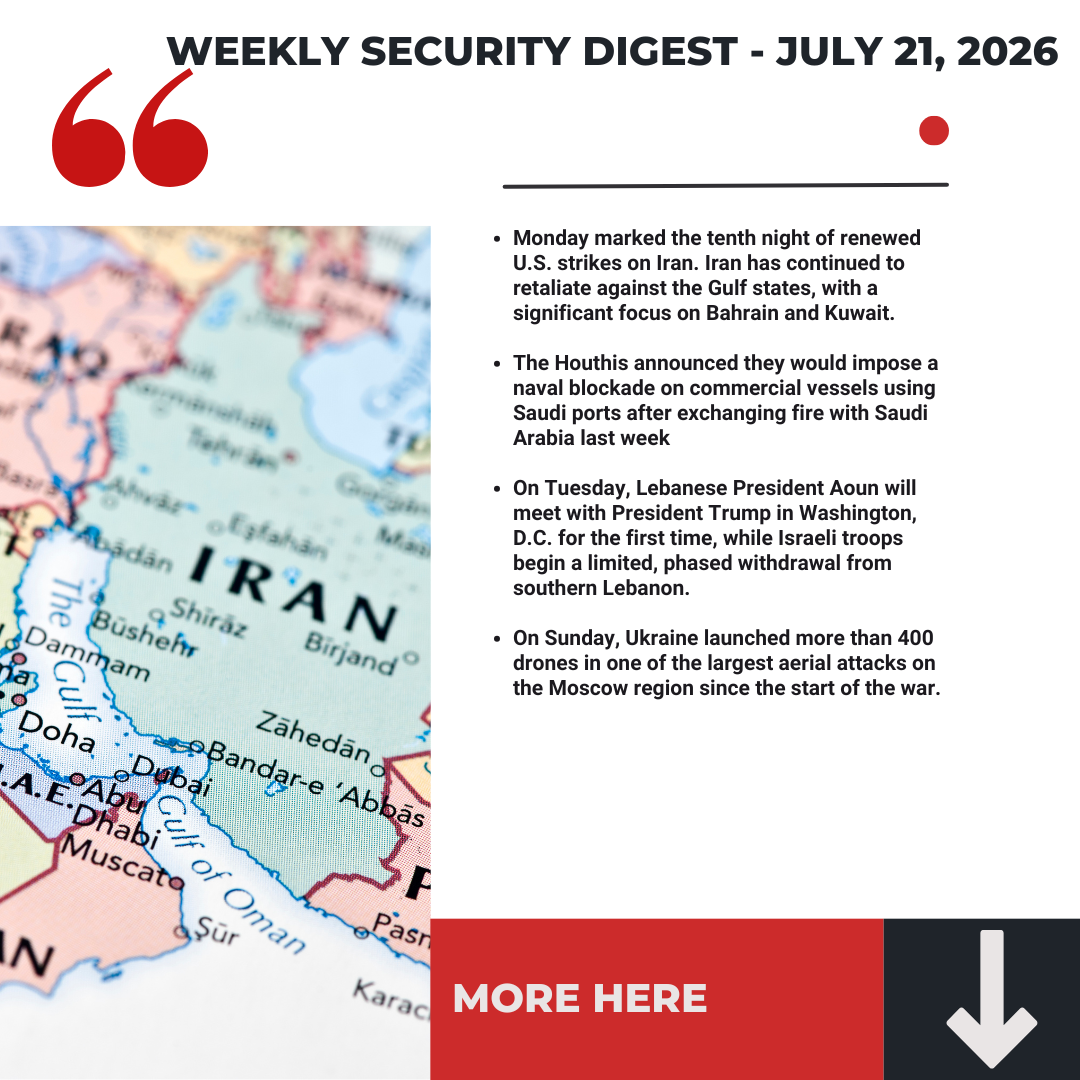
| Middle East → Monday marked the tenth night of renewed U.S. strikes on Iran. Iran has continued to retaliate against the Gulf states, with a significant focus on Bahrain and Kuwait. Third-party mediators (Egypt, Pakistan, and Oman) reportedly proposed a 10-day “cooling off period” to stop hostilities and reopen the Strait of Hormuz. However, President Trump ordered the Pentagon to launch further retaliatory strikes after Iranian missiles killed at least two American service members in Jordan on Saturday. → The Houthis announced they would impose a naval blockade on commercial vessels using Saudi ports after exchanging fire with Saudi Arabia last week. The naval blockade could potentially halt shipping through the Bab al-Mandeb, a key channel for global container shipping and a crucial alternative route for Saudi and other Gulf oil exports with the Strait of Hormuz effectively closed. Riyadh threatened to respond “firmly” and has reportedly initiated protective measures for commercial vessels in the region. Notably, the Houthi announcement focused specifically on Saudi ports on the Red Sea, rather than stopping all trade through the Bab al-Mandeb. This might indicate hesitation to immediately escalate to closing the region’s second strait and drawing ire and airstrikes from the Saudis, Americans, and/or Israelis. It is possible that the Houthi blockade threat was made without genuine resolve and that, via the Omanis, Saudi Arabia might reach an accommodation to dissuade the Houthis from launching new hostilities in earnest. Ultimately, the Houthis have limited interest in taking dramatic action on Iran’s behalf, rather than merely deploying aggressive rhetoric. They still want to avoid reviving full-scale civil war in Yemen and, despite surviving the last rounds of U.S. and Israeli strikes, their economy can ill-afford more damage to port and other infrastructure. → On Tuesday, Lebanese President Aoun will meet with President Trump in Washington, D.C. for the first time, while Israeli troops begin a limited, phased withdrawal from southern Lebanon. The Lebanese Armed Forces (L.A.F.) will replace the I.D.F. in those villages, as per the “pilot zone” agreement. Under the agreement, the L.A.F. is meant to clear these villages of Hezbollah weapons and resources. In Washington, President Aoun is expected to push for military assistance, domestic political support, and U.S. pressure on Israel to remain committed to the deal. International Affairs → On Friday, the European Commission proposed reforms to the European Union’s Emissions Trading System that would provide heavy industry with greater flexibility and additional time to reduce greenhouse gas emissions. Environmental groups and some lawmakers criticized the proposal. The proposed changes include extending free emissions allowances for certain industries, slowing the reduction in available carbon permits, and modifying elements of the carbon market to address concerns over industrial competitiveness and energy costs. The proposal also aims to maintain the E.U.’s target of reducing greenhouse gas emissions by 90% by 2040. → On Sunday, Ukraine launched more than 400 drones in one of the largest aerial attacks on the Moscow region since the start of the war. Ukrainian officials said the strikes targeted logistics hubs, fuel depots, and infrastructure supporting Russia’s military operations in response to continued Russian missile attacks on Ukrainian cities. Russian authorities reported multiple injuries, damage to residential buildings, and fires at several industrial facilities despite claims that their air defenses intercepted the majority of the drones. → On Monday, Andy Burnham formally became the United Kingdom’s prime minister after Sir Keir Starmer resigned. Burnham pledged to pursue a new long-term program focused on economic renewal, and restoring public trust in government. The leadership transition follows growing pressure within the Labour Party after disappointing electoral results under Starmer. Prime Minister Burnham is expected to bring about a significant shift in the government’s domestic agenda while maintaining continuity on key foreign policy priorities. → On Monday, thousands of supporters of India’s Cockroach Janta Party, a youth-led movement demanding education and employment reforms, attempted to march on India’s parliament despite a police ban. Police used tear gas and batons to disperse demonstrators, with reports of multiple injuries and temporary internet restrictions imposed in parts of New Delhi. The demonstrations were initially triggered by alleged examination paper leaks and have evolved into a broader movement highlighting public frustration over youth unemployment and government accountability, calling for Education Minister Dharmendra Pradhan’s resignation. → On Monday, member states of the Economic Community of West African States reaffirmed their support for the proposed Nigeria–Morocco Gas Pipeline, endorsing the project as a strategic initiative to strengthen regional economic integration and access to natural gas across West Africa. The pipeline would transport Nigerian natural gas through multiple West African countries before connecting to Morocco and European markets. → On Tuesday, A.S.E.A.N. foreign ministers met in Manila. The ministers called for an immediate cessation of hostilities in the Middle East and the full reopening of the Strait of Hormuz. Discussions centered on protecting regional energy and trade flows, advancing stalled diplomacy on Myanmar, and accelerating negotiations with China on a maritime code of conduct. United States → On Wednesday, Vice President JD Vance suggested that Jeffrey Epstein had connections to senior U.S. and Israeli intelligence figures during an interview on The Joe Rogan Experience, echoing longstanding conspiracy theories for which he acknowledged there is no conclusive evidence. The comments have renewed debate over the handling of the Epstein case and its intersection with broader discussions of intelligence agencies, government transparency, and U.S.-Israel relations. |
A Note From Interfor
→ Don Aviv and Sabrina Tan on the increasing threat of cyber attacks in Time Magazine.
→ Interfor’s team makes the case that N.A.T.O. faces a subtler threat than invasion.
| Resources: US Department of State Travel Advisories CISA: nation-state cybersecurity threats and other resources for cybersecurity matters. |
To find out more, please reach out to info@interforinternational.com
Related Blog
VIEW ALL
Geopolitics. Global Security, & Current Events
Interfor International‘s Weekly Security Digest – September 1, 2026
Geopolitics. Global Security, & Current Events
Interfor International‘s Weekly Security Digest – August 25, 2026
Geopolitics. Global Security, & Current Events
Interfor International‘s Weekly Security Digest – August 18, 2026