

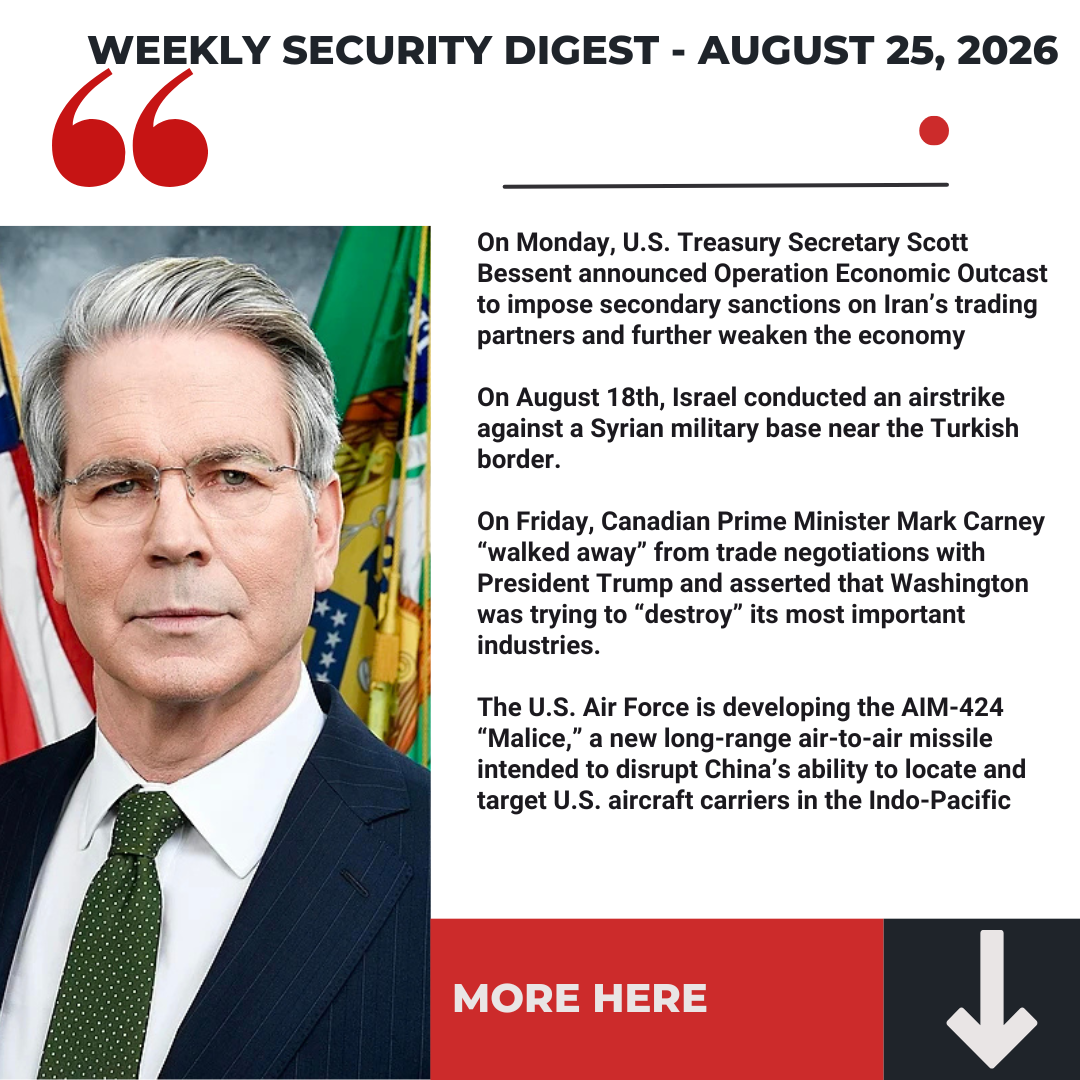
| Middle East → On Monday, U.S. Treasury Secretary Scott Bessent announced Operation Economic Outcast to impose secondary sanctions on Iran’s trading partners and further weaken the economy. Existing secondary sanctions will expand to include digital assets, gold, shipping, and technology. The U.S. has employed a sanctions regime against Iran for several decades but has often stopped short of enforcing these policies on Iran-friendly countries like China, Turkey, and Qatar. Secretary Bessent stated that each country would have a separate timeline to discontinue trade with Iran. Iranian Speaker of Parliament Mohammad Bagher Ghalibaf denied that Washington was economically strong enough to enforce these sanctions. Despite the emphasis on new measures in this announcement, the U.S. blockade on Iran’s oil exports remains the single most potent weapon when it comes to economic pressure. The U.S. may or may not successfully persuade third countries to cut off trade with Iran, but almost entirely suppressing Iran’s oil exports for months, with no clear light at the end of the tunnel, will have a severe effect on Iran’s economy. Central to this strategy is the extended U.S. commitment to this plan. Much of Iran’s leverage comes from a perception that Trump has been desperate for a deal and that Iran can withstand economic pressure longer than the U.S. can. If Trump can prove that he is not concerned about the Strait of Hormuz being closed through the upcoming U.S. election, Iran loses that leverage. In this context, Iran will almost certainly look for ways to increase pressure and restore a sense of urgency for the U.S. to reengage in negotiations that would see the blockade ended. This could mean further Iranian targeting of tankers passing through the Strait of Hormuz or an intensification of Houthi attacks in the Red Sea. → August 18, Israel conducted an airstrike against a Syrian military base near the Turkish border. Israel argues that the attack was a “warning shot” to deter Damascus from allowing Turkey to build up its military presence or establish operations within Syria. Syrian Foreign Minister Al Shaibani denied any such plans. On Sunday, Al Shaibani and Israeli Mossad Director Roman Gofman met to discuss reducing tensions and to safeguard recent months of diplomatic progress. International Affairs → On Friday, Canadian Prime Minister Mark Carney “walked away” from trade negotiations with President Trump and asserted that Washington was trying to “destroy” its most important industries. Carney will announce new tariffs on the U.S. today, following President Trump’s 50% tariff on automobiles, auto parts, and steel. Other Canadian politicians have reacted to public remarks by President Trump and Prime Minister Carney. Ontario Premier Doug Ford is calling for restrictions on key exports to the U.S., including electricity and critical minerals → On Monday, the United Kingdom agreed to share classified technical information on British-made components of the S.C.A.L.P. cruise missile to support plans for production in Ukraine. The decision clears a key obstacle to French-Ukrainian plans to establish local assembly lines for the missile, which is known as Storm Shadow in the U.K. This projectile can strike targets more than 250 kilometers away. Prime Minister Andy Burnham announced the move during a visit to Kyiv, where he also met with President Volodymyr Zelenskyy and other European leaders. However, the missiles are unlikely to be produced in Ukraine before 2027 and Kyiv continues to prioritize additional air defenses against intensifying Russian ballistic missile attacks. → Europol warned that museum thefts across Europe are becoming increasingly violent, with criminals using sledgehammers, axes, firearms, and explosives to access high-value objects. The E.U. law enforcement agency said traditional specialist art-theft networks are increasingly being replaced by decentralized groups of opportunistic criminals, some recruited through social media and messaging platforms on a “crime-as-a-service” basis. Thieves have increasingly targeted gold, jewelry, and other precious objects that can be dismantled or melted down and resold, amid an 85% increase in gold prices over the past two years. Europol cited the October 2025 Louvre heist, during which thieves threatened guards and visitors, and stole approximately €88 million in jewelry, as an example of the evolving tactics. Over the past several months, Interfor has observed an increase in crime-as-a-service incidents in other sectors, most notably in the hired kidnappings of crypto executives in the U.S. and Canada. In both cases, social media, encrypted messaging platforms, and the dark web can facilitate the recruitment of third-party attackers, making attribution more difficult. Though not explicitly linked, the trends in crypto and art theft highlight a critical security shift: institutions or individuals of concentrated wealth may face an increasing level of hybrid cyber/physical/financial targeting. Interfor’s Threat Monitoring Program works to mitigate this vulnerability to the extent possible and welcomes any questions or concerns. → On Friday, a Myanmar military airstrike hit a Buddhist monastery in the central Sagaing region, killing 14 people and injuring at least 20 others during a meditation retreat marking Buddhist Lent. More than 100 people were reportedly attending the retreat when a fighter jet dropped two bombs approximately 15 minutes apart in Myaung township. The military has not commented on the attack, while local resistance fighters alleged that the monastery was deliberately targeted. The strike follows a recent U.N. investigation that reported an increase in aerial attacks against civilians, claims that Myanmar’s government has rejected. → On Friday, the United Nations warned that the Ebola outbreak in the Democratic Republic of the Congo is spreading “exponentially,” with more than 2,500 deaths recorded since the outbreak began in May. Roughly half of those deaths occurred during the previous 20 days, while the virus has spread across six provinces, primarily in the country’s conflict-affected east. The outbreak, caused by the less-studied Bundibugyo strain, is now the largest recorded in the D.R.C., with insecurity, population displacement, and limited health infrastructure complicating containment efforts. The W.H.O. has deployed doses of the Ebola vaccine to the country, although the Ervebo vaccine was developed for the Zaire strain and its effectiveness against Bundibugyo remains uncertain. United States → The U.S. Air Force is developing the AIM-424 “Malice,” a new long-range air-to-air missile intended to disrupt China’s ability to locate and target U.S. aircraft carriers in the Indo-Pacific. Malice is designed to strike aircraft supporting China’s so-called “kill chain,” including airborne early-warning, surveillance, and targeting platforms that relay information needed for long-range missile attacks. The program is part of a broader U.S. effort to weaken China’s anti-access/area-denial network by targeting the sensors and communications systems supporting its missile arsenal. China has invested heavily in long-range anti-ship weapons, but their effectiveness against moving naval targets depends on maintaining continuous surveillance and targeting data. Cyber → Cybercrime experts are warning that scam syndicates across Asia are increasingly investing in agentic A.I., which could allow criminal groups to automate complex fraud operations with limited human involvement. Unlike generative A.I. used to produce scripts, translations, or deepfakes, agentic systems can independently perform multiple tasks and potentially target large numbers of victims across different languages. Transnational online scam losses in the Asia-Pacific region reached an estimated $114 billion in 2025, triple the level recorded in 2023. Experts warn that increased automation could also allow syndicates to operate remotely with fewer workers, reducing their reliance on the large physical scam compounds currently prevalent in Southeast Asia. |
A Note From Interfor
→ Don Aviv and Jeremy Hurewitz on the recent hostage crisis in California in The Hill.
→ Interfor’s team makes the case that N.A.T.O. faces a subtler threat than invasion.
| Resources: US Department of State Travel Advisories CISA: nation-state cybersecurity threats and other resources for cybersecurity matters. |
To find out more, please reach out to info@interforinternational.com
Related Blog
VIEW ALL
Geopolitics. Global Security, & Current Events
Interfor International‘s Weekly Security Digest – October 6, 2026
Geopolitics. Global Security, & Current Events
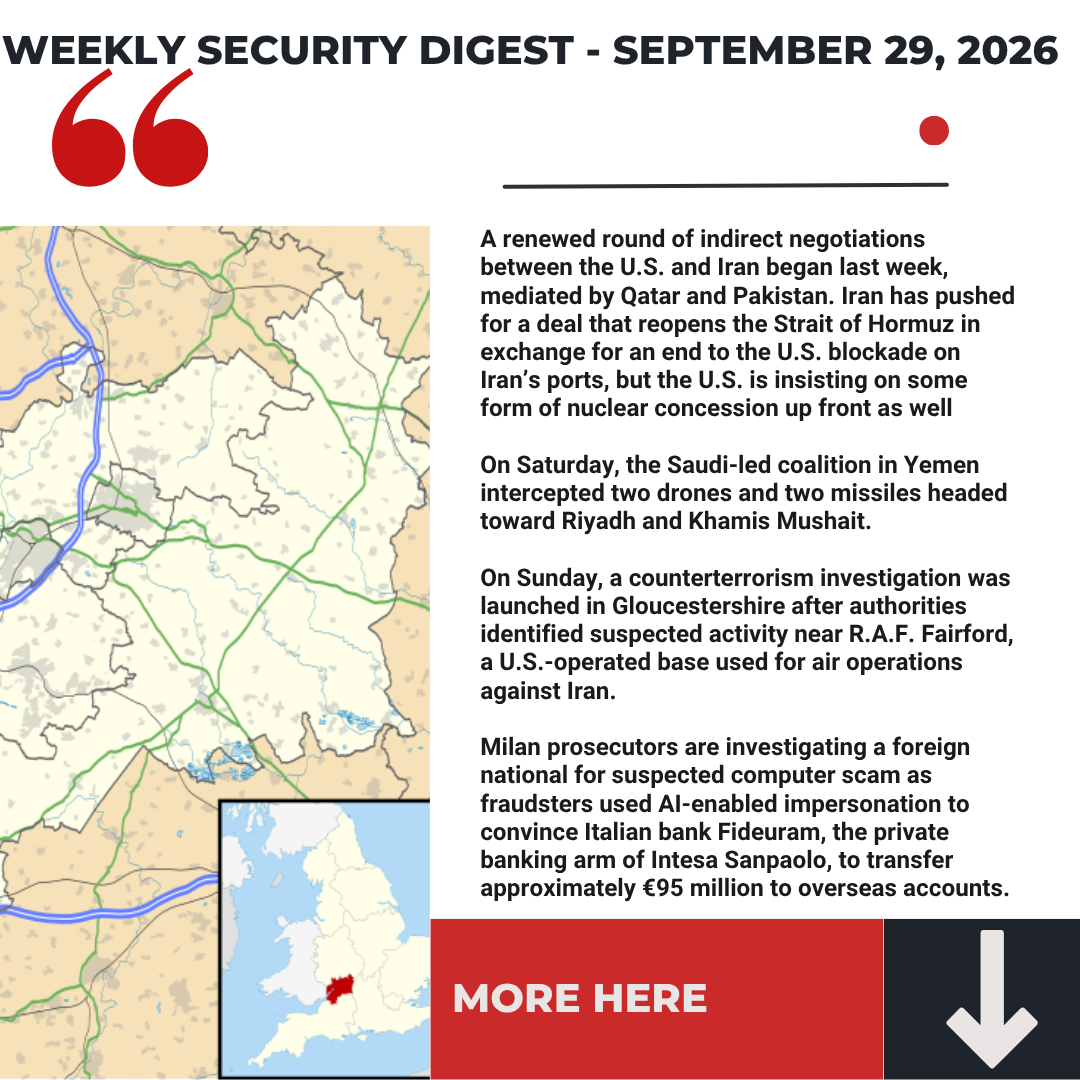
Interfor International‘s Weekly Security Digest – September 29, 2026
Geopolitics. Global Security, & Current Events
Interfor International‘s Weekly Security Digest – September 22, 2026