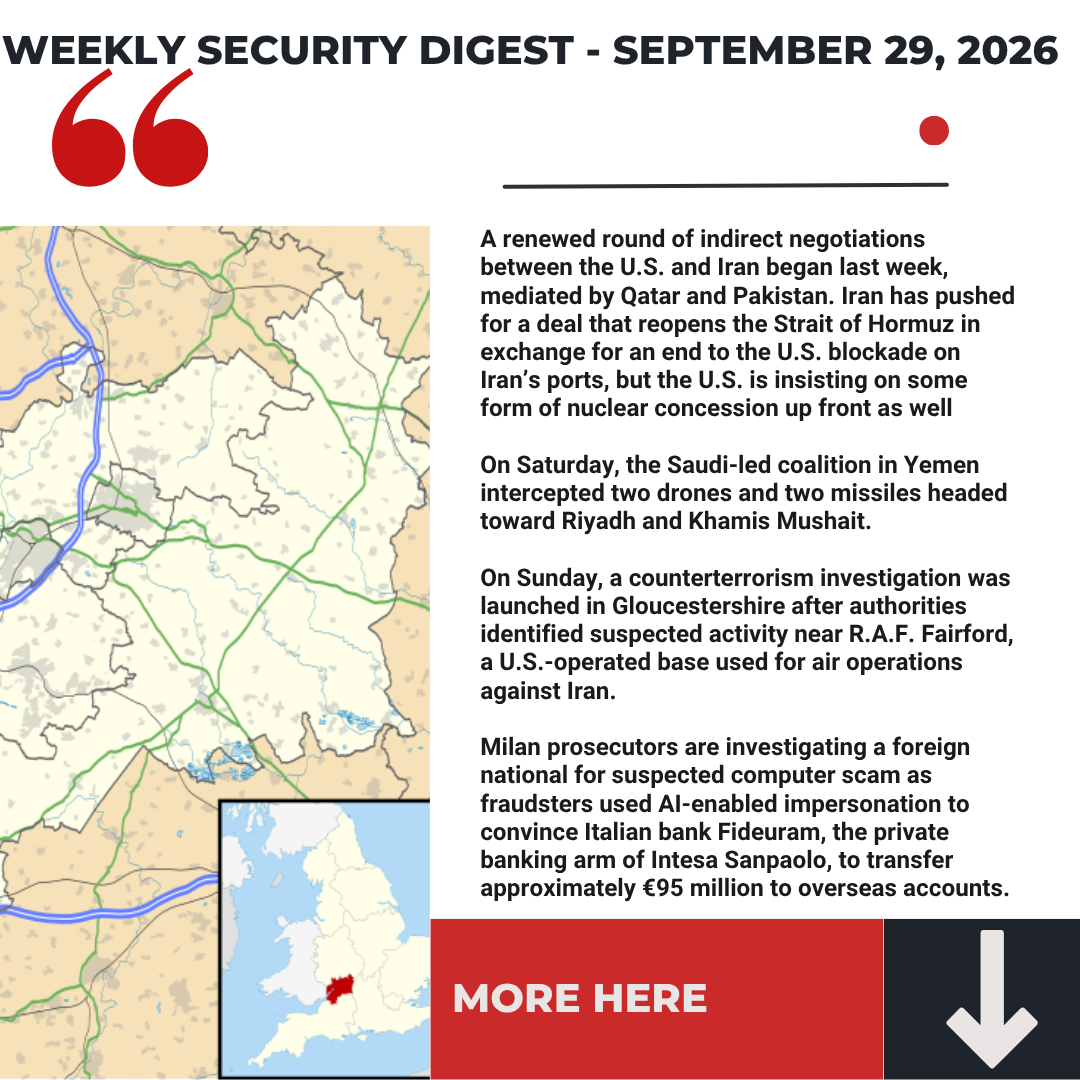


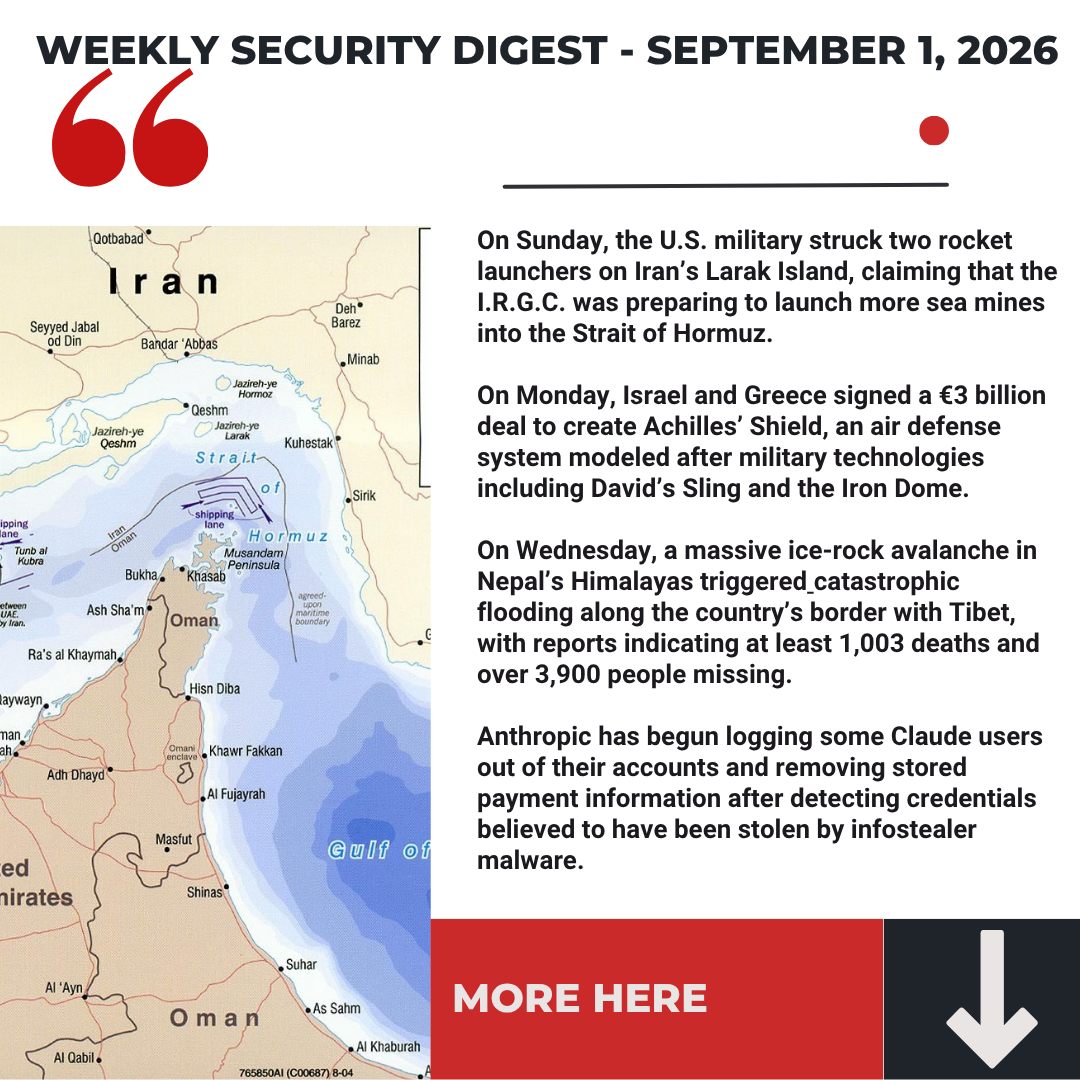
| Middle East → On Sunday, the U.S. military struck two rocket launchers on Iran’s Larak Island, claiming that the I.R.G.C. was preparing to launch more sea mines into the Strait of Hormuz. In response, Iran launched at least eight projectiles toward the U.S. military base in Jordan, all of which were intercepted. Following the attack on a U.S. military site, President Trump is reportedly considering limited strikes on Iran to prevent them from rebuilding the radar and missile systems they need to target shipping in the Strait. However, on Tuesday, Iranian President Pezeshkian claimed that Iran would immediately abide by the terms of the June M.O.U. if Washington did so first. The tide has somewhat turned in recent weeks, with the U.S. claiming much higher numbers of oil tankers are successfully exiting the Strait of Hormuz. As we highlighted last week, Iran will increase its targeting of shipping to try to upset that new status quo and reclaim its leverage. Otherwise, the Islamic Republic would be sitting under a painful blockade indefinitely watching its primary negotiating leverage expire. Still, this escalation is worrisome. If the U.S. does opt to launch a wave of attacks on Iranian military assets aimed at keeping the Strait open – a “mow the lawn” approach – the Islamic Republic may decide to retaliate disproportionately, skipping rungs on the escalation ladder in order to reclaim control over the conflict. This reflects the paradox the U.S. has faced since the beginning of the conflict: When U.S. strategy succeeds – for example, in killing Iran’s top leadership – the Islamic Republic assesses that it faces an existential threat and retaliates with more dramatic measures than expected, imposing a cost the U.S. and its partners were not psychologically prepared to weather. When U.S. strategy fails, Iran gains leverage, pushing a favorable resolution farther out of reach. This unfortunate dynamic is why the Trump administration now prefers to maintain the blockade as its primary means of regaining leverage, effectively a middle course, rather than escalating kinetically. → On Monday, Israel and Greece signed a €3 billion deal to create Achilles’ Shield, an air defense system modeled after military technologies including David’s Sling and the Iron Dome. Over the past several years, Greece had been modernizing its armed forces to protect its naval and territorial interests amid longstanding tensions with Turkey. The deal highlights the growing international interest in Israeli arms exports, which has steadily grown since 2024. Some analysts are also interpreting this deal as Israel investing further in a geopolitical axis to oppose Turkey. Mirroring the recent Mecca agreement linking Saudi Arabia, Pakistan, and Turkey, Israel is enhancing ties with the U.A.E., India, and Greece. Prime Minister Netanyahu has focused more antagonistic rhetoric on Turkey, in particular, in recent months. International Affairs → On Wednesday, a massive ice-rock avalanche in Nepal’s Himalayas triggered catastrophic flooding along the country’s border with Tibet, with reports indicating at least 1,003 deaths and over 3,900 people missing. Scientists believe part of a glacier collapsed into the Lhende Khola river system, temporarily blocking the water before releasing a powerful surge of ice and debris downstream. The flooding destroyed nearly 40 kilometers of roads and several hydropower facilities. Nepal requested assistance from India and China for rescue operations. Researchers are examining whether rising temperatures contributed to the glacier’s instability, as accelerating ice loss and thawing permafrost increase the risk of similar cascading disasters across the Himalayas. → On Saturday, Iceland voted against restarting negotiations to join the European Union, with 52.8% against and 47.2% in favor of a referendum that recorded an 82.5% turnout. The campaign focused primarily on Iceland’s fishing industry and concerns that E.U. membership could reduce national control over fishing grounds and quotas. Prime Minister Kristrún Frostadóttir said following the result that her government would not revisit E.U. membership during its remaining time in office, while Foreign Minister Katrín Gunnarsdóttir said Iceland would instead seek to strengthen its defense relationships on a bilateral basis. → On Monday, President Trump announced additional details of the agreement with Venezuela to develop 17 oil fields. The U.S. government will hold a 35% stake in a new joint venture with North American Blue Energy Partners (N.A.B.E.P.), while securing the right to purchase 20% of the company’s output for the next century. N.A.B.E.P. is expected to invest $100 billion in Venezuela’s oil infrastructure, though this process may be delayed by political uncertainty and deteriorated infrastructure. The agreement comes as Washington seeks to expand its energy resources in the Western Hemisphere. → On Saturday, Zambian authorities charged opposition leader Brian Mundubile with treason, following his detention over activities that allegedly threatened national security. The charges followed a raid on a property linked to Mundubile, during which authorities said they recovered military-grade weapons and equipment. Mundubile has denied allegations that his political group was planning an armed insurgency. Despite these allegations, Mundubile finished second to President Hakainde Hichilema in the August 13 election with approximately 38% of the vote. He rejected the result, alleging electoral fraud. The case has intensified Zambia’s post-election political crisis, with rights groups raising concerns over opposition arrests and access to legal proceedings. → A group of soldiers launched an attempted coup in Niger, attacking President Abdourahamane Tiani’s residence, state television headquarters, and Air Base 101 at Niamey’s international airport. The rebels failed to seize the presidency but took control of the airport for several hours, while parts of the military reportedly hesitated to intervene and at least one battalion refused orders to attack them. Government forces eventually retook the airbase with support from Russian Africa Corps personnel stationed there. The attempted coup comes amid growing frustration within Niger’s armed forces over repeated losses to jihadist groups. Tiani himself seized power in a 2023 coup. → On Monday, Russian Foreign Minister Sergei Lavrov described N.A.T.O.’s growing military presence in the Arctic as a “direct threat” to Russia’s security and warned that Moscow could respond with asymmetric measures. N.A.T.O. launched Arctic Sentry in February to strengthen surveillance and military capabilities in the High North, while Norway has also expanded its Arctic forces amid heightened tensions with Russia. Lavrov warned that increased military exercises near Russia’s northern borders could lead to an armed confrontation. Cyber → Anthropic has begun logging some Claude users out of their accounts and removing stored payment information after detecting credentials believed to have been stolen by infostealer malware. The company said the infections occurred on users’ devices rather than through a breach of Anthropic’s systems, with malware capturing authentication tokens and other credentials that could allow attackers to access Claude accounts. Anthropic is requiring affected users to reset their passwords and reauthenticate before regaining access. The company said the measures are intended to prevent unauthorized Claude usage and fraudulent charges while compromised credentials remain in circulation. |
A Note From Interfor
→ Interfor’s CEO Don Aviv joins cyber firm OSEC for a webinar on inherited security risk on 9/23 at 2 PM ET.
→ Don Aviv and Jeremy Hurewitz on the recent hostage crisis in California in The Hill.
| Resources: US Department of State Travel Advisories CISA: nation-state cybersecurity threats and other resources for cybersecurity matters. |
To find out more, please reach out to info@interforinternational.com
Related Blog
VIEW ALL
Geopolitics. Global Security, & Current Events
Interfor International‘s Weekly Security Digest – October 13, 2026
Geopolitics. Global Security, & Current Events
Interfor International‘s Weekly Security Digest – October 6, 2026
Geopolitics. Global Security, & Current Events
Interfor International‘s Weekly Security Digest – September 29, 2026