

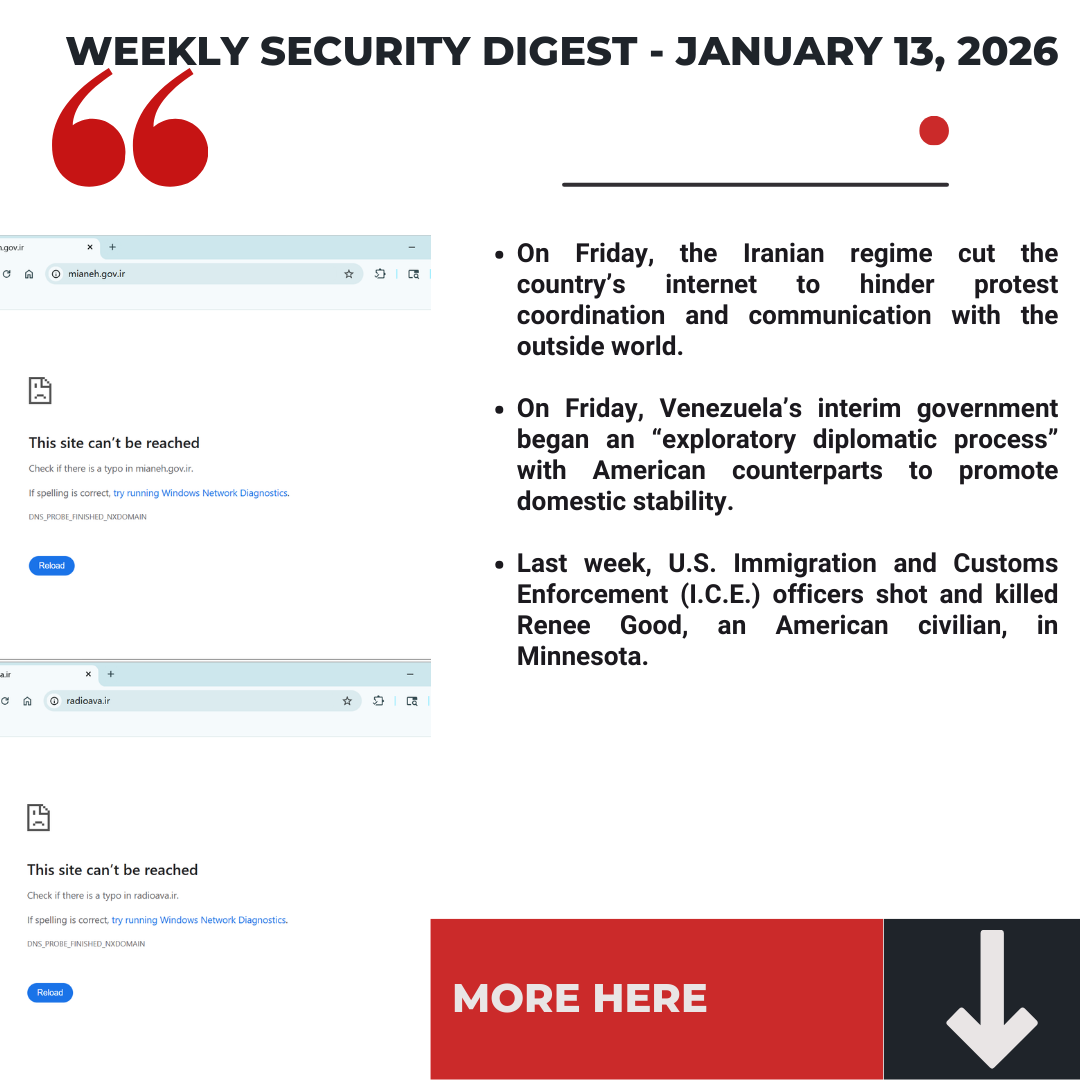
| Middle East → On Friday, the Iranian regime cut the country’s internet to hinder protest coordination and communication with the outside world. The limited reports emerging from the country suggest thousands of protesters have been killed – the regime claims 2,000 deaths, while the anti-regime diaspora outlet Iran International estimates 12,000 dead. On Sunday, President Trump confirmed his team is in contact with Iranian opposition figures (notably, Reza Pahlavi). In addition to its standard countrywide internet cut, the Islamic Republic has had unexpected success using jamming technology to neutralize Starlink terminals. Altogether this means a very slow trickle of news is actually coming out of the country, but we expect videos of bloodshed to get out over the coming days and weeks. Reza Pahlavi, the son of Iran’s last Shah, has gained momentum over the last week. Chants using his name are now common at Iranian protests. This does not mean he has widespread support to take power, but in the absence of other leadership, protesters seem willing to rally around him or at least loudly reference him as a means of frustrating the regime. We are closely watching for any signs that either political or military actors are pushing to remove Supreme Leader Ayatollah Ali Khamenei from power. Past analyses have pointed to the Islamic Revolutionary Guard Corps (I.R.G.C.) as the likeliest force to grab power from Khamenei. In recent months, however, prominent political leaders – for example, former president Hassan Rouhani – have been positioning themselves as possible alternatives. As for likely outcomes for the regime, much depends on how long the protests can sustain momentum in the face of violent repression and whether or not internal or external forces act to alter the regime’s calculus. The likeliest version of regime change remains some sort of internal shift inside the Islamic Republic. Either the I.R.G.C. or the country’s political leadership could theoretically sideline the Supreme Leader and the broader clerical establishment and take control of the government. Other scenarios where the regime falls and is replaced with an entirely new cast of characters, perhaps including Reza Pahlavi, remain unlikely. Our assessment here will only change if we see real signs that members of Iran’s security apparatus are considering defection. → Following Trump’s threat to attack Iran’s regime if they use violence to suppress the protest movement, the Pentagon has presented the President with several military options. Simultaneously, Trump told reporters that he was considering an Iranian request for diplomatic negotiations. Interfor assesses that President Trump has yet to decide on a precise option for intervention in and/or diplomacy with Iran. While the regime has absolutely crossed Trump’s red line regarding repressive violence, the U.S. still does not have a carrier group in the Gulf and is therefore not ideally positioned to initiate what could become multiple exchanges of strikes with Iran. For the moment, we put the likelihood of a U.S. and/or allied attack on the regime in the next two weeks at 50%. We should also note that there is a distinction between the U.S. or its allies attacking with or without a U.S. aircraft carrier in position: if Trump green lights an attack with no carrier nearby, U.S. bases in the Gulf will be at higher risk in the event of an Iranian counterattack. By publicly claiming that the diplomatic option is still on the table, Trump may be playing for time, hoping to slow down the regime’s crackdown and to see what diplomatic options come up, all while the U.S. moves military assets into position. At the same time, the Islamic Republic likely sees Trump’s mention of diplomacy as, if anything, an indication that an attack is under serious consideration. U.S.-Iran talks were days away when Israel and the U.S. bombed the Islamic Republic this past summer. → As part of Operation Hawkeye Strike, the U.S. Central Command conducted a series of strikes against Islamic State targets in Syria on Saturday. These strikes follow similar operations last month, which the U.S. military carried out in response to the murder of two U.S. servicemembers and a civilian translator by Islamic State militants. In November, Syrian President al-Sharaa joined the U.S.-led coalition to fight the Islamic State. Syria is likewise carrying out raids of known Islamic State hubs. International Affairs → On Friday, Venezuela’s interim government began an “exploratory diplomatic process” with American counterparts to promote domestic stability. Several key questions still remain, including whether Venezuela will transition into a democracy, which foreign firms will be involved in Venezuela’s oil industry, and the fate of the country’s political prisoners. Regarding oil, President Trump wants to entice industry giants including ExxonMobil, ConocoPhillips, and Chevron to invest in the country. Exxon CEO Darren Woods expressed skepticism about Trump’s plans and called for durable protections against additional losses, citing fears of further asset seizures by the Venezuelan government. → Tensions between Europe and the United States are heightened due to President Trump’s continued discussion of a U.S. “takeover” of Greenland. Last week, Denmark, France, Germany, Italy, and others released a joint statement reaffirming support for Denmark and Greenland. On Monday, Greenland released its own statement echoing these sentiments. → On Friday, U.S. Treasury Secretary Scott Bessent announced that Argentina had repaid the U.S. for a “currency swap framework” authorized in 2025. The Exchange Stabilization Fund was created to assist Argentina’s struggling economy, helping to increase the value of the peso and strengthening bilateral ties between the two nations. → On Monday, the International Court of Justice (I.C.J.) began hearing arguments and testimony in Gambia’s genocide case against Myanmar. The prosecution argues that Myanmar conducted a “coordinated, scorched-earth campaign” against the Rohingya minority. If the case is successful, it will mark the first time a sovereign nation is held accountable by the I.C.J. for genocide. → On Sunday, President Trump warned Cuba to “make a deal” with the U.S. or Washington will continue to restrict its access to Venezuelan oil shipments. Cuban President Miguel Diaz-Canel criticized Trump via X, blaming Trump for Havana’s economic downslide. President Trump claimed that the two countries were in talks, though Diaz-Canel denies these claims. United States → Last week, U.S. Immigration and Customs Enforcement (I.C.E.) officers shot and killed Renee Good, an American civilian, in Minnesota. The shooting prompted nationwide protests against I.C.E. and the Trump administration, claiming that the agency has too much impunity to harass or harm local populations. One such protest occurred in New York City, attracting a large crowd. Given the recent volume of anti-Trump and anti-I.C.E. activity in New York, this event has the potential to trigger more intense protest activity. Our team is monitoring. |
A Note From Interfor
→ On the one-year anniversary of the French Quarter Attack, please find a note from Interfor’s CEO, Don Aviv.
| Resources: US Department of State Travel Advisories CISA: nation-state cybersecurity threats and other resources for cybersecurity matters. |
To find out more, please reach out to info@interforinternational.com
Related Blog
VIEW ALL
Geopolitics. Global Security, & Current Events
Interfor International‘s Weekly Security Digest – October 6, 2026
Geopolitics. Global Security, & Current Events
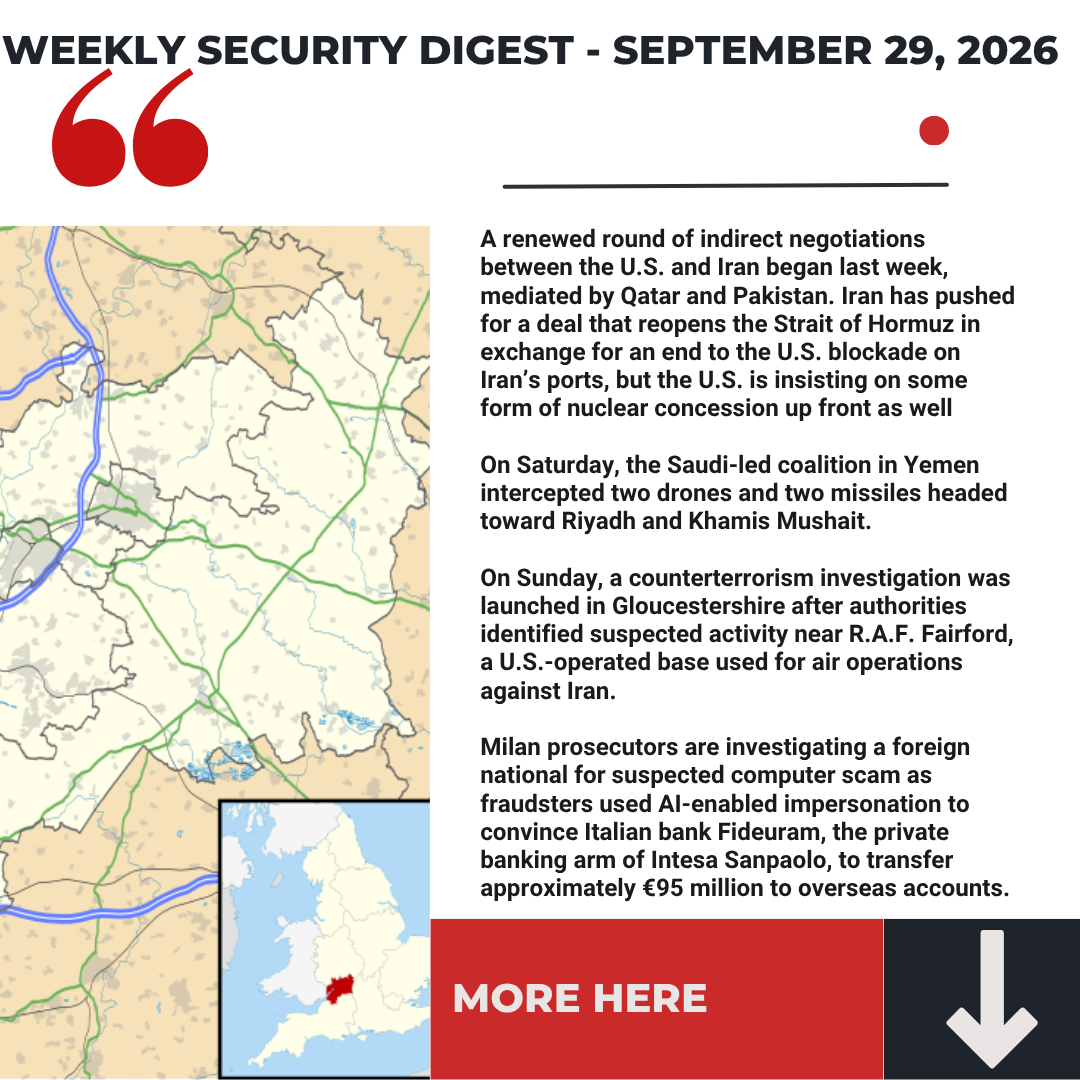
Interfor International‘s Weekly Security Digest – September 29, 2026
Geopolitics. Global Security, & Current Events
Interfor International‘s Weekly Security Digest – September 22, 2026