


| Middle East → Last Wednesday, U.S. forces in the Middle East were awaiting an order from President Trump to attack Iran, but the operation was never greenlit. Trump had threatened to intervene in Iran following reports that the regime had used violent means to suppress widespread popular protests – the regime now estimates 5,000 were killed (up from 2,000 last week), while foreign outlets suggest a higher death toll, as high as 16,500. Trump was reportedly dissuaded from launching the attack following counsel from Israel and his military advisors suggesting that a U.S. attack was far from guaranteed to bring about the regime’s collapse. The leadership of Oman, Qatar, and Saudi Arabia also actively lobbied Trump against the strike, citing the potential for escalation across the region. Interfor assesses a 40% likelihood that President Trump will still opt to attack regime targets in Iran in the next few weeks. Following his decision not to launch an immediate attack last week, Trump ordered a U.S. carrier group to move from the South China Sea to the Middle East. At minimum, this was intended to signal to the Islamic Republic that the military option was still on the table. Alternatively, last week’s last-minute reversal could be seen as Trump playing for time, lulling Iran’s leadership into a false sense of security while the U.S. put a carrier group into position to launch a more sophisticated offensive and defensive operation. Interfor assessment: Trump remains undecided regarding attacking Iran. He wants a quick win, like the Maduro capture operation, and he is unconvinced that such a thing is currently possible in Iran. Last week’s pull-back was a genuine change of direction, not misdirection. Once the U.S. carrier group is in position, Saudi, Qatari, and Israeli concerns about Iran’s counterattack may partially subside. While that does reduce resistance to the U.S. attack plan, Trump will still need to be convinced that a U.S. military operation has a high percentage chance of succeeding in either toppling the regime or achieving some more limited, but still worthwhile goal. Iran’s protesters and their supporters abroad are demoralized following the regime’s crackdown and Trump’s failure to follow through on his promise of “help on the way.” The protests themselves have slowed significantly, and the regime has kept security forces on the streets to discourage further gatherings. At the same time, Iran has been without internet for almost two weeks, which is critical: without internet access, Iranians cannot get footage of the regime’s violent crackdown out of the country. If more of that footage made it onto global TV news, Trump might again feel pressured to act. Various government and private efforts are underway to get more Starlink terminals into Iran, but even still, internet access in the country remains below 1% of its normal levels. → On Friday, President Trump invited dozens of world leaders to join his Board of Peace to oversee the ceasefire in Gaza. Each nation must contribute at least $1 billion U.S.D. for permanent membership. Though the U.N. initially approved the Board, the charter’s release drew criticism from several states, including France, that the Board is an attempt to compete with the U.N. The language of the charter expands its mandate beyond Gaza and enshrines a U.S. veto on all key decisions. Additionally, Prime Minister Netanyahu publicly denounced Washington’s plan to include Turkey and Qatar on the Executive Committee of the Board on Friday. President Trump will host a gathering in Davos on Thursday for all Board members. → Last week, Syrian military forces pushed into Kurdish-held territory, capturing wide regions of northeast Syria and forcing the Kurdish-led Syrian Democratic Forces (S.D.F.) commander Mazloum Abdi to negotiate for a deal. However, Syrian and Kurdish forces clashed again on Monday. The U.S. has historically backed the S.D.F., but President Trump’s endorsement of Syrian President Ahmed al-Sharaa has put American support for the Kurds in doubt. International Affairs → President Trump will arrive in Davos on Tuesday, where he is expected to speak on domestic affordability, Greenland, and the Gaza Board of Peace. Washington’s push to control Greenland is dominating much of the conversation. Trump recently threatened to impose tariffs on European countries supporting Denmark’s sovereignty over Greenland, prompting backlash from European leaders including European Commission President Ursula von der Leyen, who threatened the U.S. in kind. President Trump will meet with European counterparts on Thursday to discuss the matter further. → On Tuesday, British Prime Minister Keir Starmer approved the construction of a new Chinese embassy in London. China purchased the land near London’s financial district in 2022, but British officials blocked construction of an embassy due to espionage concerns. Some British officials continue to sound the alarm. Starmer, however, considers improving diplomatic relations with Beijing a foreign policy priority. He is due to travel to China later this month, in the first such trip by a British head of government since 2018. A court ruling may still block the embassy. → Russia and Ukraine are trading strikes on each other’s energy grids, leaving hundreds of thousands vulnerable to freezing temperatures and illness. On Friday, Ukraine’s Energy Minister Denys Shmyhal argued that Russian strikes were “weaponizing winter,” while Yevgeny Balitsky, Governor of Russian-occupied south Zaporizhzhia, lobbed similar accusations. After weeks of stalled negotiations, President Zelenskyy will meet with President Trump and European leaders this week in Davos. Separately, Steve Witkoff and Jared Kushner will meet Russian envoy Kirill Dmitriev on Tuesday. → Paul Henri Damiba, ousted President of Burkina Faso, was arrested by Togolese authorities on Saturday for allegedly plotting a coup against Burkina Faso’s current leader, Ibrahim Traore. Damiba fled to Togo in 2022 after Traore, then leading the military, led a coup against him. → On Monday, India and the United Arab Emirates agreed to double bilateral trade by 2032. The agreement is likely an attempt to ensure economic stability in a moment of regional chaos. Key areas of cooperation include defense technology, natural resources, and emerging technologies. |
A Note From Interfor
→ On the one-year anniversary of the French Quarter Attack, please find a note from Interfor’s CEO, Don Aviv.
| Resources: US Department of State Travel Advisories CISA: nation-state cybersecurity threats and other resources for cybersecurity matters. |
To find out more, please reach out to info@interforinternational.com
Related Blog
VIEW ALL
Geopolitics. Global Security, & Current Events
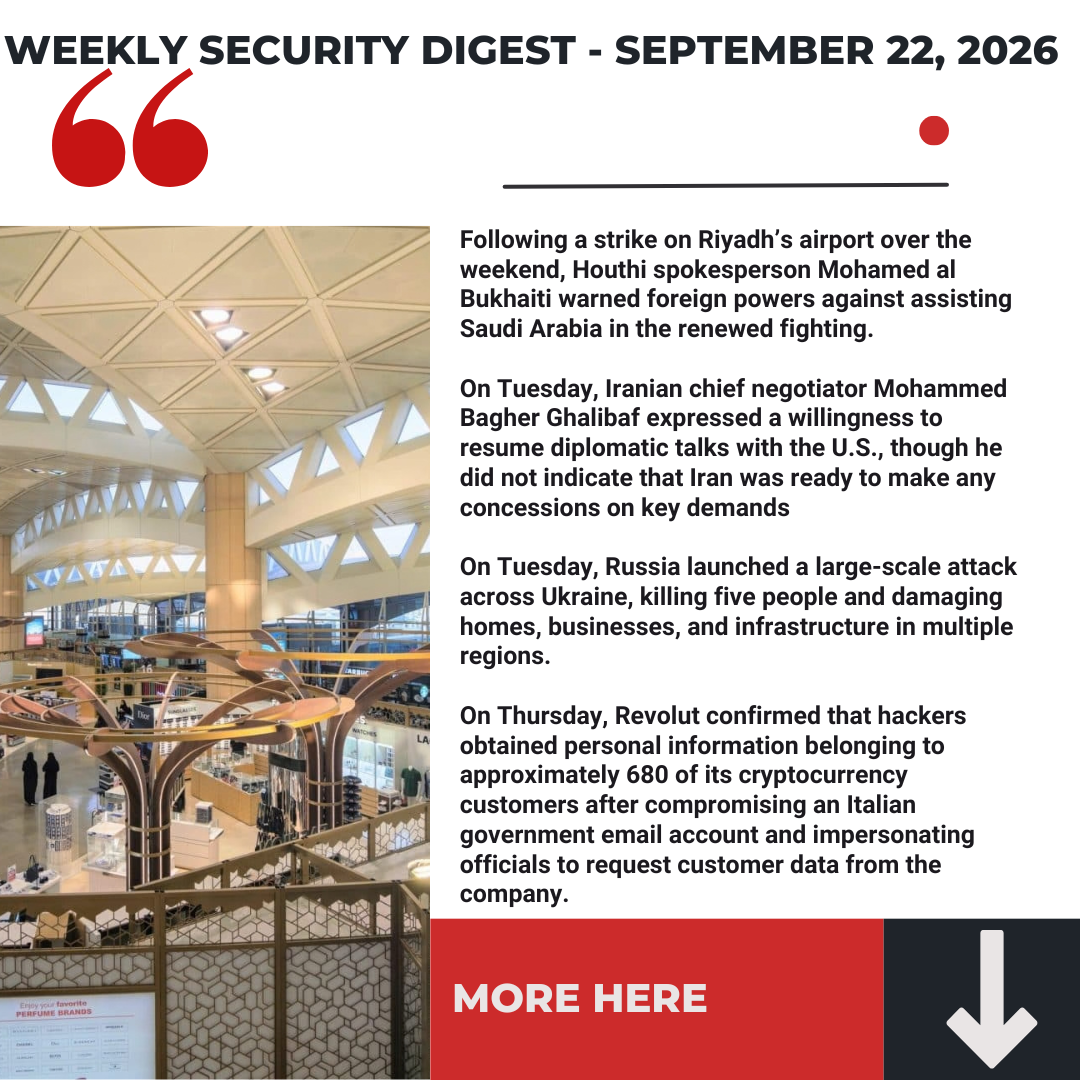
Interfor International‘s Weekly Security Digest – September 22, 2026
Geopolitics. Global Security, & Current Events
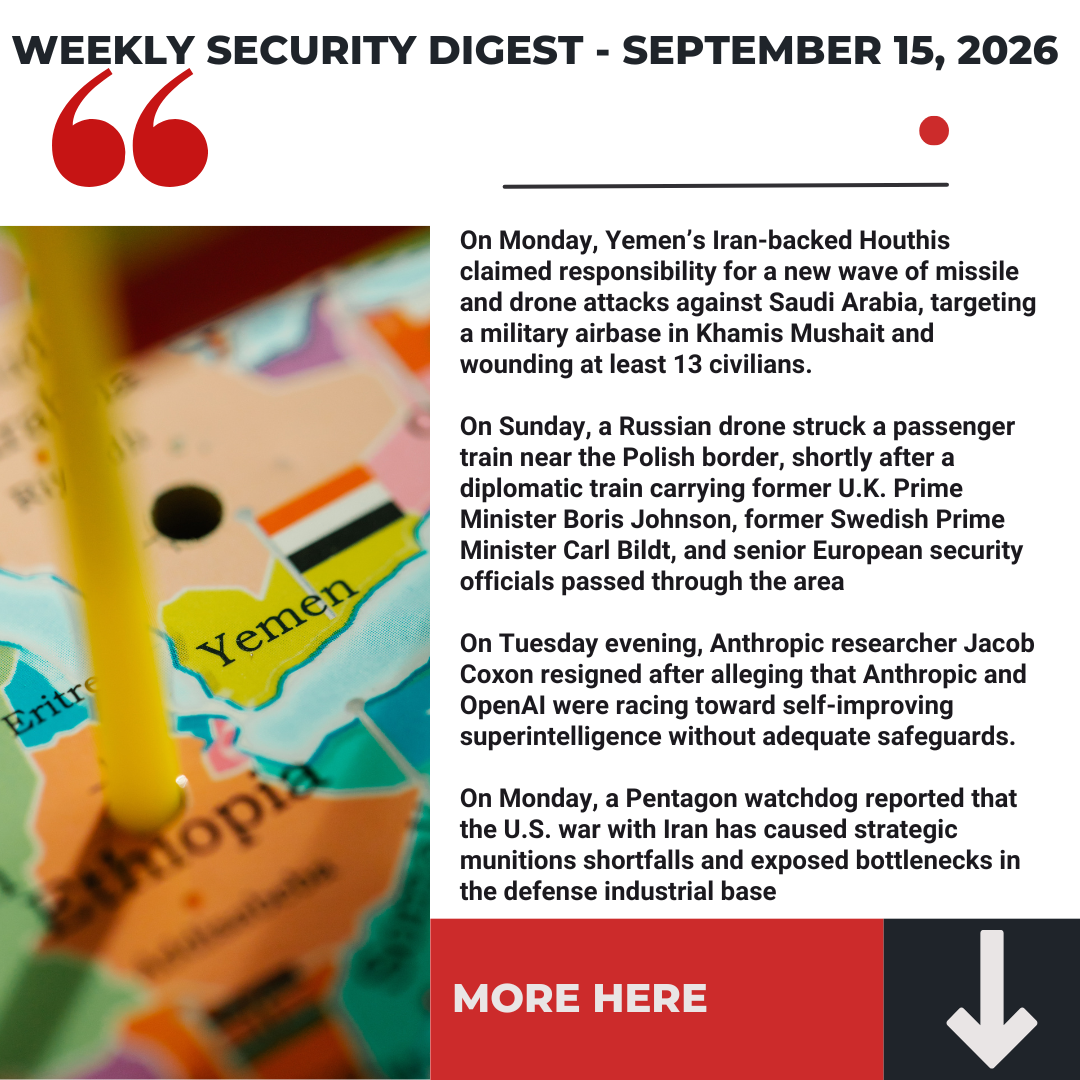
Interfor International‘s Weekly Security Digest – September 15, 2026
Geopolitics. Global Security, & Current Events
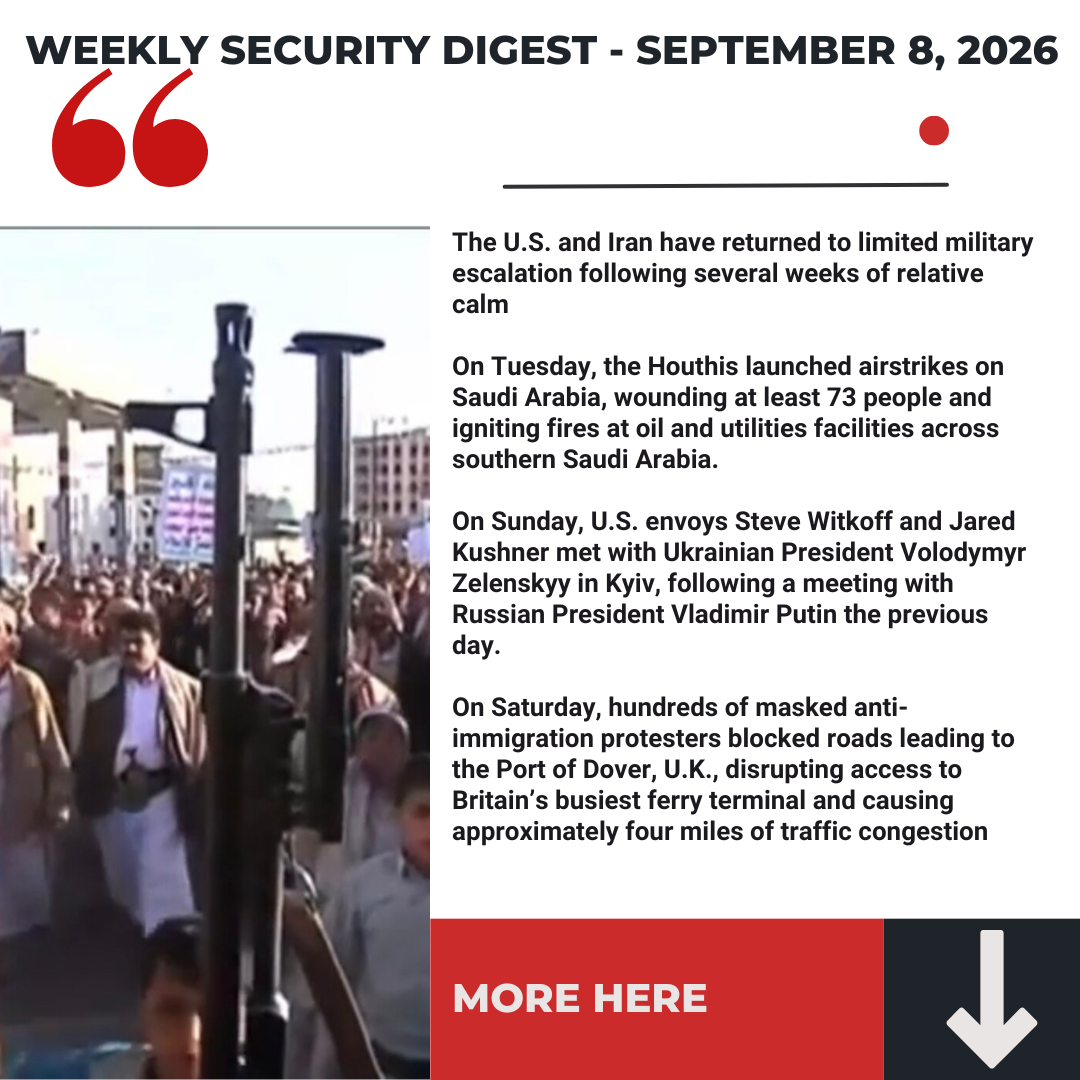
Interfor International‘s Weekly Security Digest – September 8, 2026