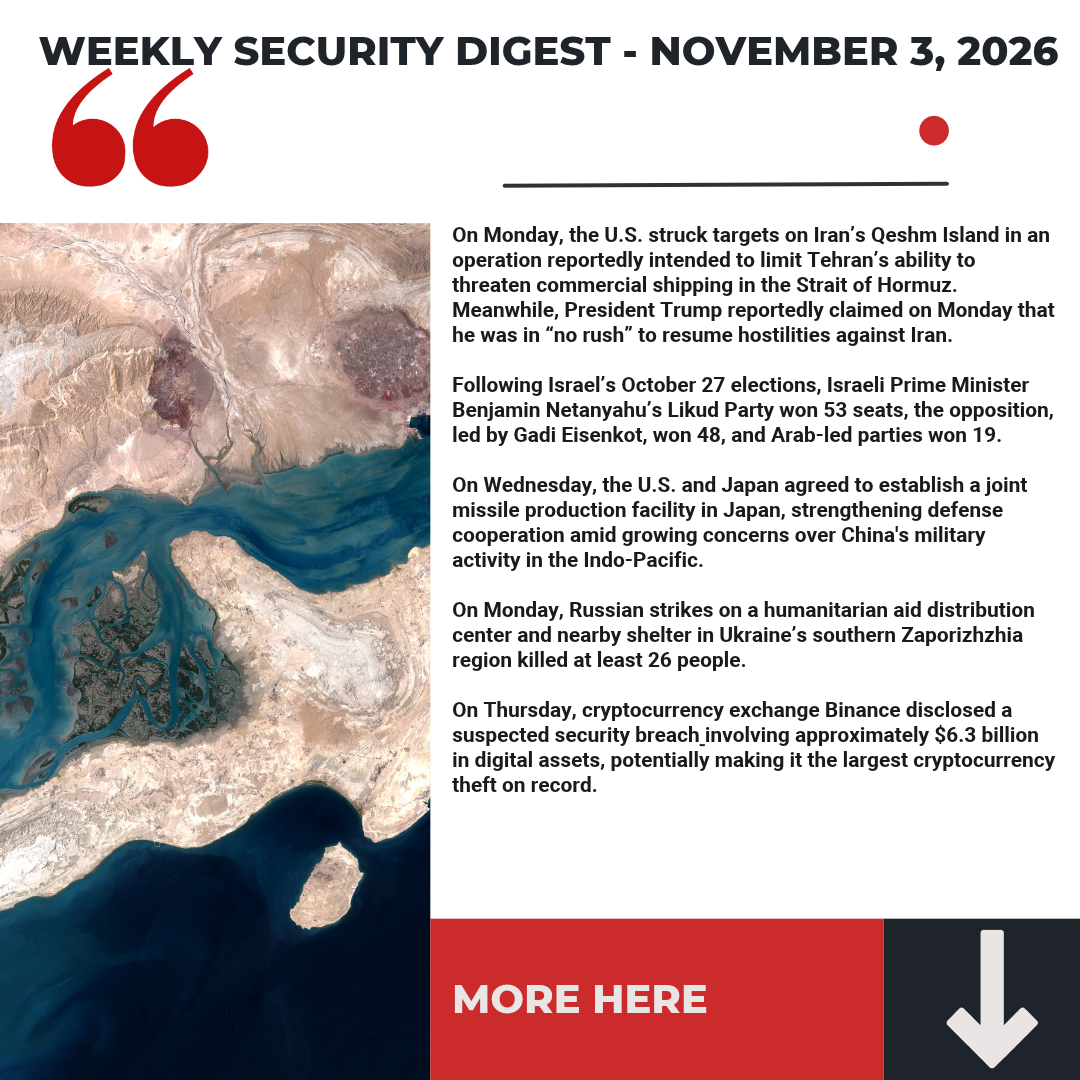


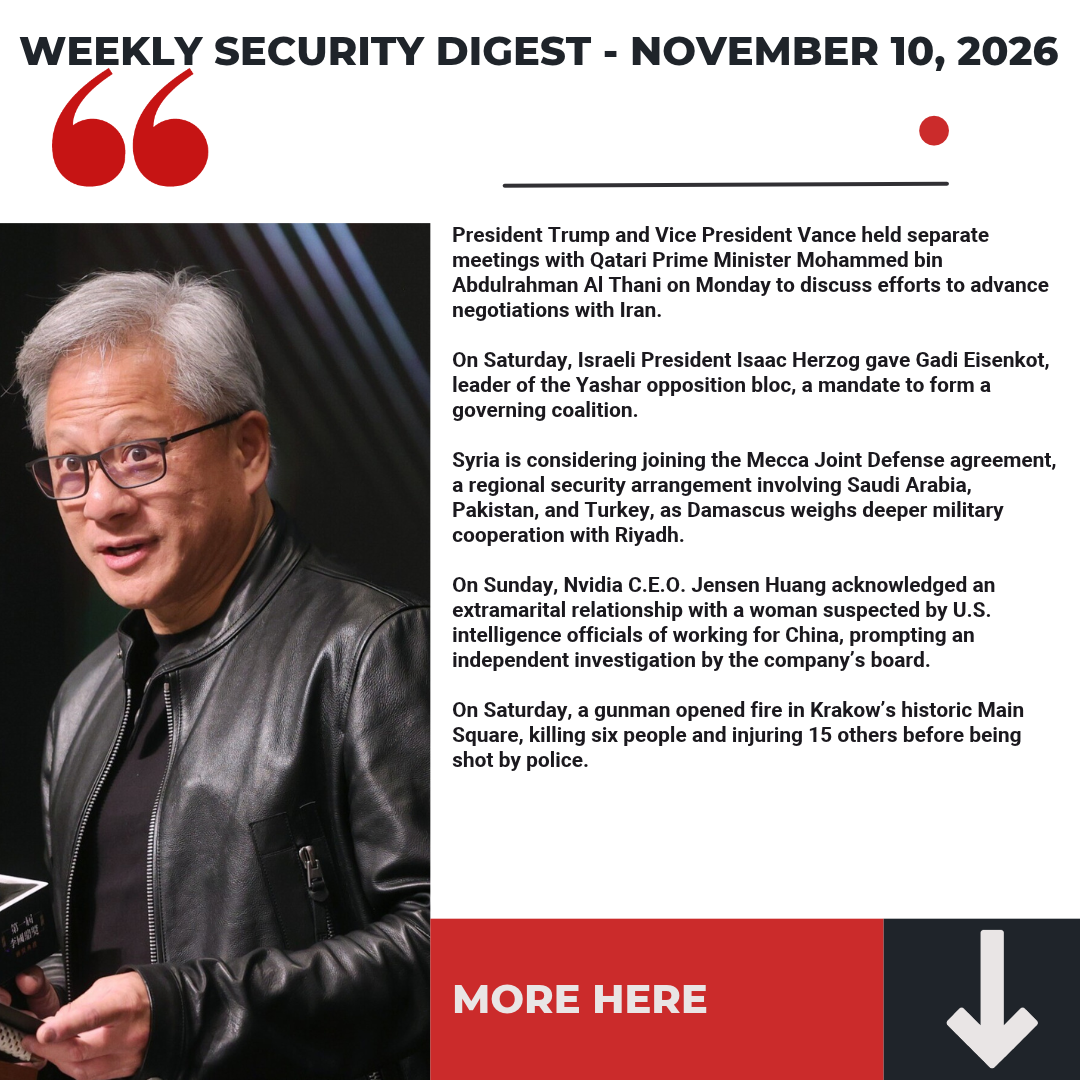
| Middle East → President Trump and Vice President Vance held separate meetings with Qatari Prime Minister Mohammed bin Abdulrahman Al Thani on Monday to discuss efforts to advance negotiations with Iran. Trump later posted to Truth Social that a resumption of military conflict was “quite unlikely,” though the U.S. will maintain its military posture in the region. He has not indicated a willingness to remove the naval blockade but is reportedly reviewing two Qatari proposals regarding Iran’s nuclear program. While the risk of escalation remains, Trump is for the moment signaling a holding pattern, within which the U.S. will continue the blockade on Iran and occasionally fire on Iranian military sites used to target shipping in the Strait. Over the past two weeks, it became clear that while factions inside the White House were at odds over escalating the war (led by Defense Secretary Pete Hegseth) vs. leaning into diplomacy (led by Vice President J.D. Vance), another group, led by Secretary of State Marco Rubio and C.I.A. Director John Ratcliffe, was promoting a middle route, focused on maintaining the blockade until Iran’s willingness to make diplomatic compromises increased. Trump now appears to favor that middle route. We are unsurprised by this apparent shift. As we noted last week, Trump has backed down from threats to escalate on multiple occasions since April, citing diplomatic prospects. The Gulf states have serious, merited, concerns about potential Iranian retaliation on their territory following a U.S. escalation. And despite his boisterous rhetoric, Trump has proven to be far from impulsive when it comes to decisions to launch major military operations. With major consequences on the table and no guaranteed political gain, Trump likely sees a continuation of the status quo – keeping open the prospect of victory and postponing any allegations of a U.S. defeat – as his best option. → On Saturday, Israeli President Isaac Herzog gave Gadi Eisenkot, leader of the Yashar opposition bloc, a mandate to form a governing coalition. He has 28 days to do so, with the possibility of a 14-day extension. Eisenkot stated following the announcement that he seeks to build a national emergency government, though to secure enough seats he will need to include either the Arab or ultra-Orthodox parties. Both options would require him to compromise on major campaign promises. Additionally, the full Knesset was sworn in on Tuesday, with Member of the Knesset (M.K.) Matan Kahana expected to be sworn in as the new Speaker of Knesset within the next week. → Syria is considering joining the Mecca Joint Defense agreement, a regional security arrangement involving Saudi Arabia, Pakistan, and Turkey, as Damascus weighs deeper military cooperation with Riyadh. The discussions come as Saudi Arabia seeks support in countering Houthi threats along its border with Yemen. Syria is reportedly preparing to send approximately 600 fighters to Saudi Arabia, where they would reinforce border security, while Syrian military personnel have already been involved in training and advisory activities. The potential deployment would mark an expansion of Syrian-Saudi security cooperation, although Damascus has not confirmed a decision to join the agreement. International Affairs → On Sunday, Nvidia C.E.O. Jensen Huang acknowledged an extramarital relationship with a woman suspected by U.S. intelligence officials of working for China, prompting an independent investigation by the company’s board. U.S. officials reportedly believe the woman sought information and potentially attempted to influence Nvidia’s efforts to expand advanced A.I. chip sales to China. Nvidia’s board stated that it had no evidence to believe company secrets or national security had been compromised, while Huang pledged to cooperate with the investigation and remain in his role. The allegations raise concerns over foreign intelligence targeting of senior technology executives and potential implications for U.S.-China semiconductor trade restrictions. → On Thursday, a Hong Kong court sentenced prominent pro-democracy activist Joshua Wong to 10 years in prison under the city’s national security law. Wong, already imprisoned since 2020, pleaded guilty to conspiring with overseas activists to lobby foreign governments for sanctions against China and Hong Kong. The ruling drew criticism from the U.S. and human rights organizations, which accused Beijing of using national security legislation to suppress political opposition. Chinese authorities defended the sentence, maintaining that Wong’s activities threatened national security. → On Thursday, reports cited a confidential U.N. report alleging that a U.A.E.-linked security company recruited Colombian mercenaries to fight alongside Sudan’s Rapid Support Forces (R.S.F.), a paramilitary group accused of genocide and widespread atrocities. Investigators reportedly traced the fighters’ deployment through Libya and Somalia. The findings add to longstanding allegations that Abu Dhabi has supplied military assistance to the R.S.F., which the U.A.E. denies. The report could complicate the candidacy of Emirati diplomat Lana Nusseibeh for U.N. secretary-general, given her previous role in rejecting allegations of U.A.E. involvement in Sudan’s civil war. → On Friday, environmental activists entered a Microsoft data center construction site in Amsterdam, climbing cranes and setting off flares. The demonstration, organized by Dutch activist group Geef Tegengas, opposed the facility’s environmental impact and Microsoft’s involvement in Israeli military operations. Police intervened and detained approximately 150–200 protesters. The incident formed part of broader European demonstrations against data center expansion, raising concerns over potential disruptions to construction sites and technology infrastructure. → On Saturday, a gunman opened fire in Krakow’s historic Main Square, killing six people and injuring 15 others before being shot by police. Authorities have opened a terrorism investigation, stating that the 24-year-old suspect held far-right extremist views. Police subsequently discovered three additional bodies at his family home. The attack, one of Poland’s deadliest mass shootings in recent history, prompted national mourning and heightened security measures in Warsaw, raising concerns over extremist violence in public spaces. → On Sunday, Pope Leo XIV arrived in Argentina for the first papal visit in nearly four decades, amid tensions between the Catholic Church and President Javier Milei over his austerity policies. During an address to Argentine officials and civil society representatives, the Pope urged political leaders to respect democratic institutions and ensure economic growth benefits vulnerable populations. The remarks were interpreted by some as criticism of Milei’s spending cuts, which have reduced social services despite lowering inflation. → On Tuesday, North Korea accused U.N. Secretary-General António Guterres of siding with South Korea after he called on both countries to resume dialogue following a September landmine explosion in the Demilitarized Zone that injured three South Korean soldiers. Kim Yo Jong, sister of North Korean leader Kim Jong Un, rejected Seoul’s accusations that North Korean mines caused the blast and defended Pyongyang’s border fortification activities. The dispute has further strained inter-Korean relations, raising concerns over potential military escalation. → On Monday, a large-scale Russian drone attack hit Ukrainian electrical substations in the Kyiv, Dnipropetrovsk, Cherkasy, and Vinnytsia regions. President Zelenskyy announced that the European Union agreed to special emergency mechanisms in order to expedite funding for power grid repairs. In Odessa, a food distribution center for public schools and kindergartens was also targeted, killing at least three people. Ukraine responded to attacks on its infrastructure, striking targets outside St. Petersburg, including the KINEF oil refinery and a factory involved in producing propellant for Russian Iskander missiles. These attacks come ahead of U.S.-mediated peace talks in Abu Dhabi beginning today. Cyber → French authorities accused Iran’s Islamic Revolutionary Guard Corps (I.R.G.C.) of orchestrating a cyberattack that disrupted refrigeration systems at approximately 700 supermarkets in October. Hackers reportedly manipulated refrigeration systems remotely, causing widespread food spoilage and equipment damage. France summoned Iran’s ambassador and announced plans to pursue European sanctions, while prosecutors opened an investigation into an I.R.G.C.-linked cyber unit. Similar incidents were reported in other European countries, although any connection remains unconfirmed. |
| Resources: US Department of State Travel Advisories CISA: nation-state cybersecurity threats and other resources for cybersecurity matters. |
To find out more, please reach out to info@interforinternational.com
Related Blog
VIEW ALL
Geopolitics. Global Security, & Current Events
Interfor International‘s Weekly Security Digest – November 10, 2026

Geopolitics. Global Security, & Current Events
Interfor International‘s Weekly Security Digest – November 3, 2026