

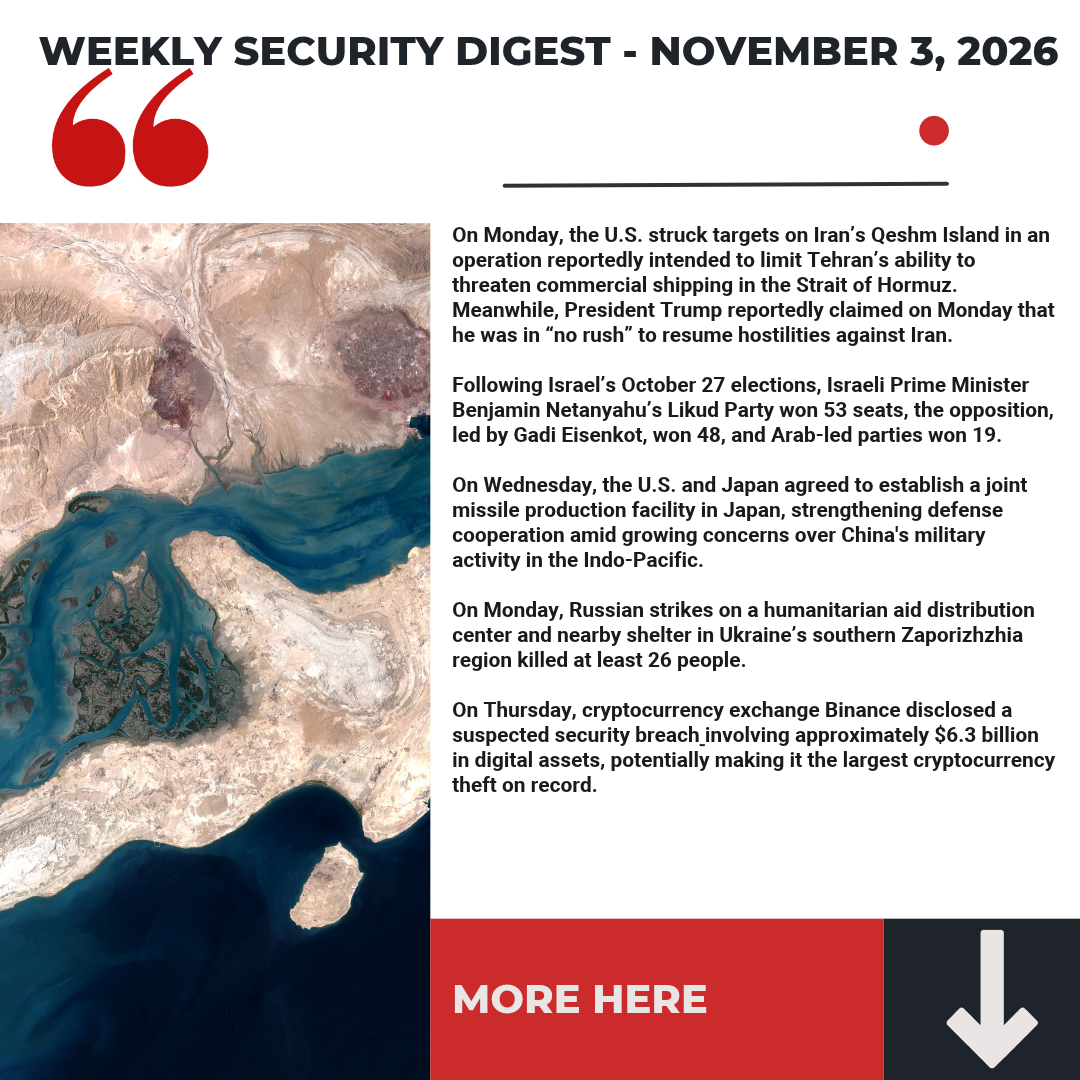
| Middle East → On Monday, the U.S. struck targets on Iran’s Qeshm Island in an operation reportedly intended to limit Tehran’s ability to threaten commercial shipping in the Strait of Hormuz. Meanwhile, President Trump reportedly claimed on Monday that he was in “no rush” to resume hostilities against Iran. However, the U.S. military is strengthening its regional posture by restocking munitions and moving personnel from vulnerable bases ahead of a potential larger campaign. Gulf states are also preparing for possible Iranian retaliation. Qatari mediation efforts continue amid competing demands, with Washington seeking nuclear concessions and Tehran demanding the lifting of the U.S. naval blockade, release of frozen funds, and permission to resume oil sales. The consensus remains that escalation between the U.S. and Iran will become more likely after today’s election. However, we assess an increasing probability that Trump will cite claimed diplomatic progress as a reason to delay attacks. He has repeatedly backed down in this fashion since he made similar threats against Iranian infrastructure in the first phase of the war. Fundamentally, little has changed since April. U.S. attacks on Iran’s energy industry would likely provoke Iranian retaliation against parallel infrastructure in the Gulf states, which is seen across the region as an unacceptable outcome. That is why we are seeing such an intense flurry of diplomacy from Qatari mediators ahead of the potential U.S. escalation. Nevertheless, the U.S. has continued to prepare for a new offensive against Iran, with additional military hardware arriving in the region. Moreover, regardless of how the dust settles on the Israeli election, Netanyahu will continue to push for a new attack against Iran. Altogether, we still assess a U.S. escalation against Iran as likely in the coming weeks and months, but Trump could very well delay planned strikes at least once and/or moderate attack plans in hopes of limiting the scope and severity of Iran’s response. → Following Israel’s October 27 elections, Israeli Prime Minister Benjamin Netanyahu’s Likud Party won 53 seats, the opposition, led by Gadi Eisenkot, won 48, and Arab-led parties won 19. Without any party securing a majority (61), both Likud and the opposition bloc are negotiating for a potential coalition, to likely include either the Arab parties or the Jewish religious right, respectively. Likud alleged late last week that Arab-led parties manipulated the October 27 election through Qatari-funded electoral fraud. The allegations follow historic voter turnout among Arab citizens of Israel. The Central Elections Committee rejected Likud’s claims and stated that the results will stand until any allegations are substantiated. International Affairs → On Wednesday, the U.S. and Japan agreed to establish a joint missile production facility in Japan, strengthening defense cooperation amid growing concerns over China’s military activity in the Indo-Pacific. Japanese Defense Minister Shinjiro Koizumi and U.S. Defense Secretary Pete Hegseth also reaffirmed their commitment to strengthening regional deterrence, while Washington proposed expanding maritime security cooperation with Southeast Asian nations. The agreement comes amid continued tensions in the South China Sea, where competing territorial claims and confrontations involving Chinese and Philippine forces remain a significant regional security concern. → On Friday, thousands of protesters joined a nationwide general strike across Italy, demanding higher wages, affordable housing, and improved public services amid rising living costs. Organized by the grassroots union Unione Sindacale di Base (U.S.B.), demonstrations took place in more than 40 cities, drawing students, workers, farmers, and transport operators. Turnout estimates varied significantly, with authorities reporting 255,000 participants nationwide and organizers claiming up to 1.5 million. Although most marches remained peaceful, isolated clashes with police occurred in Rome, Turin, and Mestre → On Saturday, demonstrators gathered in New Delhi to protest Prime Minister Narendra Modi’s government over revisions to India’s voter registration lists, which have reportedly removed more than 130 million names. Opposition leader Rahul Gandhi accused the government of undermining democracy and called for the resignation of the chief elections commissioner. The demonstration, among the largest against Modi in recent years, followed months of protests over electoral procedures and broader government policies. → On Monday, Russian strikes on a humanitarian aid distribution center and nearby shelter in Ukraine’s southern Zaporizhzhia region killed at least 26 people. Rescue operations were disrupted by additional Russian drone attacks, while strikes elsewhere in Ukraine injured at least 17 people. The attacks coincided with the expiration of a limited humanitarian ceasefire in the neighboring Kherson region, which had temporarily allowed aid deliveries and civilian evacuations. Separately, cyberattacks compromised emergency alert applications in both Ukraine and Russia, generating false warnings about nuclear and chemical threats. The renewed violence raises concerns over further escalation ahead of U.S.-mediated peace negotiations scheduled for November 10-11 in Abu Dhabi. → On Monday, President Trump notified Congress of plans to remove South Africa and Rwanda from the African Growth and Opportunity Act (A.G.O.A.), a trade agreement offering some sub-Saharan African countries duty-free access to U.S. markets. The decision would come into effect January 1, 2027. Washington cited South Africa’s trade and investment barriers, corruption concerns, and foreign policy positions that conflict with U.S. interests. For Rwanda, Washington raised concerns over alleged support for M23 rebels in eastern Democratic Republic of the Congo, as well as its human rights record and restrictions on political freedoms and labor rights. Cyber → On Thursday, cryptocurrency exchange Binance disclosed a suspected security breach involving approximately $6.3 billion in digital assets, potentially making it the largest cryptocurrency theft on record. Initial findings suggested attackers exploited a compromised employee laptop to execute unauthorized withdrawals, prompting Binance to suspend deposits and withdrawals temporarily. The exchange reported freezing approximately $3 billion in affected assets and pledged to cover customer losses, while cybersecurity researchers linked the attack to suspected North Korean hackers. → On Monday, a new wave of suspected cyberattacks disrupted supermarket refrigeration systems across seven European countries, including Belgium, Sweden, Ireland, and the Netherlands. Hackers remotely manipulated temperature controls, raising some units to 122°F and forcing retailers, including Carrefour, Delhaize, Coop, and SuperValu, to discard spoiled products. Although the perpetrators remain unidentified, the repeated attacks raise concerns about deliberate disruption of European food supply chains, particularly as thousands of vulnerable systems remain accessible online. |
| Resources: US Department of State Travel Advisories CISA: nation-state cybersecurity threats and other resources for cybersecurity matters. |
To find out more, please reach out to info@interforinternational.com
Related Blog
VIEW ALL
Geopolitics. Global Security, & Current Events
Interfor International‘s Weekly Security Digest – November 3, 2026
Geopolitics. Global Security, & Current Events
Interfor International‘s Weekly Security Digest – October 27, 2026
Geopolitics. Global Security, & Current Events
Interfor International‘s Weekly Security Digest – October 20, 2026