

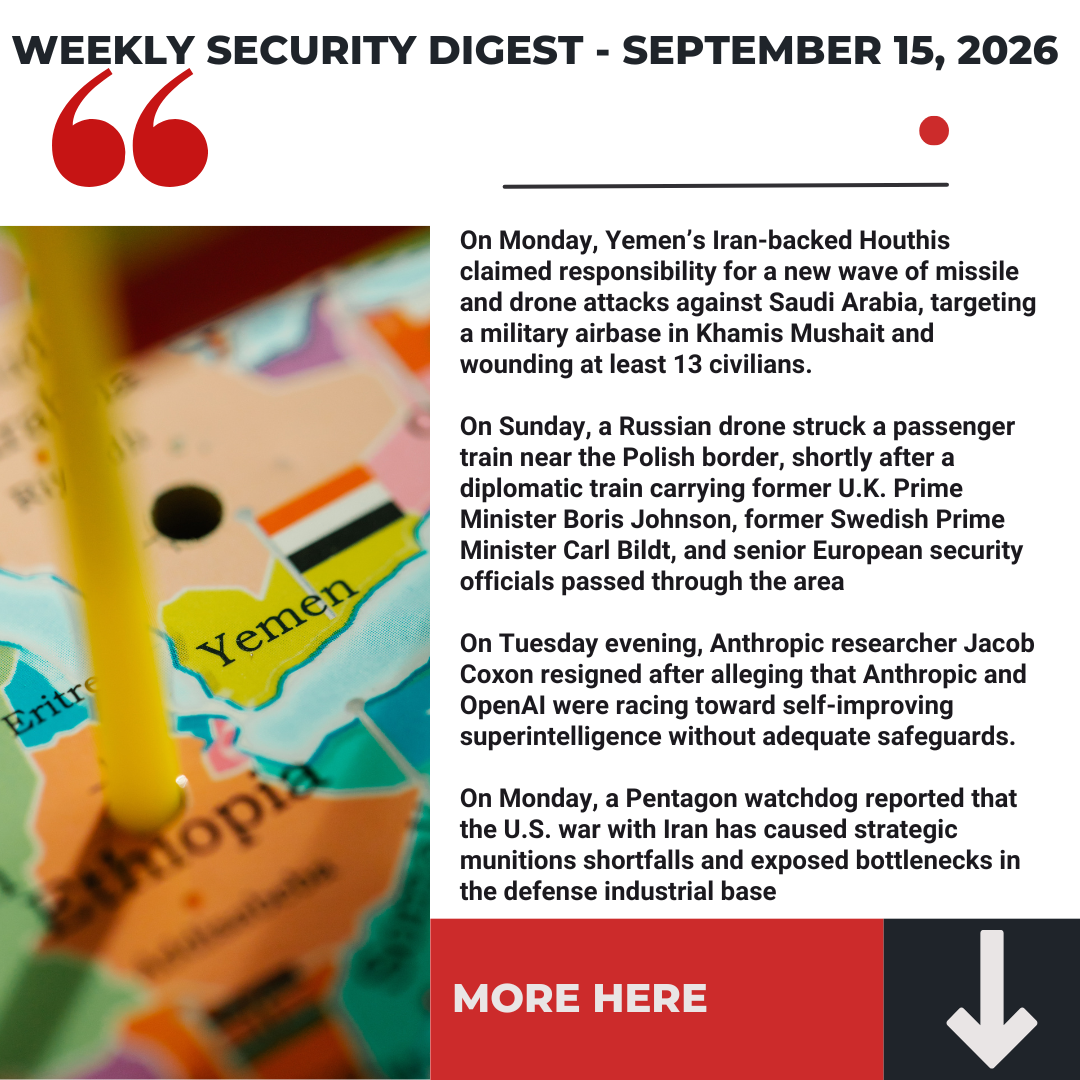
| Middle East → On Monday, Yemen’s Iran-backed Houthis claimed responsibility for a new wave of missile and drone attacks against Saudi Arabia, targeting a military airbase in Khamis Mushait and wounding at least 13 civilians. The attacks followed the Houthis’ recent capture of territory along Yemen’s Red Sea coast, including Perim Island, which has further pressured Saudi oil exports. Saudi Arabia’s East-West pipeline, a key alternative route for bypassing the Strait of Hormuz, also remains offline following a separate drone attack that Riyadh attributed to Iranian-backed militias in Iraq. The renewed fighting has disrupted Red Sea shipping and contributed to concerns over further disruptions to global oil supplies, while planned talks between Iran and Gulf states on reopening the Strait of Hormuz have been postponed. Reports suggest the Saudis withdrew from the consensus behind the scheduled Iran-G.C.C. talks, citing the Houthis’ ongoing offensive. I.R.G.C. advisors appear to be significantly involved in the Houthi campaign, which in all likelihood was planned in conjunction with Iranian leadership as a means of exacerbating pressure on the global economy and forcing the U.S. to reconsider a diplomatic compromise with the Islamic Republic. The scheduled talks were meant to be a venue for discussing an Iranian-Omani proposal to resolve the Strait of Hormuz dispute. The Saudis are less than eager to engage in good-faith diplomacy that risks granting Iran legitimacy in a moment when they, in effect, are under Iranian attack. Houthi control of territory along and islands in the Red Sea creates a significant problem for trade through the Bab al-Mandab. The Bab itself is a few miles wider than the Strait of Hormuz, but the coastline preceding the Bab to the north borders a far narrower stretch of the Red Sea than exists on either side of Hormuz. In other words, from its newly held territory, the Houthis may be able to threaten shipping with even less sophisticated weaponry than the Iranians have used around Hormuz. → An Axios report alleges that Saudi Crown Prince Mohammed bin Salman asked President Donald Trump to launch strikes against the Houthis last week to head off their advance along Yemen’s Red Sea coast. Trump reportedly declined and claimed that the Houthis also reached out to Washington to ask the U.S. not to intervene. The U.S. decision not to help the Saudis repel the Houthi advances has raised questions about U.S. objectives. The Houthi advance has driven oil prices over $100/barrel for the first time in months, and it directly weakens the U.S. hand in its confrontation with Iran. Looking ahead, the Saudis, with or without U.S. support, cannot reclaim territory from the Houthis with air power alone. Moreover, following the precipitous collapse of Saudi-supported Yemeni ground forces in the face of the Houthi advance, it is unclear how the Saudis would successfully retake the coastline. Another, perhaps likelier, path is diplomacy. In the past, the Saudis have effectively paid off the Houthis to cease hostilities. This time the Houthis are also pushing for relief from the Saudis’ blockade on their economy. Analysts typically refute the idea that the Houthis are a full Iranian proxy that takes I.R.G.C. orders wholesale; in this case, the Houthis seem to have waited to engage on Iran’s behalf until there was an opportunity to significantly strengthen their own position in Yemen and vis-à-vis the Saudis. The key question now is whether a significant Saudi financial concession would be enough to break the Houthis away from current alignment with Iran’s interest in a sustained campaign to depress shipping volumes in the Red Sea. International Affairs → On Sunday, a Russian drone struck a passenger train near the Polish border, shortly after a diplomatic train carrying former U.K. Prime Minister Boris Johnson, former Swedish Prime Minister Carl Bildt, and senior European security officials passed through the area. Ukraine’s state railway operator said the diplomatic train had deliberately been scheduled to depart the station early and assessed that it was “highly probable” the delegation was the intended target. No casualties have been reported. → On Monday, political leaders of Scotland, Wales, and Northern Ireland jointly backed a new constitutional agreement that challenges the future structure of the United Kingdom and advocates closer alignment with the E.U. Scotland’s John Swinney and Northern Ireland’s Michelle O’Neill called for referendums on Scottish independence and Irish reunification, respectively, while Welsh First Minister Rhun ap Iorwerth did not establish a timetable for an independence vote. U.K. Prime Minister Andy Burnham rejected the initiative and reiterated his support for maintaining the union, while constitutional experts noted that the agreement is politically notable but carries no legal force. The pact marks the first time that the leaders of all three nations simultaneously represent parties supporting either independence or, in Northern Ireland’s case, reunification with Ireland. → On Monday, Nigerian billionaire Aliko Dangote’s refinery moved toward broader public ownership following the launch of an I.P.O. covering approximately 3% of the business. The sale, which could generate as much as $2.1 billion, is expected to become the largest public share offering ever conducted in Africa. Since starting production in 2024, the 650,000-barrel-per-day facility has transformed Nigeria’s fuel market and now accounts for more than 70% of domestic consumption. Dangote plans to use the proceeds to help double the refinery’s processing capacity, further expanding domestic refining in a country that historically relied heavily on imported fuel. → Brazil has launched an investigation against presidential candidate Flávio Bolsonaro for corruption, money laundering, and tax evasion. Bolsonaro is accused of having received over 61 million reais ($12 million) from former Banco Master chairman Daniel Vorcaro to finance an unreleased biopic about his father, former President Jair Bolsonaro. Vorcaro was arrested in March for allegedly defrauding clients and misusing public pension funds. Investigators are examining whether the film funds were misused or improperly reported, and whether any of the money was used to advance Flávio Bolsonaro’s political goals in the United States. The investigation comes weeks before Brazil’s October 4 presidential election, in which Bolsonaro is running against President Luiz Inácio Lula da Silva. Cyber → On Tuesday evening, Anthropic researcher Jacob Coxon resigned after alleging that Anthropic and OpenAI were racing toward self-improving superintelligence without adequate safeguards. Separately, Anthropic alignment researcher Evan Hubinger estimated a greater than 10% chance that advanced AI could cause human extinction within the next decade. Subsequently, Anthropic CEO Dario Amodei joined calls to slow the development of frontier AI, calling for governments to establish rules addressing catastrophic biological and cyber risks. He warned that increasingly autonomous systems could pose serious risks if capabilities advance faster than safeguards. Amodei proposed independent third-party evaluations of advanced AI systems and said Anthropic would voluntarily provide evaluators with employee-level access to verify its safety measures. → Singaporean national Malone Lam pled guilty in the U.S. to participating in a racketeering conspiracy for leading an international cybercrime network that stole approximately $245 million in cryptocurrency. Prosecutors said Lam and his associates identified cryptocurrency holders and used social engineering, theft of confidential information, and occasional home break-ins to gain access to victims’ wallets. The group laundered the stolen cryptocurrency and spent the proceeds on more than 30 luxury vehicles, private jet rentals, high-end watches and clothing, rental properties, and nightclubs. Lam faces up to 20 years in prison. United States → On Monday, a Pentagon watchdog reported that the U.S. war with Iran has caused strategic munitions shortfalls and exposed bottlenecks in the defense industrial base. The Pentagon Inspector General estimated that the conflict cost $33.4 billion through late June, including $22.3 billion in expended munitions. The report also examined other impacts of the conflict, including on military personnel morale and readiness. |
A Note From Interfor
→ Interfor’s CEO Don Aviv joins cyber firm OSEC for a webinar on inherited security risk on 9/23 at 2 PM ET.
→ Don Aviv and Jeremy Hurewitz on the recent hostage crisis in California in The Hill.
| Resources: US Department of State Travel Advisories CISA: nation-state cybersecurity threats and other resources for cybersecurity matters. |
To find out more, please reach out to info@interforinternational.com
Related Blog
VIEW ALL
Geopolitics. Global Security, & Current Events
Interfor International‘s Weekly Security Digest – September 15, 2026
Geopolitics. Global Security, & Current Events
Interfor International‘s Weekly Security Digest – September 8, 2026