


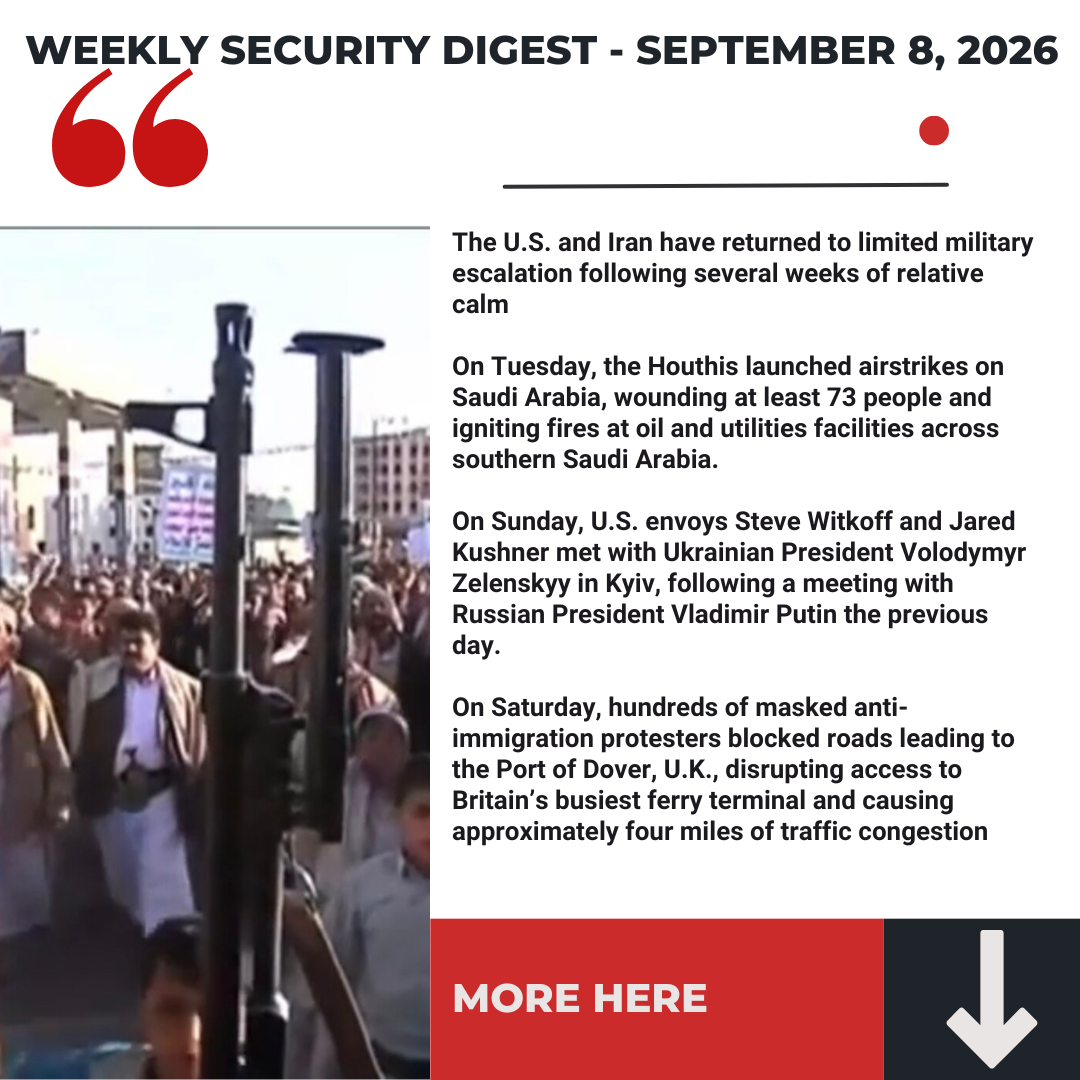
| Middle East → The U.S. and Iran have returned to limited military escalation following several weeks of relative calm. Washington has intensified its economic pressure campaign and maritime operations around the Strait of Hormuz, while Iran has responded by threatening U.S. military and energy assets across the Gulf and proposing additional restrictions on shipping. Meanwhile, Oman and other regional mediators continue efforts to establish a diplomatic framework for resuming commercial traffic through the Strait, though significant disagreements remain. The Trump administration is also reportedly creating a post-war plan to tie together regional pressure on Iran, normalization with Israel, and Gaza’s reconstruction. Speculation is rising in Iran that the U.S. intends to maintain the current no-peace-no-war status quo through the midterm elections, after which Trump will consider a renewed military campaign against the Iranian regime. This adds yet more motivation for those I.R.G.C. officials already pushing for a strategic escalation to reclaim economic leverage and hurt Trump’s approval rating before the U.S. election. → On Tuesday, the Houthis launched airstrikes on Saudi Arabia, wounding at least 73 people and igniting fires at oil and utilities facilities across southern Saudi Arabia. The attacks targeted Aramco facilities and King Khalid Air Base. Operations at affected sites were temporarily suspended. The Houthis claimed the attack was in response to recent Saudi strikes on Yemen, while Riyadh vowed to retaliate. As the U.S. sustains its economic pressure campaign on Iran, the Islamic Republic is looking for ways to impose greater costs on the global economy and force the U.S. back to the negotiating table. Escalating the war in Yemen is a viable way of doing that – oil prices surged toward $100 per barrel today following Houthi attacks on Saudi energy infrastructure – and, critically, Houthi aggression will not trigger direct U.S. retaliation on Iranian territory. International Affairs → On Sunday, U.S. envoys Steve Witkoff and Jared Kushner met with Ukrainian President Volodymyr Zelenskyy in Kyiv, following a meeting with Russian President Vladimir Putin the previous day. The discussion focused on restarting stalled Russia-Ukraine negotiations, with Washington seeking a revised proposal before winter. President Zelenskyy claimed that the U.S. is considering a package of air defense and energy assistance for Ukraine in the interim. → On Saturday, hundreds of masked anti-immigration protesters blocked roads leading to the Port of Dover, U.K., disrupting access to Britain’s busiest ferry terminal and causing approximately four miles of traffic congestion. Protesters, many dressed in black clothing and balaclavas, linked arms across roads and chanted “stop the boats,” while the far-right Patriot Platform group claimed responsibility for the action. Police dispersed the protesters by midday without making arrests, but the coordinated action has raised questions over the police response after authorities initially described it as a “spontaneous protest.” → On Sunday, Germany’s far-right Alternative for Germany (A.f.D.) party won 43.8% of the vote in Saxony-Anhalt’s state election, its strongest result since the party was founded in 2013 and more than double its share in the 2021 election. The center-right Christian Democratic Union (C.D.U.) party, which has governed the state since 2002, fell from 37.1% to just 17.2%. The A.f.D. secured 39 of the state parliament’s 83 seats, leaving it three seats short of the majority needed to govern alone, while Germany’s other major parties continue to reject a coalition with the party. → On Sunday, Indonesia’s Anak Krakatau volcano erupted, sending ash across the country and forcing authorities to close eight airports. By Sunday evening, 1,558 flights had been cancelled, affecting approximately 170,000 passengers. Two ash plumes reached 20,000 and 50,000 feet, spreading across Jakarta and parts of Java and Sumatra, while schools in affected areas were authorized to shift temporarily to remote learning. The eruption has since eased and flights from Jakarta resumed today, although Anak Krakatau remains active and authorities continue to monitor the risk of additional eruptions. → On Monday, Russia and North Korea opened the first road bridge across their shared border, creating a new transportation link between the two countries. The 1-kilometer, two-lane bridge connects Russia’s Khasan and North Korea’s Rason and is designed to accommodate up to 300 vehicles per day. Russian and North Korean officials said the bridge will strengthen trade and economic cooperation. The new crossing has raised concerns that increased vehicle traffic could make the movement of military equipment or goods subject to U.N. sanctions more difficult for intelligence agencies to monitor. → On Monday, Nepal held a national day of mourning for the victims of the August 26 floods in Nepal and Tibet, which have killed more than 1,300 people and left approximately 5,000 missing. Search operations are focused on 12 hydropower projects, where roughly 900 workers are missing and about 500 are believed to be trapped inside tunnels; international rescue teams from India, China, South Korea, and the United States are assisting. Families of missing workers have protested in Kathmandu, criticizing delays in deploying heavy equipment and demanding faster rescue operations. → Wildfires burning across Indonesia have spread toxic haze across Malaysia, Singapore, and the Philippines, exposing millions of people to hazardous air pollution as a “super” El Niño intensifies drought conditions. In Indonesia, authorities recorded more than 50,000 respiratory infections linked to forest and land fires in July and August, including over 12,000 cases among children under five, while Malaysia has reported increases in asthma and conjunctivitis. Indonesian authorities have warned that conditions could deteriorate further in the coming months as El Niño intensifies, with researchers estimating that as much as 11 million hectares could burn this year under a worst-case scenario. → On Friday, an Argentine court ordered the return of “Portrait of a Lady,” an 18th-century painting looted by the Nazis during World War II, to the heir of Dutch Jewish art dealer Jacques Goudstikker. The painting had been missing for decades before Dutch journalists identified it in 2025 photographs advertising the Argentine home of Patricia Kadgien. Her father, Friedrich Kadgien, was a senior Nazi financial official who fled to Argentina after the war. Kadgien and her husband, who were charged with concealing the artwork, agreed to relinquish ownership in exchange for avoiding trial and spending two years under court supervision. Authorities are also examining other artworks seized from properties belonging to the Kadgien family to determine whether they were similarly looted during the Nazi era. |
A Note From Interfor
→ Interfor’s CEO Don Aviv joins cyber firm OSEC for a webinar on inherited security risk on 9/23 at 2 PM ET.
→ Don Aviv and Jeremy Hurewitz on the recent hostage crisis in California in The Hill.
| Resources: US Department of State Travel Advisories CISA: nation-state cybersecurity threats and other resources for cybersecurity matters. |
To find out more, please reach out to info@interforinternational.com
Related Blog
VIEW ALL
Geopolitics. Global Security, & Current Events
Interfor International‘s Weekly Security Digest – October 20, 2026
Geopolitics. Global Security, & Current Events
Interfor International‘s Weekly Security Digest – October 13, 2026
Geopolitics. Global Security, & Current Events
Interfor International‘s Weekly Security Digest – October 6, 2026