

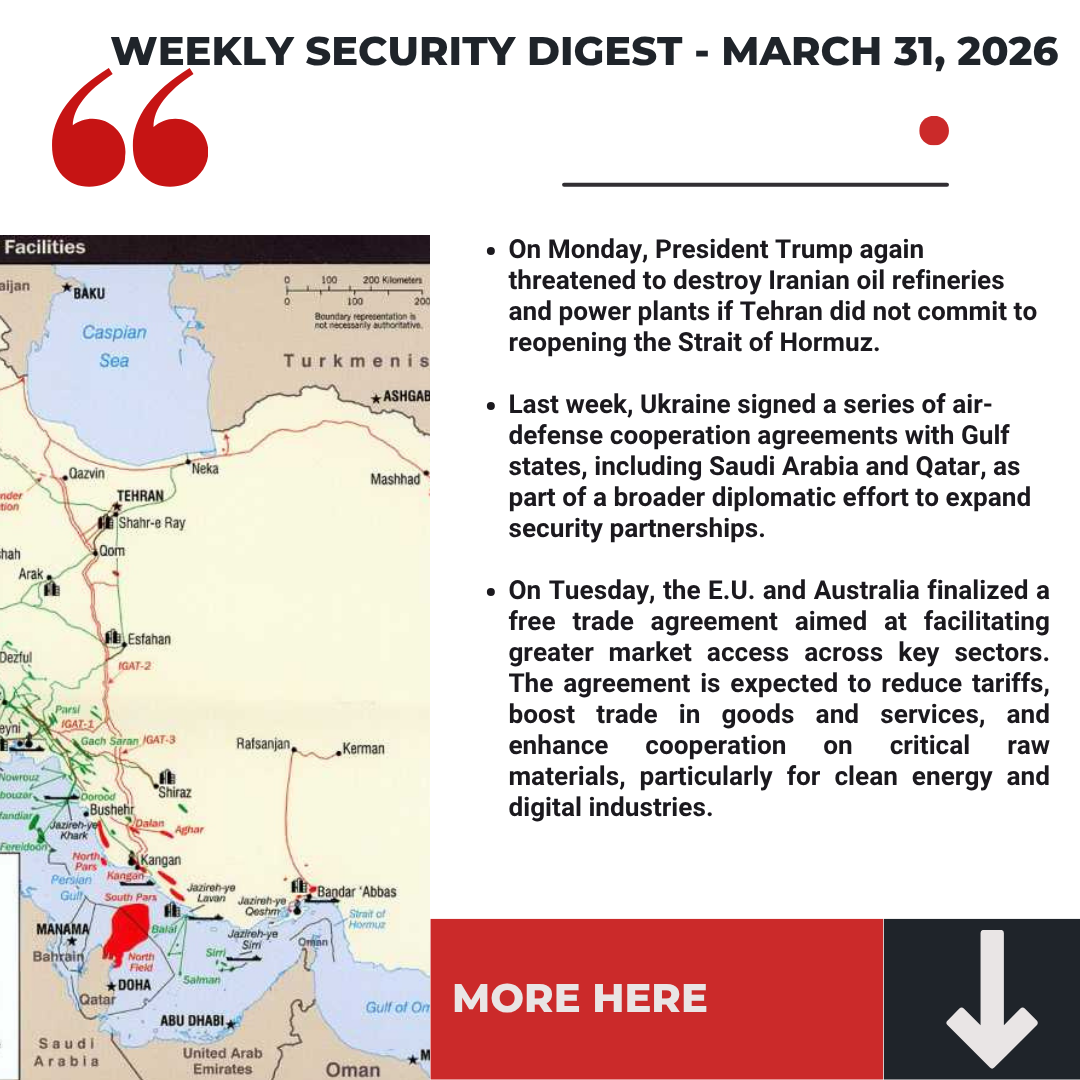
| Middle East On Monday, President Trump again threatened to destroy Iranian oil refineries and power plants if Tehran did not commit to reopening the Strait of Hormuz. The U.S. has continued to accumulate ground forces in the region ahead of prospective operations aimed at opening the Strait. At the same time, Trump has implied he would consider ending the war without a resolution to the Strait of Hormuz crisis. As of now, U.S. escalation against Iran appears more likely than a diplomatic agreement. The U.S. and Iran are still not negotiating directly, and, even if they were, they are many miles apart when it comes to terms for an agreement. Perhaps most importantly, the U.S. has little leverage to coerce concessions from Iran on the Strait of Hormuz. The Islamic Republic has successfully delivered on its decades-old threat to close the Strait and consequently has significantly increased its leverage. Iran remains unconvinced that the U.S. has the combined political will and military capability to take the necessary measures to degrade Iran’s ability to threaten the Strait. The Islamic Republic also retains devastating options for escalation, such as by attacking desalination plants in the Gulf or by greenlighting the Houthis to close the Bab al-Mandab. With all that in mind, the regime is unlikely to concede the most meaningful leverage it has had in years in the face of a threat it thinks it can not just survive but counter with devastating effect. If, as expected, Iran calls Trump’s bluff, Interfor assesses the President is likely to authorize ground operations in pursuit of Strait of Hormuz objectives. The other option is to unilaterally walk back past threats and effectively concede Iranian control over the Strait – not impossible Trump could make this choice, but he would be widely criticized at home and abroad. Perhaps more importantly, Trump has demonstrated that even when he positions military assets threateningly to facilitate negotiation, he tends to use those assets if negotiations fail. → On Saturday morning, the Houthis launched a missile at southern Israel in their first attack since the U.S.-Israeli conflict with Iran began. The Houthis threatened further escalation if the U.S. and allies used the Red Sea to target Iran. The primary threat the Houthis pose – targeting shipping in the Red Sea and threatening trade via the Bab al-Mandab – has yet to be realized. The Houthi threat to Red Sea shipping and the Bab al-Mandab is critical. While the Strait of Hormuz is an essential corridor for global oil and gas flows, the Bab al-Mandab actually carries a higher volume of broader global maritime trade. It also carries enough oil to exacerbate the challenges already imposed by the Iranian actions in the Strait of Hormuz. The Houthis could also directly target key ports in Saudi Arabia and Oman being used as exit points for oil diverted from the Strait of Hormuz. There is some evidence that the Houthis have been hesitant to engage, despite Iran’s urging. They have suffered significant losses from past rounds of Israeli and American attacks. The Houthis have also benefited significantly from a pause of hostilities with the U.A.E. and Saudi Arabia, which presumably would end if the Houthis attack one or both Gulf States. Iran is treating a potential Saudi and/or Emirati decision to join the U.S.-Israel war effort as the trigger for Houthi attacks on Red Sea shipping routes. The Houthis would likely heed that Iranian order, and yet, it is somewhat reassuring, oddly, that the initial Houthi attack focused on Israel. This could show that the Houthis are still hoping to avoid direct confrontation with the Gulf, which would almost certainly draw major airstrikes from some combination of the U.A.E., Saudi Arabia, the U.S., and/or Israel. International Affairs → Last week, Ukraine signed a series of air-defense cooperation agreements with Gulf states, including Saudi Arabia and Qatar, as part of a broader diplomatic effort to expand security partnerships. The deals focus on sharing expertise and technology to counter missile and drone threats, drawing on Ukraine’s battlefield experience from the war with Russia. In return, Kyiv is seeking access to more advanced air-defense systems to strengthen its own capabilities, highlighting a shift in Ukraine’s role from security recipient to defense supplier. → On Tuesday, the E.U. and Australia finalized a free trade agreement aimed at facilitating greater market access across key sectors. The agreement is expected to reduce tariffs, boost trade in goods and services, and enhance cooperation on critical raw materials, particularly for clean energy and digital industries. Beyond its economic impact, the agreement reflects a broader strategic effort to diversify supply chains and strengthen resilience amid evolving global trade dynamics. → On Saturday, former Nepalese Prime Minister K.P. Sharma Oli and former Home Minister Ramesh Lekhak were arrested on charges of negligence for allegedly failing to prevent the deaths of dozens of protesters during anti-corruption demonstrations in 2025, following a government-backed investigation into the violence. The arrests come shortly after a new government took office under Prime Minister Balendra Shah, who campaigned on accountability and justice for victims of the crackdown. Authorities stated the move is part of efforts to ensure legal accountability and restore public trust, although the development has intensified political tensions and sparked demonstrations by Oli’s supporters. → On Friday, Ethiopia secured more than $13 billion in investment commitments at the “Invest in Ethiopia 2026” forum in Addis Ababa, spanning sectors including manufacturing, agriculture, energy, and construction. According to the Ethiopian Investment Commission (E.I.C.), a significant share of the investment was secured by Chinese partners, particularly in projects related to renewable energy, hydrogen and green ammonia, highlighting Beijing’s continued role in supporting Ethiopia’s industrial and infrastructure development. → Italian authorities are investigating a high-value art heist at the Magnani Rocca Foundation near Parma, where four masked individuals broke in and stole three paintings by Renoir, Cézanne and Matisse worth an estimated €9 million. The suspects completed the theft within minutes before fleeing, with the alarm system preventing further losses. Described as a well-organized operation, the case is being handled by the Carabinieri and the Cultural Heritage Protection Unit and ranks among the most significant art thefts in Italy in recent years. |
A Note From Interfor
→ Suggestions on social media risk management in our blog post here.
→ Thoughts on a changing Thailand – read our blog post here.
| Resources: US Department of State Travel Advisories CISA: nation-state cybersecurity threats and other resources for cybersecurity matters. |
To find out more, please reach out to info@interforinternational.com
Related Blog
VIEW ALL
Geopolitics. Global Security, & Current Events
Interfor International‘s Weekly Security Digest – April 28, 2026
Geopolitics. Global Security, & Current Events
Interfor International‘s Weekly Security Digest – April 21, 2026
Geopolitics. Global Security, & Current Events
Interfor International‘s Weekly Security Digest – April 14, 2026