

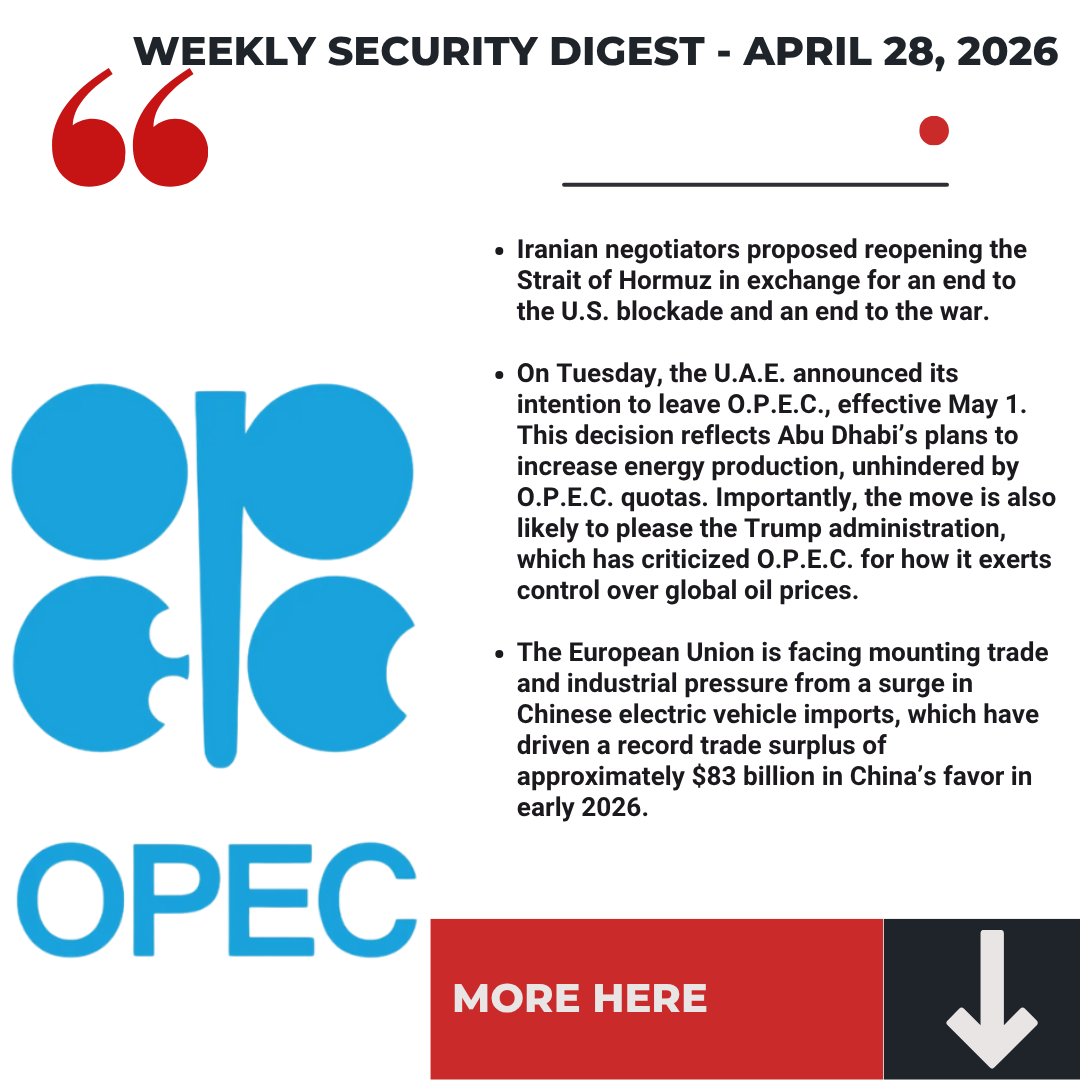
| Middle East → Iranian negotiators proposed reopening the Strait of Hormuz in exchange for an end to the U.S. blockade and an end to the war. The Iranian proposal puts off addressing U.S. demands on nuclear and other issues until later talks. The proposal comes after President Trump cancelled Steve Witkoff and Jared Kushner’s trip to Islamabad to continue negotiations, claiming that the Iranians were not cooperative enough. President Trump signaled this weekend that he planned to continue pressuring Iran with the naval blockade. However, allied nations, including France and Germany, are increasingly advocating for an end to the blockade to ease economic hardships for oil importers. Over the weekend we saw tensions inside the Iranian regime collide with President Trump’s eagerness to declare victory. Araghchi’s announcement that the Strait was open was already being criticized by the I.R.G.C. as too great a concession. Then Trump, via social media and comments to journalists, exaggerated the state of negotiations and how much Iran had already conceded, in essence throwing a lit match at the gunpowder of Iranian internal political tensions. Iran’s offer puts the Trump administration in a challenging position. On the one hand, it validates Trump’s blockade strategy: no longer is the U.S. under pressure to give up on its nuclear demands in order to reopen the Strait. It has successfully created a one-to-one trade of blockade for blockade that effectively leaves the items on the negotiating table for later. Israel and U.S. hawks will argue that the threat to resume the war should only be taken off the table in exchange for the war’s core objectives: a massively degraded, ideally eliminated Iranian nuclear program, defanged missile and drone capabilities, and no further support for regional proxies. Reducing a war-ending calculation to just getting the Strait open is playing Iran’s game; in essence, the U.S. would be accepting the premise that the Iranian regime will survive, with its nuclear, missile, drone, and proxy initiatives intact, in exchange for a reopened Strait of Hormuz. Ghalibaf is in an interesting position. He sits at the intersection of Iran’s civilian government, as Speaker of Parliament, and the I.R.G.C., as a retired general, and yet, he has no shortage of opponents in both constituencies. He is, in essence, seen as too personally ambitious to be a trusted steward of either group’s political objectives. He remains, however, the best positioned individual to bridge the gap between a civilian government that wants a deal and an I.R.G.C. that does not, but for the moment he appears to face an uphill battle. Theoretically, Trump’s team might seriously consider a similar deal where both parties drop their blockades as a precondition to more conclusive talks to end the war and resolve disputes on the nuclear and other issues. But Iran is clearly still pushing to get out of this war without compromising on its capabilities or rights. Much of this also reflects a lack of consensus inside Iran’s leadership regarding what compromises can or should be made on the nuclear program. For some pragmatists, largely in the political establishment, the nuclear program was always meant to serve as leverage, something to be traded away (albeit never fully) for sanctions relief and other benefits. However, at the senior levels of the I.R.G.C. the nuclear program is viewed as even more important now than it was before the war. Even those hardliners not yet ready to push toward weaponization still see significant value in remaining a nuclear threshold state. → On Tuesday, the U.A.E. announced its intention to leave O.P.E.C., effective May 1. This decision reflects Abu Dhabi’s plans to increase energy production, unhindered by O.P.E.C. quotas. Importantly, the move is also likely to please the Trump administration, which has criticized O.P.E.C. for how it exerts control over global oil prices. Leaving O.P.E.C. sends a clear signal that the U.A.E. is not just prioritizing its U.S. and Israeli ties following the war, but doing so instead of greater Gulf and broader regional cooperation. It also shows that the war with Iran has not made the U.A.E. reconsider its rivalry with Saudi Arabia. International Affairs → The European Union is facing mounting trade and industrial pressure from a surge in Chinese electric vehicle imports, which have driven a record trade surplus of approximately $83 billion in China’s favor in early 2026. The sharp increase, fueled by rapidly expanding Chinese E.V. exports, has intensified concerns in Brussels over industrial competitiveness, market distortion and strategic dependency on Chinese supply chains. E.U. officials are considering targeted policy measures, including stricter foreign subsidy controls and increased state aid and investment to support domestic E.V. and battery production. → On Monday, Romania’s Social Democratic Party (P.S.D.) withdrew its support for Prime Minister Ilie Bolojan, triggering a major coalition crisis and raising the prospect of government collapse. P.S.D. criticized the administration’s fiscal reforms, including tax increases and public spending cuts. The move is expected to strip the government of its parliamentary majority, with P.S.D. ministers set to resign and opposition parties preparing a potential no-confidence vote. It may also create space in Parliament for the far-right Alliance for the Union of Romanians (A.U.R.), which is gaining ground in opinion polls. → On Saturday, Sri Lankan authorities arrested 22 Buddhist monks at Bandaranaike International Airport in a drug bust involving approximately 110 kg of cannabis, worth approximately $3.45 million. The drugs were concealed in luggage after their return from Thailand. The 22 monks are expected to appear before the Negombo Magistrate’s Court as proceedings continue, according to state media. → On Thursday, the International Criminal Court (I.C.C.) confirmed charges of crimes against humanity against former Philippine President Rodrigo Duterte over his “war on drugs” between 2011 and 2019. The campaign involved thousands of extrajudicial killings. Judges stated there are substantial grounds to believe Duterte committed the alleged crimes, rejecting arguments from his legal team regarding jurisdiction and fitness to stand trial. The decision was welcomed by critics, with Leila de Lima, member of the Philippines’ House of Representatives, describing it as “a great day for the fighters against impunity and state-sponsored violence.” → Mali is facing a heightened risk of fragmentation following a large-scale, coordinated offensive by jihadist groups and Tuareg separatists, with explosions and sustained gunfire reported in the capital Bamako and multiple regions across the country. Both the separatist Azawad Liberation Front (F.L.A.) and the al-Qaeda-linked J.N.I.M. claimed credit for the attack. |
A Note From Interfor
→ Don Aviv and Jeremy Hurewitz on Pakistan’s involvement in the Iran war for The Hill
→ Don Aviv and Sabrina Tan on the increasing threat of cyber attacks in Time Magazine
| Resources: US Department of State Travel Advisories CISA: nation-state cybersecurity threats and other resources for cybersecurity matters. |
To find out more, please reach out to info@interforinternational.com
Related Blog
VIEW ALL
Geopolitics. Global Security, & Current Events
Interfor International‘s Weekly Security Digest – September 15, 2026
Geopolitics. Global Security, & Current Events
Interfor International‘s Weekly Security Digest – September 8, 2026