

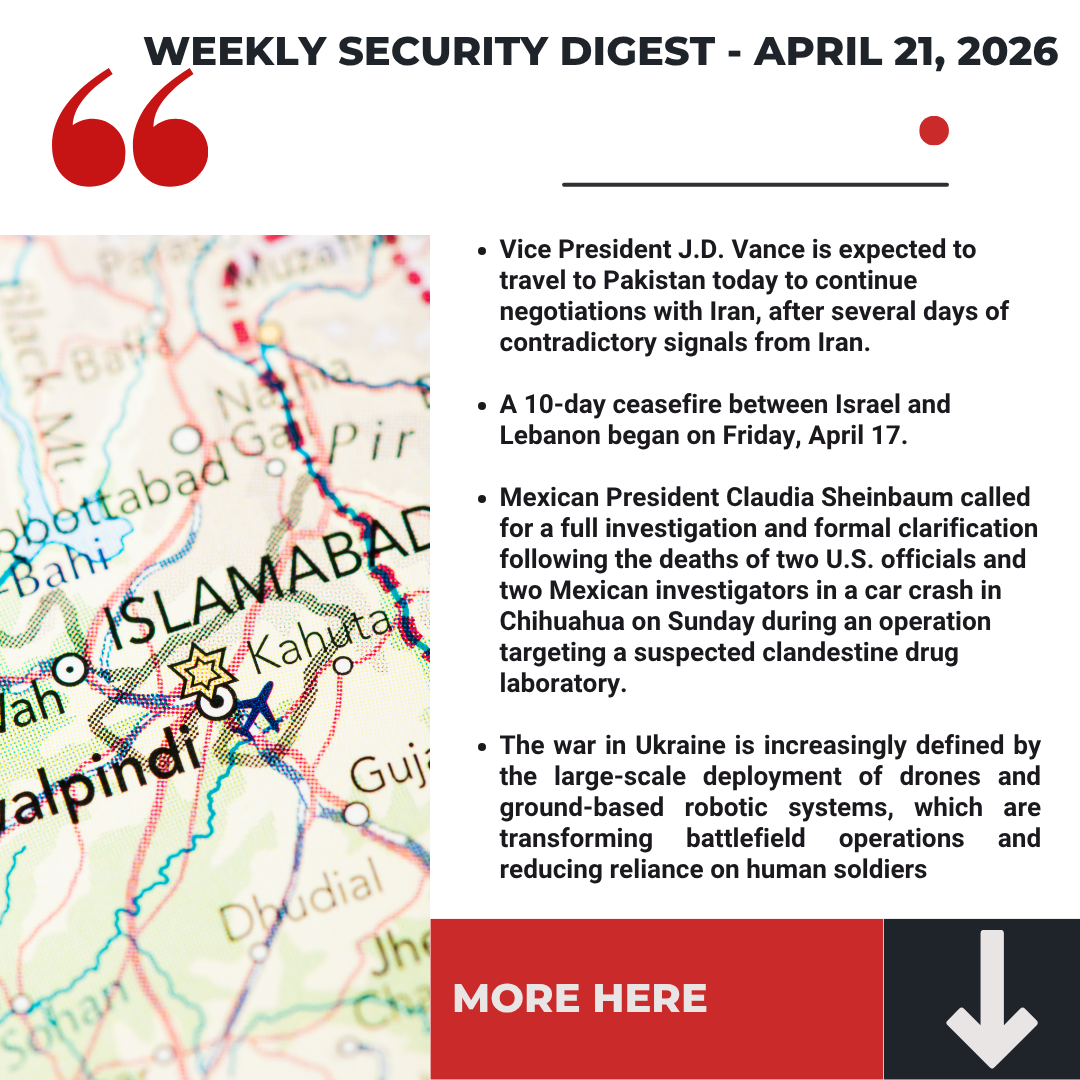
| Middle East → Vice President J.D. Vance is expected to travel to Pakistan today to continue negotiations with Iran, after several days of contradictory signals from Iran. On Saturday, Iranian Foreign Minister Abbas Araghchi announced that the Strait of Hormuz would open for international shipping traffic; however, the I.R.G.C. fired on commercial vessels just hours later. U.S. officials interpreted these events as evidence that divisions remain within Iran’s leadership, in particular between the leadership of the I.R.G.C. and lead negotiator Mohammad-Bagher Ghalibaf. Over the weekend we saw tensions inside the Iranian regime collide with President Trump’s eagerness to declare victory. Araghchi’s announcement that the Strait was open was already being criticized by the I.R.G.C. as too great a concession. Then Trump, via social media and comments to journalists, exaggerated the state of negotiations and how much Iran had already conceded, in essence throwing a lit match at the gunpowder of Iranian internal political tensions. As for what comes next, both a ceasefire extension and a return to war suddenly feel equally possible. More than at any point since the ceasefire began, the U.S. appears ready to resume the war. And yet, Trump would almost certainly still prefer a deal, or more time to reach one, if possible. Iran’s civilian leadership also wants some form of deal but needs to contend with an I.R.G.C. establishment that distrusts any U.S. proposal and feels comfortable with the prospect of more war. Much depends on two individuals: Trump and Ghalibaf. Trump is reportedly furious about the state of affairs and could opt to return to war out of a desire to inflict damage on the Islamic Republic. Ghalibaf is in an interesting position. He sits at the intersection of Iran’s civilian government, as Speaker of Parliament, and the I.R.G.C., as a retired general, and yet, he has no shortage of opponents in both constituencies. He is, in essence, seen as too personally ambitious to be a trusted steward of either group’s political objectives. He remains, however, the best positioned individual to bridge the gap between a civilian government that wants a deal and an I.R.G.C. that does not, but for the moment he appears to face an uphill battle. → A 10-day ceasefire between Israel and Lebanon began on Friday, April 17. Hezbollah is notably not a party to this agreement and, just one day after its signing, ambushed Israeli and U.N.I.F.I.L. soldiers in southern Lebanon, killing one Israeli and one French soldier. Israel has not retreated from its military positions in southern Lebanon due to the risk of continued attacks from the militant group. Pakistani mediators reportedly pushed the ceasefire forward in response to an Iranian demand that Lebanon be included in bilateral U.S.-Iran negotiations. International Affairs → Mexican President Claudia Sheinbaum called for a full investigation and formal clarification following the deaths of two U.S. officials and two Mexican investigators in a car crash in Chihuahua on Sunday during an operation targeting a suspected clandestine drug laboratory. Sheinbaum has framed the incident as a violation of Mexican law, noting that the U.S. partnered with Chihuahua state without federal approval, and asserted that the recent incident highlights a lack of transparency in U.S. involvement with Mexican law enforcement. Despite her strong statements, President Sheinbaum has largely shied away from overtly contradicting President Trump’s regional security policy since taking office in October 2024. This incident also exposes a domestic political fault line: Sheinbaum’s MORENA party is wary of U.S. operational involvement, while Chihuahua’s P.A.N. governor Maru Campos, governing a border state with acute security pressures, is far more willing to accept U.S. assistance. President Trump has repeatedly pushed Mexico to do more to counter cartel operations near the U.S. border and threatened greater U.S. involvement if Mexico fails to act. The fact that this dispute is breaking so cleanly along political lines could present an opportunity for Trump to take sides, as he has in Argentina, Hungary, and elsewhere. We could see Trump voice support for P.A.N. and other officials willing to line up with the U.S. against the cartels, while antagonizing President Sheinbaum, perhaps via punitive trade policy. → The European Union plans to introduce new measures to strengthen online protections for children, targeting the design and functionality of digital platforms to reduce exposure to harmful content and addictive features. Officials are considering proposals including stricter age-verification systems, limits on “scroll-like” and repeat engagement mechanisms, and enhanced enforcement of the General Data Protection Regulation (G.D.P.R.) to ensure platforms actively mitigate risks to minors. The initiative reflects growing concern over the impact of social media on young users, with regulators seeking to balance child safety, privacy and digital access while increasing accountability for tech companies operating in the E.U. → The war in Ukraine is increasingly defined by the large-scale deployment of drones and ground-based robotic systems, which are transforming battlefield operations and reducing reliance on human soldiers. Ukrainian forces have expanded the use of unmanned systems for reconnaissance, logistics, evacuation and direct combat, with some operations reportedly conducted entirely by drones and robots without infantry involvement. The growing integration of robotics and A.I. on the battlefield is drawing attention from Western militaries, highlighting Ukraine’s role as a testing ground for next-generation warfare concepts and raising concerns over the long-term implications of increasingly automated conflict. → On Sunday, a large fire devastated a coastal village in Malaysia’s Borneo region, destroying around 1,000 homes and displacing more than 9,000 people, according to local authorities. The blaze spread rapidly through densely packed wooden houses built on stilts, exacerbated by strong winds and limited emergency access. Authorities reported no fatalities, but thousands of residents have been relocated to temporary shelters as authorities investigate the cause. → On Monday, a 7.7 magnitude earthquake struck Japan’s northern coast, triggering a temporary tsunami alert and large-scale precautionary evacuations across coastal areas. Authorities recorded tsunami waves of up to 2.6 feet, but, after seeing no major damage, warnings were later lifted. Some minor injuries occurred. The Japanese government also issued an advisory indicating a slightly elevated risk of a larger “megaquake” in the coming days, urging residents in affected regions to review emergency preparedness measures. → On Thursday, a South African court sentenced opposition leader Julius Malema to five years in prison in a ruling with significant political implications. Malema, the leader of the Economic Freedom Fighters (E.F.F.), was convicted on multiple charges, including illegal possession and public use of a firearm, with the court emphasizing the seriousness of the offense given his public role. Malema appealed the sentence and remains free pending legal proceedings, but if upheld, the conviction could disqualify him from holding public office, potentially reshaping South Africa’s political landscape and the future of the E.F.F. |
A Note From Interfor
→ Don Aviv and Jeremy Hurewitz on Pakistan’s involvement in the Iran war for The Hill
→ Don Aviv and Sabrina Tan on the increasing threat of cyber attacks in Time Magazine
| Resources: US Department of State Travel Advisories CISA: nation-state cybersecurity threats and other resources for cybersecurity matters. |
To find out more, please reach out to info@interforinternational.com
Related Blog
VIEW ALL
Geopolitics. Global Security, & Current Events
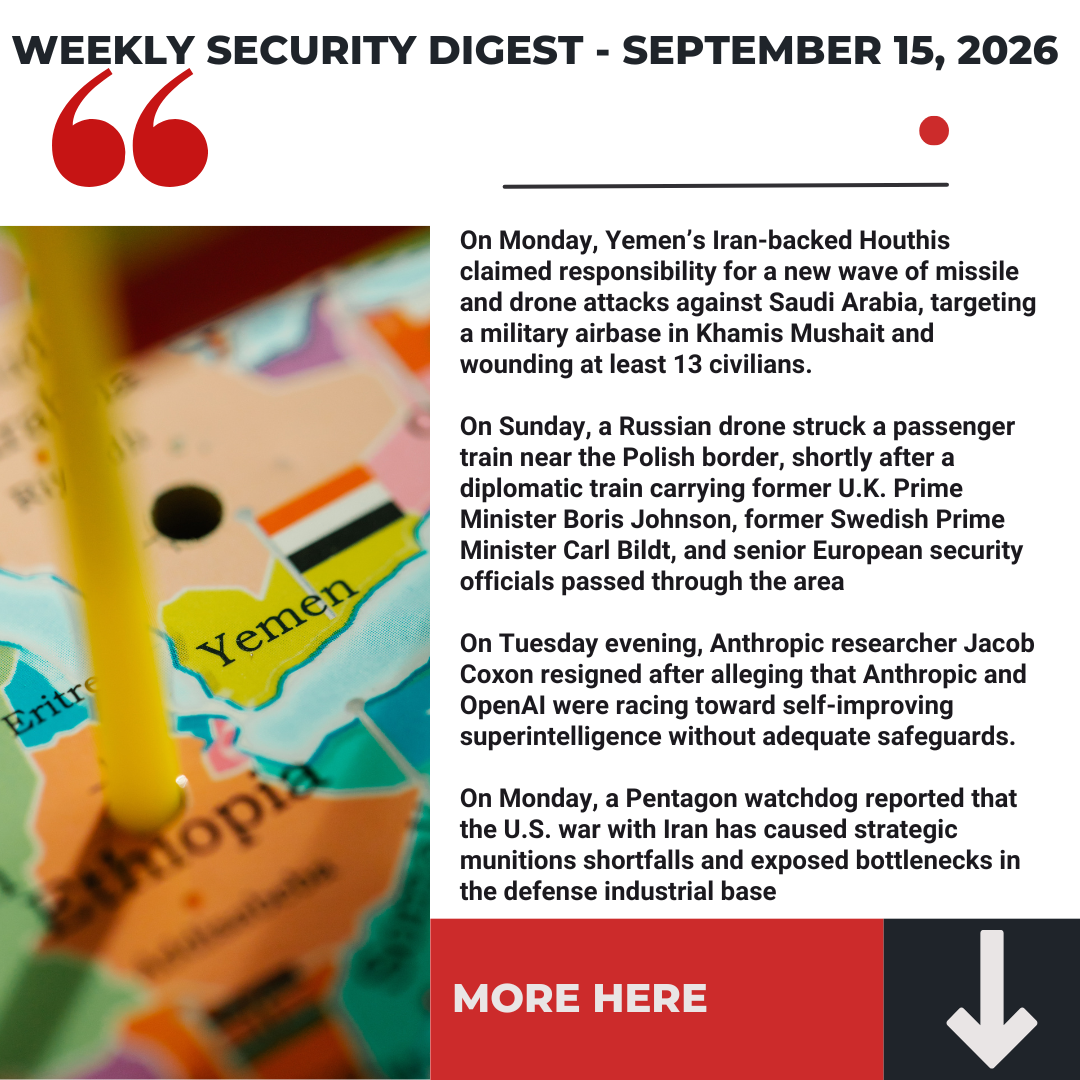
Interfor International‘s Weekly Security Digest – September 15, 2026
Geopolitics. Global Security, & Current Events
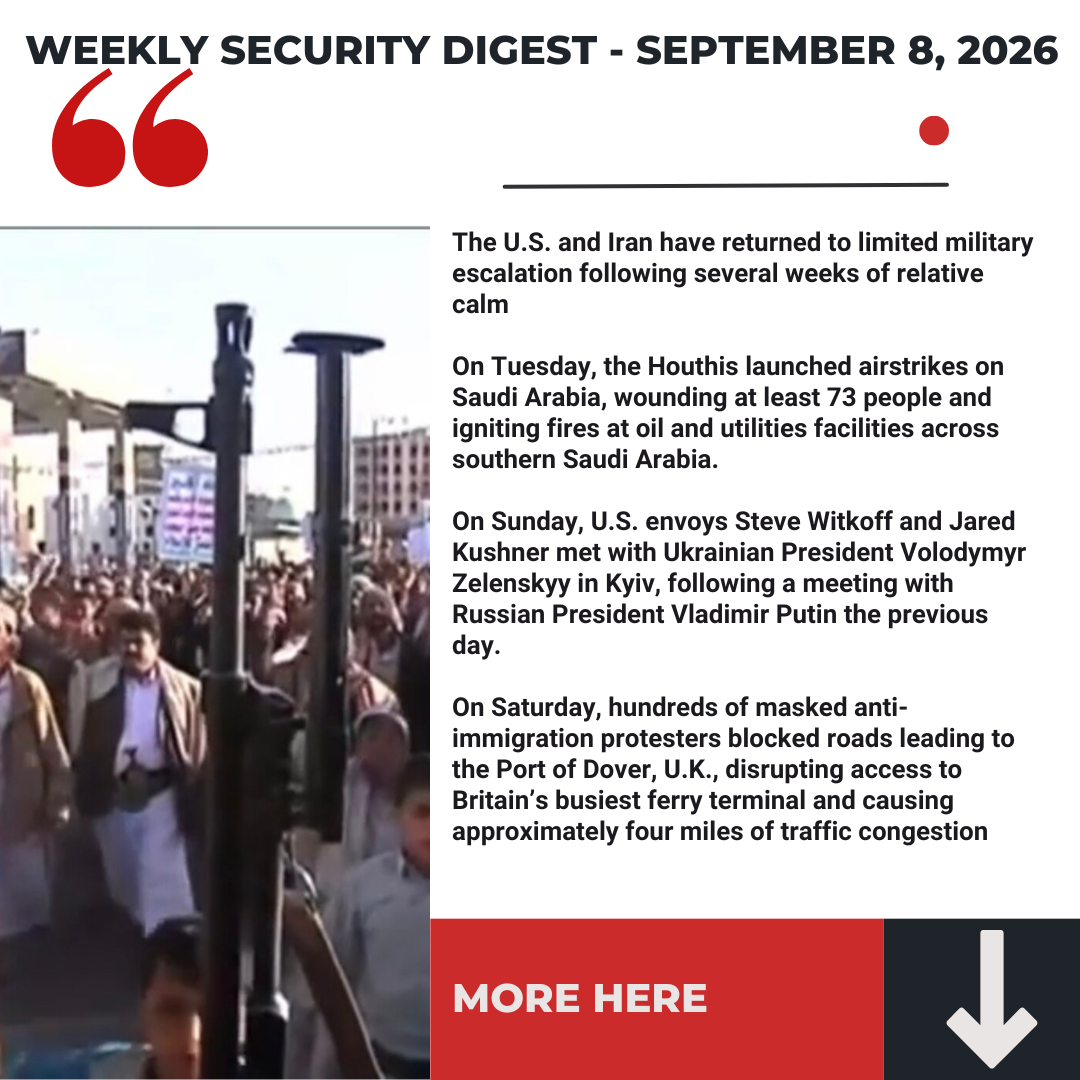
Interfor International‘s Weekly Security Digest – September 8, 2026