

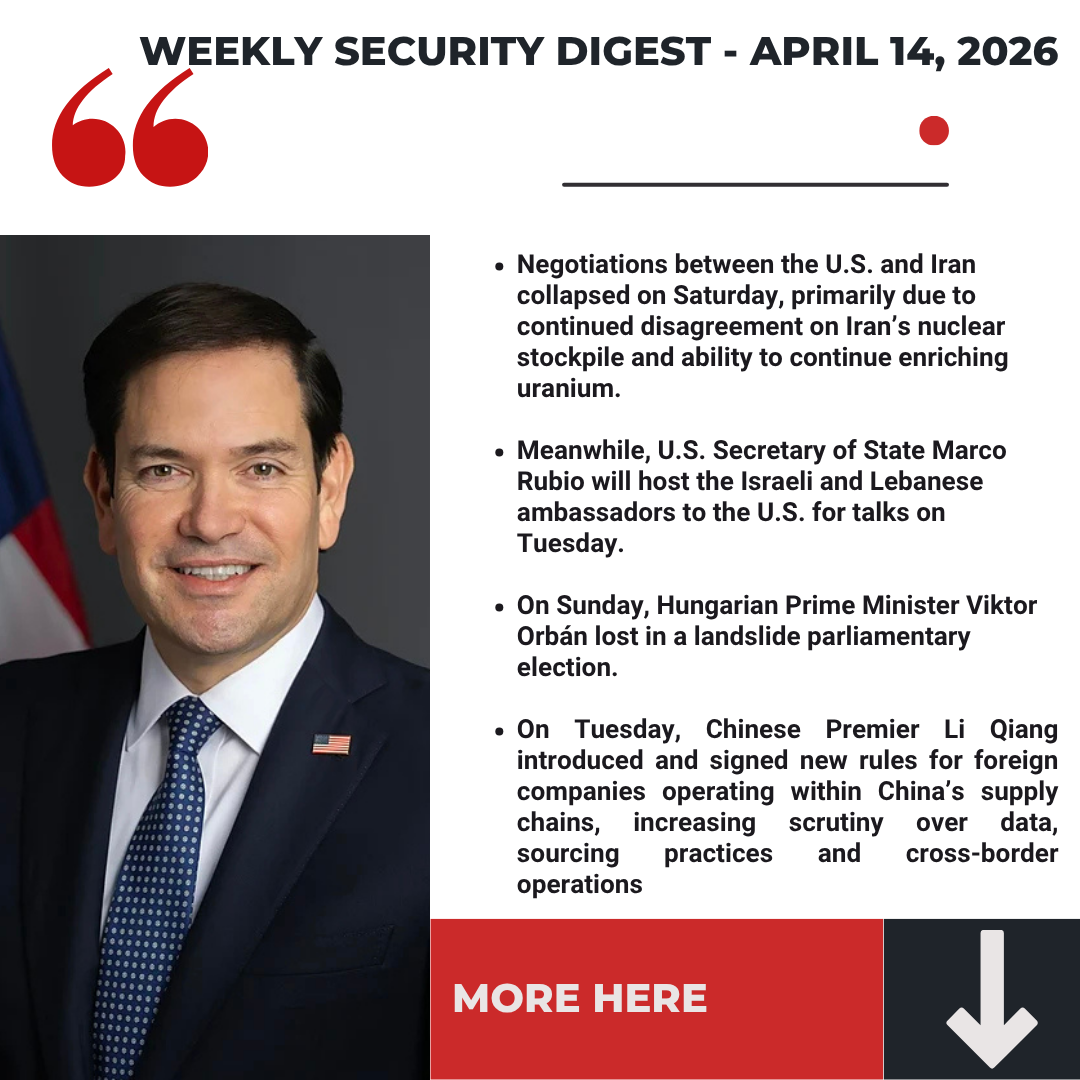
| Middle East Negotiations between the U.S. and Iran collapsed on Saturday, primarily due to continued disagreement on Iran’s nuclear stockpile and ability to continue enriching uranium. On Sunday, President Trump ordered a blockade of Iranian ports in the Strait of Hormuz in an effort to stifle one of Iran’s primary sources of cash flow. In response, Iran threatened retaliation and warned that it could retaliate against regional ports. Despite the ceasefire holding for now, the confrontation over the Strait of Hormuz is raising fears of renewed fighting and broader economic disruption. The ceasefire technically remains active until April 21. Regional mediators, including Pakistan and Turkey, are still working to bring the two parties back to the table. For the moment, neither the U.S. nor the Islamic Republic appears eager to return to a state of war. Trump hopes the U.S. blockade will balance out Iran’s leverage through its control of the Strait and thereby improve conditions for negotiations. However, the blockade also risks incidents at sea that could prompt a broader resumption of hostilities. If, for example, a lone I.R.G.C. unit fires on a U.S. warship, that could result in the two countries trading fire again, at which point either (and/or Israel) could choose to escalate back to full-scale hostilities. In the meantime, no one is talking about Trump’s original threat to attack Iranian power plants anymore, which the President likely sees as a small victory. One vector of escalation we are watching closely is potential Houthi action to close the Bab al-Mandab. The U.S. blockade has imposed a cost on Iran that parallels the impact of the closure of Hormuz on the region. Iran could see closing the Bab al-Mandab as a way to claim escalation dominance in this vector without necessarily prompting a return to full-scale war. However, the Houthis would have to fire at commercial vessels in the Red Sea in order to instigate a shipping crisis, meaning, unlike a blockade, closing the Bab al-Mandab would require a hostile act that would risk escalation. For the moment, we do not see Houthi attacks on Red Sea shipping as likely (~20%). The Houthis’ approach to the current war has been cautious. As the de facto government of northern Yemen, the Houthis are in a state of effective detente with Saudi Arabia. Attacking Israel is popular among Yemenis, but the Houthis have much to lose and little to gain by acting against the Gulf States, especially while Iran is stood down due to the ceasefire and cannot back them up. → Meanwhile, U.S. Secretary of State Marco Rubio will host the Israeli and Lebanese ambassadors to the U.S. for talks on Tuesday. Israel and Lebanon have not held direct negotiations since 1993. If Rubio is successful, talks will likely focus on a ceasefire, the disarmament of Hezbollah, and a potential peace agreement. Hezbollah has already announced that it will not abide by any agreements reached between Israel and Lebanon. For negotiations to succeed, Israel wants the Lebanese government, historically unable or unwilling to control Hezbollah, to demonstrate its resolve and capability to overpower Hezbollah. International Affairs → On Sunday, Hungarian Prime Minister Viktor Orbán lost in a landslide parliamentary election. Opposition leader Péter Magyar and his Tisza Party secured a two-thirds parliamentary majority, ousting Orbán after 16 years in power. Orbán conceded defeat, marking a significant political shift in the country and across the European Union, where the vote had been widely viewed as a test of Hungary’s future direction between continued “illiberal” governance and closer alignment with E.U. norms. Magyar pledged to pursue institutional reforms, anti-corruption measures and stronger ties with European partners, while the outcome is expected to reshape Hungary’s foreign policy stance and internal governance framework. → A Parisian court convicted cement giant Lafarge of financing terrorist groups in Syria, finding that the company paid approximately €5.6 million to armed groups, including Islamic State (I.S.), between 2013 and 2014. The court described the arrangement as a form of commercial collaboration with extremist organizations. The court sentenced former C.E.O. Bruno Lafont to six years in prison and ordered the company to pay over €1 million in fines. → North Korea conducted a series of cruise and anti-ship missile tests from a newly developed naval destroyer under the supervision of leader Kim Jong Un, marking a continued expansion of its maritime strike capabilities. The launches are part of efforts to enhance the Navy’s operational reach and strengthen the country’s nuclear-capable forces, with the new 5,000-ton warship designed to carry advanced missile systems. North Korea’s ongoing military modernization is likely to heighten regional security concerns amid continued tensions with South Korea and the United States. → On Tuesday, Chinese Premier Li Qiang introduced and signed new rules for foreign companies operating within China’s supply chains, increasing scrutiny over data, sourcing practices and cross-border operations. The measures reflect Beijing’s growing focus on treating supply chains as a national security asset. Chinese authorities are increasingly empowered to conduct investigations and impose countermeasures against firms or governments seen as disrupting China’s economic interests. For multinational companies, the evolving framework signals a more complex operating environment, as businesses are required to navigate stricter compliance requirements. → Pope Leo XIV has launched a multi-country tour across Africa, marking his first major international visit since becoming pontiff and underscoring the continent’s growing strategic importance to the Catholic Church. The tour started on Monday. The Pope will visit Algeria, Cameroon, Angola and Equatorial Guinea for over a week, combining pastoral engagements with meetings with political leaders and civil society, and focusing on themes including peace, migration, interreligious dialogue and social development. The visit highlights Africa’s expanding role within global Catholicism, and reflects the Vatican’s broader effort to strengthen its presence in the Global South. → On Monday, former Nigerian oil minister Diezani Alison-Madueke appeared in a London court to contest bribery charges linked to the awarding of government oil contracts. Prosecutors allege she accepted significant financial benefits, including luxury properties, private travel and cash payments, in exchange for favorable treatment of energy firms. Alison-Madueke has denied all allegations, stating she did not abuse her office. |
A Note From Interfor
→ Don Aviv and Jeremy Hurewitz on Pakistan’s involvement in the Iran war for The Hill
→ Don Aviv and Sabrina Tan on the increasing threat of cyber attacks in Time Magazine
| Resources: US Department of State Travel Advisories CISA: nation-state cybersecurity threats and other resources for cybersecurity matters. |
To find out more, please reach out to info@interforinternational.com
Related Blog
VIEW ALL
Geopolitics. Global Security, & Current Events
Interfor International‘s Weekly Security Digest – September 8, 2026

Geopolitics. Global Security, & Current Events
Interfor International‘s Weekly Security Digest – September 1, 2026