

| Middle East → The U.S. and Iran have been trading blows since Thursday, following Iranian attacks on commercial vessels in the Strait of Hormuz. The U.S. struck Iranian military, communications, and surveillance targets in response to Iran’s activities in the Strait, and Iran retaliated against targets in Bahrain and Kuwait. On Sunday, the two sides agreed to halt hostilities to allow for diplomatic meetings to continue. Representatives from both countries will separately meet with Qatari mediators in Doha on Tuesday. The technical team responsible for negotiating the nuclear issue will not be involved. What we are seeing now is both the U.S. and Iran trying to stretch the terms of the current agreement to upgrade their gains (or downgrade their compromises). The deliberate vagueness of the M.O.U. has set conditions under which the U.S. and Iran will continue to contest each other’s leverage throughout the duration of the agreement. All of this – detailed below – is representative of the extended low-grade instability we are likely to see in the region for the foreseeable future, in lieu of a conclusive diplomatic or military end that resolves the fundamental issues underlying the conflict. For the U.S., the current agreement only vaguely deals with whether or not Iran can control the Strait or charge fees to shipping, effectively prohibiting it only for the 60 days of the M.O.U. So, the U.S. has worked with the Gulf states to promote messaging against any fees being charged on global shipping. The U.S. and its allies also successfully pressured Oman to break from Iran and independently coordinate shipping through a corridor in their territorial waters, which is likely what provoked Iran’s recent strikes on commercial vessels. During the M.O.U.’s term, Iran hopes to cement its effective authority over the Strait. At a bare minimum, it wants shippers to be forced to coordinate with Iranian authorities and to pay at least a nominal fee (a concept which Iran has been trying to use its relationship with Oman to legitimize). All of this is going on alongside the new Israel-Lebanon agreement, which, if successfully implemented, would erode Hezbollah’s armed presence and broader influence in Lebanon. This is another case where the U.S. and Israel are hoping to secure gains on an issue – Iran’s proxies – against which the U.S. failed to extract Iranian concessions during the M.O.U. negotiations. → On Friday, Israel and Lebanon signed a framework agreement that outlines a phased Israeli handover of territory to the Lebanese Armed Forces, conditioned on the disarmament of Hezbollah. As part of the deal, the I.D.F. will relinquish certain positions to the Lebanese army, supervised by American military officials. Hezbollah officials have condemned the agreement and dismissed the idea that any Lebanese government could disarm the terrorist group. Read more from Interfor on the historic opportunities made possible by this agreement here. International Affairs → On Monday, a parcel bomb exploded inside a residential building in Monaco, critically injuring Ukrainian businessman Vadym Yermolaiev, his partner, and their 13-year-old son. Yermolaiev is a real estate developer who has been sanctioned by Ukraine in 2023 for continuing to hold business interests in occupied Crimea. Investigators said the explosive device, which reportedly contained bolts and metal pellets, had been left in the building’s lobby before the suspect fled toward France. Monaco has launched a joint investigation with French authorities, with officials describing the bombing as an unprecedented act of violence in the principality. → On Sunday, Europe’s early summer heat wave continued to intensify, with Germany, Poland, and the Czech Republic all registering their highest temperatures on record. The World Health Organization (W.H.O.) linked the extreme weather to more than 1,300 deaths. Authorities across the continent are implementing emergency measures. The W.H.O. has warned that Europe is warming at roughly twice the global average rate, arguing that increasingly frequent extreme heat events are placing growing pressure on healthcare systems, infrastructure, and public safety. → On Thursday, a Tunisian court sentenced human rights activist Sihem Bensedrine to 25 years in prison for falsifying documents. Bensedrine is associated with Tunisia’s Truth and Dignity Commission, which has historically investigated abuses committed under authoritarian governments. International human rights organizations condemned the ruling, arguing that it reflects a broader crackdown on civil society and dissent under President Kais Saied. The case is likely to intensify international scrutiny of Tunisia’s democratic trajectory as concerns continue to mount over judicial independence, political freedoms, and the rollback of post-Arab Spring reforms. → On Thursday, thousands of migrants sought assistance to leave South Africa ahead of nationwide anti-immigrant demonstrations scheduled for today. Over the past several weeks, South Africa has seen several attacks on foreign nationals, with anti-immigrant groups even issuing an ultimatum demanding that undocumented migrants leave the country. Authorities announced a large-scale security deployment ahead of the protests, while several neighboring governments accelerated repatriation efforts due to concerns that the unrest could intensify. → On Sunday, the Australian government introduced legislation to expand the powers of the eSafety Commissioner, the country’s independent online safety regulator. The reforms would allow the regulator to compel social media platforms and third-party providers to disclose internal information as part of efforts to enforce the country’s ban on social media access for children under 16. The proposal would also double the maximum penalty for systemic noncompliance to A$99 million, following evidence that many teenagers continue to circumvent age-verification measures. The legislation reflects Canberra’s increasingly assertive approach toward regulating major technology companies, with several other countries considering similar restrictions. → On Wednesday, Venezuela declared a national emergency after two powerful earthquakes of magnitude 7.2 and 7.5 struck the country’s north-central region, causing widespread destruction across Caracas and several neighboring states. Hundreds of thousands of people are now urgently seeking shelter, medical care, clean water, and emergency supplies. International search-and-rescue teams and humanitarian organizations expanded relief operations, while the U.N., the E.U., and multiple foreign governments mobilized emergency assistance. Authorities continue to assess the full extent of the damage as aftershocks persist and rescue operations transition toward longer-term recovery and humanitarian support. Cyber → On Monday, Hong Kong’s initial public offering (I.P.O.) market continued to benefit from strong investor demand for Chinese technology companies, despite Nasdaq reclaiming the global lead in I.P.O. fundraising following SpaceX’s record-breaking listing. Chinese companies in artificial intelligence, semiconductors, robotics, and advanced manufacturing continue to drive Hong Kong’s I.P.O. pipeline. China prioritizes strategic technology industries and encourages domestic firms to raise capital closer to home. The contrasting trajectories reflect the growing bifurcation of global capital markets, with Hong Kong increasingly serving as China’s preferred financing hub while U.S. exchanges continue to dominate international offerings. |
A Note From Interfor
→ Don Aviv on the future of Gulf after the MOU in Tomorrow’s Affairs.
→ Don Aviv and Sabrina Tan on the increasing threat of cyber attacks in Time Magazine.
| Resources: US Department of State Travel Advisories CISA: nation-state cybersecurity threats and other resources for cybersecurity matters. |
To find out more, please reach out to info@interforinternational.com
Related Blog
VIEW ALL
Geopolitics. Global Security, & Current Events
Interfor International‘s Weekly Security Digest – October 13, 2026
Geopolitics. Global Security, & Current Events
Interfor International‘s Weekly Security Digest – October 6, 2026
Geopolitics. Global Security, & Current Events
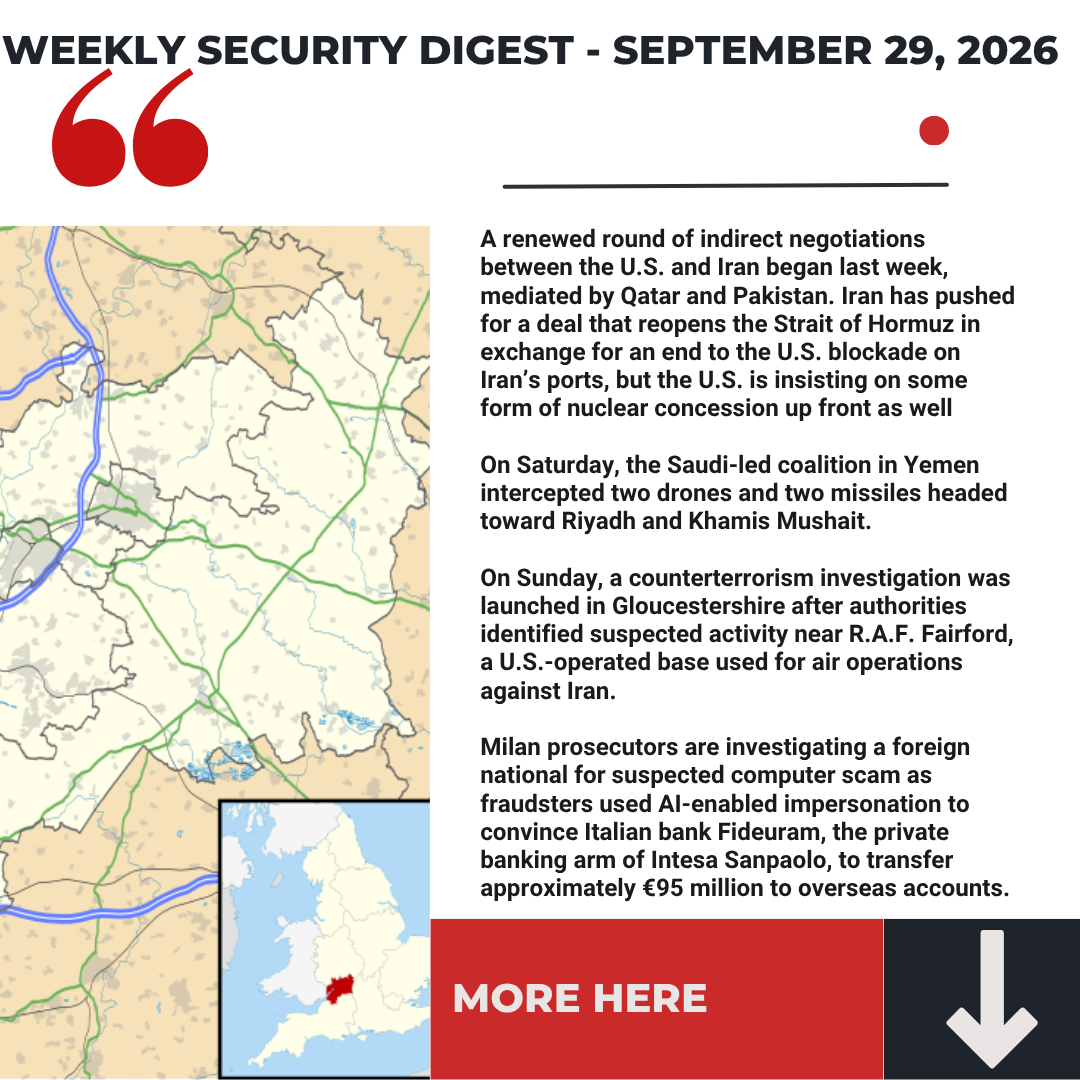
Interfor International‘s Weekly Security Digest – September 29, 2026