

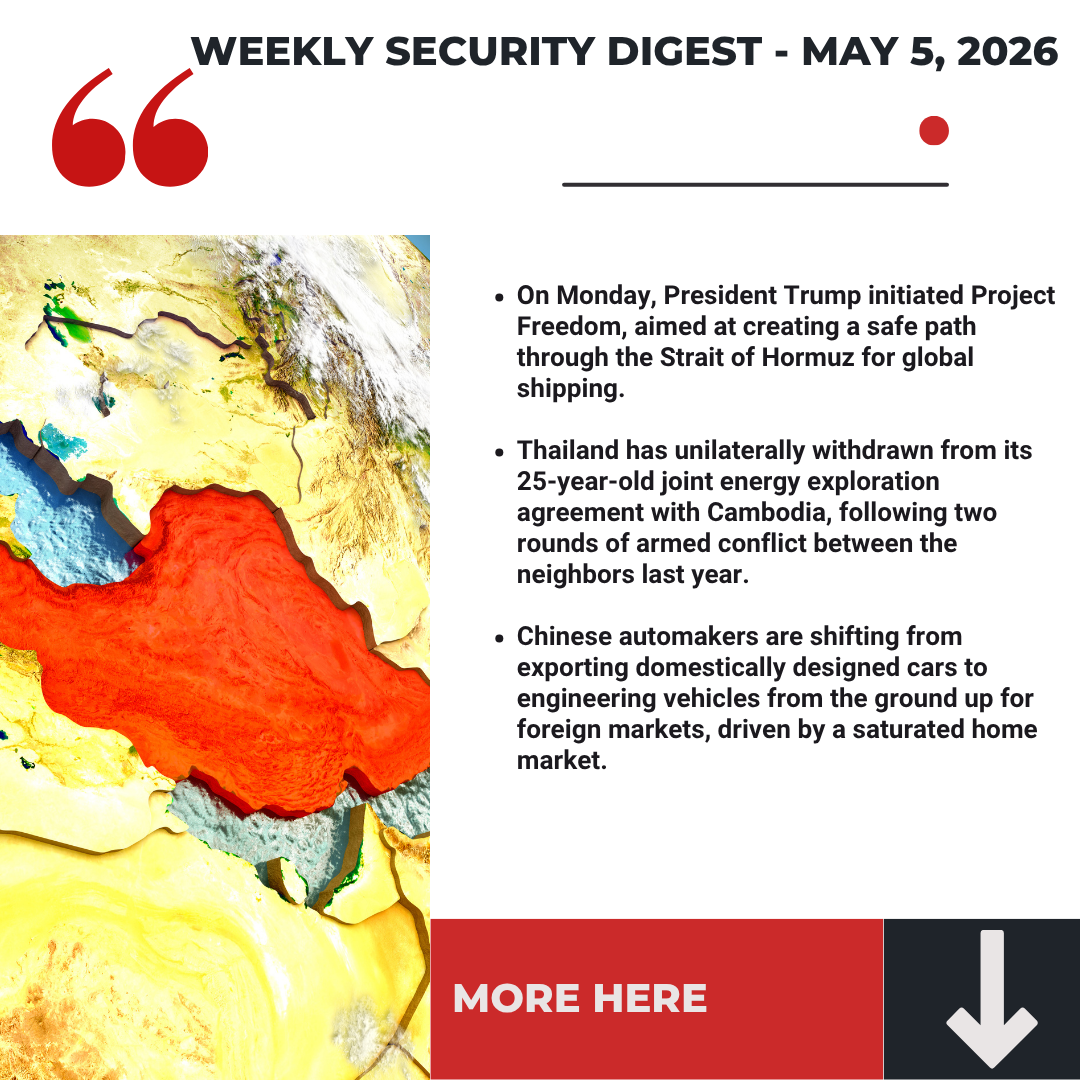
| Middle East → On Monday, President Trump initiated Project Freedom, aimed at creating a safe path through the Strait of Hormuz for global shipping. In response, Tehran launched projectiles at U.S. Navy vessels and U.S.-flagged ships in the Strait and land targets in the U.A.E. Iran did not immediately claim responsibility, but Foreign Minister Araghchi warned the U.S. and U.A.E. against continued aggression in the Strait. With no recent progress in diplomatic negotiations, this week’s events materially increase the risk of the resumption of war. Interfor’s Analysis: For the moment, President Trump seems to want to contain yesterday’s incident, with Secretary Hegseth today announcing that the ceasefire still holds. Nevertheless, the U.S. will face increased pressure from the U.A.E. and Israel to resume combat operations against Iran following the attack. Broadly, Trump has three options: 1) overlook yesterday’s events and continue to pursue a diplomatic resolution; 2) authorize a tit-for-tat limited military response, designed to symbolically punish Iran on the U.A.E.’s behalf, without triggering a return to full-scale war or derailing diplomacy; or 3) opt to return to full-scale war. For now, the first two options seem likeliest, but further attacks on the U.A.E. or other Gulf states will push the limits of what Trump can ignore. If Iran or the Houthis target Israel in the coming days, that would almost certainly provoke an Israeli response and risk escalation. International Affairs →→ Thailand has unilaterally withdrawn from its 25-year-old joint energy exploration agreement with Cambodia, following two rounds of armed conflict between the neighbors last year. Prime Minister Anutin had pledged the cancellation as a campaign promise, though he framed it as a policy decision given the deal’s limited progress since 2001. Cambodian authorities claim they will now seek resolution under the United Nations Convention on the Law of the Sea. The prospect of productive bilateral negotiations remains remote. → Chinese automakers are shifting from exporting domestically designed cars to engineering vehicles from the ground up for foreign markets, driven by a saturated home market. The strategy is already showing results, with Chinese brands doubling their U.K. market share to 14.2% in the first quarter and nearly doubling their European share to 6% last year. Chinese companies are facing declining domestic sales and will need to expand internationally to survive. → The Russian Defense Ministry declared a unilateral ceasefire for Friday and Saturday to celebrate Victory Day, Russia’s celebration of the defeat of Nazi Germany. Ukrainian President Zelenskyy announced that his country would observe a truce from Wednesday onward. The two adversaries have attempted similar temporary ceasefires since the war began, though they have largely failed to fully prevent hostilities, even for a short period. → On Thursday, the United Kingdom raised its terrorism threat level to “severe” following a stabbing in Golders Green, a historically Jewish neighborhood. The decision follows a string of antisemitic attacks, with 3,700 incidents recorded in 2025 alone. While Prime Minister Starmer’s government has pledged £25 million in community protection funding, it faces a credibility gap: Jewish groups and the government’s own terrorism advisor are calling the situation a national emergency, while ministers stop short of that language. The incident has alarmed European counterterrorism officials, who view it as a significant escalation in a broader pattern of attacks across the E.U. → Scandal has erupted around President Mattarella’s February pardon of Nicole Minetti, a former television personality convicted of procuring prostitutes for Berlusconi’s “bunga bunga” parties. The pardon was approved on humanitarian grounds due to Minetti’s care for a seriously ill adopted child, but is now under investigation for alleged irregularities. Italian authorities allege that the pardon request contained misleading information, and they are working with Interpol to determine the facts of the case. The affair is proving challenging for Meloni’s government, with Justice Minister Nordio now facing calls to resign. → A Dutch cruise ship, the MV Hondius, has been stranded off Cape Verde since Monday after a suspected hantavirus outbreak killed three passengers and left several others seriously ill. Cape Verde denied the ship permission to dock, leaving two crew members with urgent respiratory symptoms unable to receive care. Hantavirus is typically contracted by breathing in particles from infected rodent droppings or urine, and while the World Health Organization has sought to limit alarm, ongoing contact tracing across multiple countries highlights the difficulty of containing the situation. → Two of Nigeria’s leading opposition figures, Peter Obi and Rabiu Kwankwaso, defected from the African Democratic Congress (A.D.C.) to join the Nigeria Democratic Congress (N.D.C.), raising the prospect of a joint presidential ticket against President Bola Tinubu ahead of elections in early 2027. The pairing is geographically strategic, as Obi commands youth support in the south, and Kwankwaso holds sway in the north, but risks repeating the mistakes of 2023, when a fragmented opposition allowed Tinubu to win with just 37% of the vote. Whether the alliance holds will hinge on the still-unresolved question of who will be the presidential candidate. |
A Note From Interfor
→ Don Aviv and Jeremy Hurewitz on Pakistan’s involvement in the Iran war for The Hill
→ Don Aviv and Sabrina Tan on the increasing threat of cyber attacks in Time Magazine
| Resources: US Department of State Travel Advisories CISA: nation-state cybersecurity threats and other resources for cybersecurity matters. |
To find out more, please reach out to info@interforinternational.com
Related Blog
VIEW ALL
Geopolitics. Global Security, & Current Events
Interfor International‘s Weekly Security Digest – August 25, 2026
Geopolitics. Global Security, & Current Events
Interfor International‘s Weekly Security Digest – August 18, 2026
Geopolitics. Global Security, & Current Events
Interfor International‘s Weekly Security Digest – August 11, 2026