

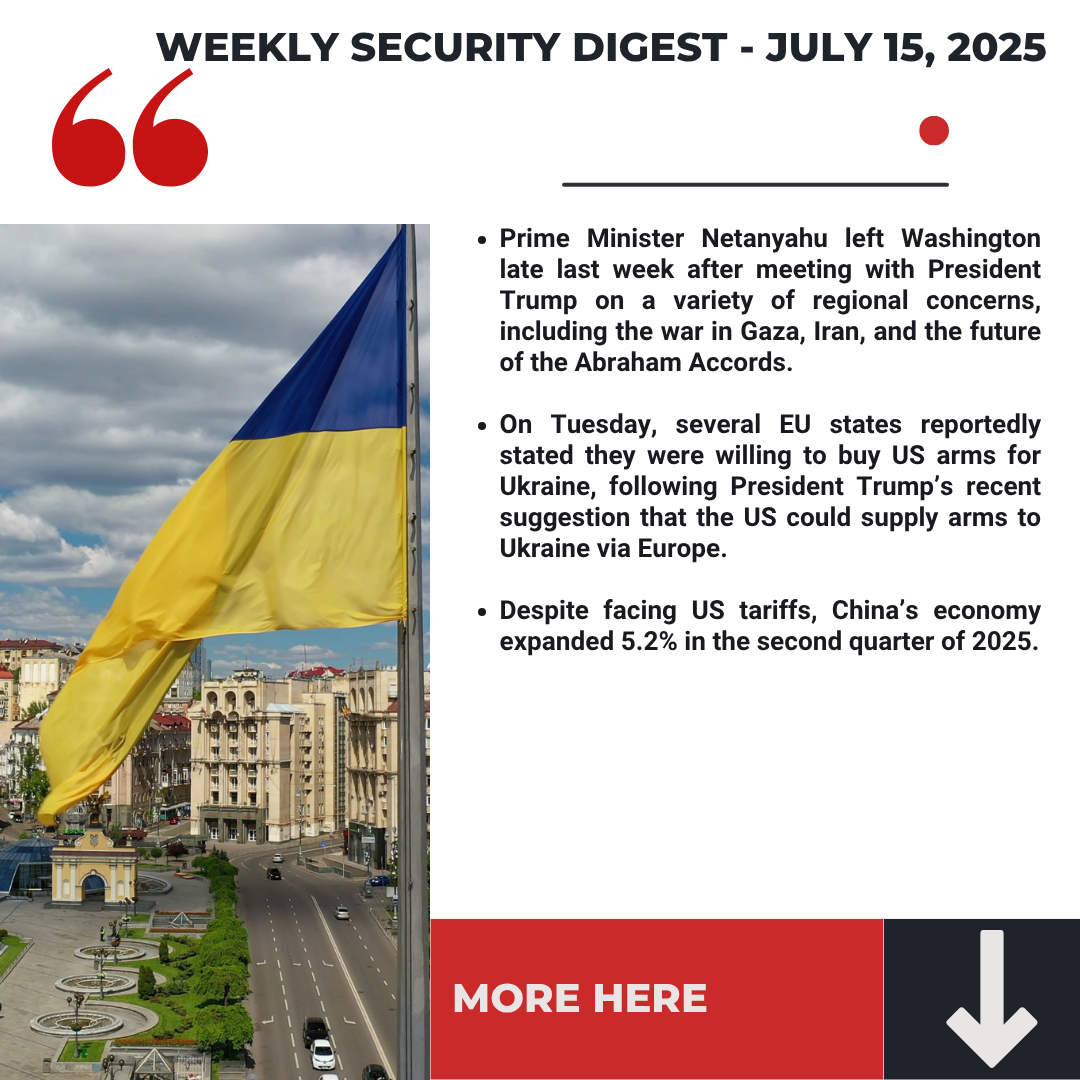
| Middle East → Prime Minister Netanyahu left Washington late last week after meeting with President Trump on a variety of regional concerns, including the war in Gaza, Iran, and the future of the Abraham Accords. In regards to Gaza, Netanyahu returned to Jerusalem without announcing a ceasefire deal, as some had predicted. Rather, the IDF has reportedly intensified operations on the ground, while talks in Doha remain stuck on to what extent the IDF will remain in Gaza during and after a ceasefire and control of the aid distribution system. Further complicating negotiations, the Israeli Defense Minister Israel Katz is promoting a plan to move hundreds of thousands of Gazans into Rafah, displacing many from their homes elsewhere in the Strip. The plan has not been formally announced, though critics in and outside of Israel have denounced it as a violation of international humanitarian law. Interfor Analysis: In addition to discussing Gaza, Netanyahu and his team spoke to the Trump administration about Iran and the potential need for further military action against the Islamic Republic’s nuclear program. At this stage, President Trump has indicated a preference for diplomacy, but we expect Israel to continue to push for military alternatives, unless the US is able to secure a deal that reduces Iran’s domestic enrichment capacity to zero. → On Monday and Tuesday, Israel carried out airstrikes against Syrian government forces in southwestern Syria. The IDF claims that the strikes are an effort to protect the Druze minority, following a surge in ethnic violence in Syria. Dozens have reportedly been killed in clashes between Druze forces and the government since Sunday. |
| International Affairs → On Tuesday, several EU states reportedly stated they were willing to buy US arms for Ukraine, following President Trump’s recent suggestion that the US could supply arms to Ukraine via Europe. The details of these transfers are not yet public, though some US officials have suggested that European states should give their weapons to Ukraine and buy replacements from the US, potentially leaving donor states militarily exposed. Officials from Sweden, the Netherlands, Norway, and Finland have expressed support for the idea. The Financial Times reported on Tuesday that President Trump is privately inquiring if President Zelenskyy would be able to use these weapons to strike main Russian cities, including Moscow. → Despite facing US tariffs, China’s economy expanded 5.2% in the second quarter of 2025. The growth rate shows that China has been able to maintain its export and investment volumes despite weak domestic demand and US tariffs. However, some Chinese economists remain concerned that a slowdown could be imminent, particularly in the real estate market. → Four Canadian men, including two active servicemembers, were charged with facilitating terrorist activity and firearms- and explosives-related charges. The men allegedly were planning to form an “anti-government militia” in order to gain control of land in Quebec. → On Saturday, President Trump announced 30% tariffs on the EU and Mexico starting August 1. In response, EU Commission President Ursula von der Leyen stated that the EU would take “necessary steps” to safeguard its interests, though von der Leyen and other European leaders have stopped short of indicating that aggressive action will be taken. If the tariffs do go into effect, it would primarily impact the pharmaceuticals, automobile, aircraft, medical instruments, and wine industries. → On Friday, the Sudanese paramilitary group attacked the city of El Fasher in Darfur, the last government-controlled territory in the region. The army successfully pushed the RSF outside of El Fasher the following day, though the attack led many civilians to flee to nearby cities. Regardless of if they fled, civilians are subject to increasing famine and frequent violence. After two years of violent conflict between the RSF and the government, the ICC stated they believed war crimes were taking place in Darfur, following consistent calls for humanitarian assistance to the region. Check out our interview with the newest member of Interfor Academy, Tom Hardin, known as “Tipper X” by the FBI. |
| Resources: US Department of State Travel Advisories CISA: nation-state cybersecurity threats and other resources for cybersecurity matters. Check out our newly enhanced media hub. See our most recent talk on the rise of ideological violence in the United States and how corporate security professionals are meeting the challenge, featuring former Director of the U.S. Secret Service, Mark Sullivan. Our latest analysis looks at the Israel-Iran conflict; beyond the headlines. See also our interview with Tom Hardin, one of the most active informants in securities fraud history. |
To find out more, please reach out to info@interforinternational.com
Related Blog
VIEW ALL
Geopolitics. Global Security, & Current Events
Interfor International‘s Weekly Security Digest – October 6, 2026
Geopolitics. Global Security, & Current Events
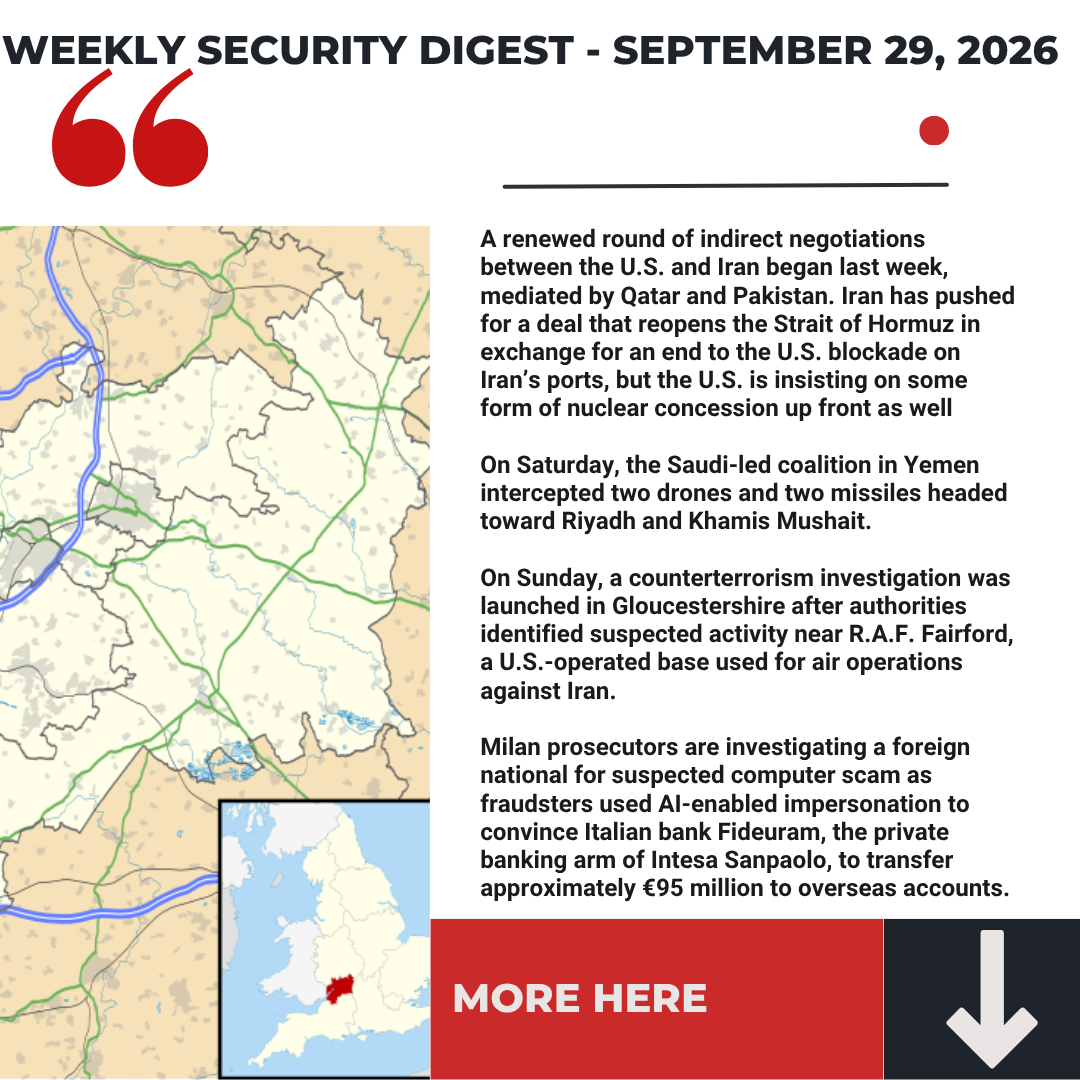
Interfor International‘s Weekly Security Digest – September 29, 2026
Geopolitics. Global Security, & Current Events
Interfor International‘s Weekly Security Digest – September 22, 2026