


| Middle East → On Sunday, Iran’s Assembly of Experts officially named Mojtaba Khamenei the country’s new Supreme Leader. He succeeds his father, Ali Khamenei, who led Iran from 1989 until his death in an Israeli strike on February 28. Mojtaba’s appointment is being seen as a reaffirmation of the leadership’s commitment to regime survival and a further consolidation of control in the hands of the Islamic Revolutionary Guard Corps (I.R.G.C.), which reportedly pushed for his selection. This development is a great example of how an outcome can look impossible before it happens and inevitable after it happens. Skeptics said that Ali Khamenei would never have advocated for his son as a successor, fearing comparison to hereditary monarchies like Iran’s former rulers, the Pahlavis. Many also believed (or hoped) that the Islamic Republic would seize the opportunity to appoint someone at least seemingly more moderate, as a symbolic concession to facilitate a new era of relations with the US. As it turns out, killing the elder Khamenei made his son’s appointment dramatically more likely. It gave Ali Khamenei legendary status as a martyr, and Mojtaba status as a “living martyr.” Moreover, it made electing Mojtaba the ultimate gesture of defiance against the US and the ultimate commitment to regime survival. Mojtaba Khamenei’s election has generated significant pessimism among those who had hoped for a speedy end to this conflict. Selecting Mojtaba signals defiance externally and an intention to stay the course at all costs internally. We expect the U.S. and Israel to target the new Supreme Leader in the days ahead. → On Saturday, Israel began a series of airstrikes on Iranian infrastructure targets, specifically oil depots, which ignited fires across Tehran. Iranian targeting of energy infrastructure across the Gulf alongside extended disruption of shipping via the Strait of Hormuz has driven oil and gas prices up significantly. Overnight Sunday, oil briefly touched $120 per barrel, before retreating back toward $90 on Monday. On Monday, President Trump told reporters both that the war was nearly done and separately implied that the U.S. could still escalate significantly. Trump is increasingly drawing criticism for generating confusion around war objectives. His team has tried to rein in discussion of regime change as a primary objective, instead pointing to the staggering success of U.S. and Israeli strikes in degrading Iranian military capabilities. However, Trump continues to reference loftier objectives, including regime change and even his intention to be consulted on who takes over Iran. The next few days will be critical for determining the route forward for the U.S. and Israeli effort following the Islamic Republic’s doubling down on regime survival with the election of Mojtaba Khamenei. Despite Mojtaba’s election, the regime is significantly weakened. And yet, we still are not seeing signs that regime collapse or even moderation is on the immediate horizon. At some point, the U.S. may have to decide what kind of political settlement would be acceptable, even with unacceptable leaders at the helm in Iran. → The Lebanese government requested that the U.S. mediate direct peace talks with Israel, but the U.S. rejected the offer, citing a lack of commitment from the Lebanese government to facilitating the disarmament of Hezbollah. Israel and Hezbollah began trading airstrikes on March 1, and Israeli forces are now on the ground in much of southern Lebanon. Lebanese President Joseph Aoun proposed a plan to pause hostilities while the Lebanese Armed Forces demilitarize Hezbollah, though Israeli officials remain reluctant to halt operations in the region. International Affairs → Spanish Prime Minister Pedro Sanchez refused to allow the United States to use joint Spanish-U.S. military bases for operations linked to strikes on Iran, citing his concerns for safeguarding international law. In response, U.S. President Donald Trump threatened to cut off trade with Spain, accusing Madrid of failing to support the military campaign and of insufficient N.A.T.O. defense spending. → On Monday, French President Emmanuel Macron announced that France and several E.U. allies are preparing a joint maritime mission to reopen and secure navigation through the Strait of Hormuz, following disruptions caused by the ongoing conflict with Iran. The initiative aims to escort commercial vessels and restore the flow of global oil shipments through one of the world’s strategic chokepoints. → In the early hours of Sunday, an explosion occurred outside the U.S. Embassy in Oslo, causing minor damage to the consular entrance but no reported injuries. Norwegian authorities are investigating the incident. Officials have not released a clear motive, though some officials speculate that it may be connected to the war with Iran. → Despite trade tensions with the U.S., China’s exports have surged in the first two months of 2026, rising by more than 20% year-on-year, far exceeding economists’ expectations and placing the country on track to surpass its record trade surplus from 2025. The data comes ahead of a planned meeting between U.S. President Donald Trump and Chinese President Xi Jinping in early April, as Beijing continues to rely on export growth to offset weak domestic consumption and a prolonged property market slowdown. → Ghana has called on the Commonwealth to condemn a missile strike that injured four Ghanaian U.N. peacekeepers serving in southern Lebanon on Friday, describing the attack as a violation of the principles underpinning the U.N. Charter. Foreign Minister Samuel Okudzeto Ablakwa urged member states to support an immediate investigation of the strike, whose origin he did not specify, and lodged a formal protest with U.N. Secretary-General António Guterres. The soldiers, deployed as part of the United Nations Interim Force in Lebanon (U.N.I.F.I.L.), were injured when a strike hit their base amid escalating hostilities between Israel and Hezbollah. The incident has heightened concerns over the safety of peacekeeping forces operating in the region. → On Wednesday, gunmen carried out a large-scale attack on villages in Kwara State, Nigeria, killing approximately 160 people and injuring dozens. The attackers stormed the communities of Woro and Nuku, reportedly going door-to-door, setting homes on fire and executing residents, while dozens of people were abducted. Nigerian authorities attributed the violence to extremist militant groups operating in the region, and President Bola Tinubu ordered the deployment of additional military forces to restore security. United States → Since at least 2016, U.S. military, C.I.A., and diplomatic officials have reported mysterious neurological symptoms after being deployed, which officials collectively call “Havana Syndrome.” Several government task forces have studied the phenomenon since, though, according to a 60 Minutes investigation that aired Sunday, many victims believe these investigations mistakenly characterized Havana Syndrome as environmental in origin or related to preexisting conditions. The investigation revealed that in 2024, covert American operatives purchased a miniaturized microwave weapon from a Russian weapons dealer. The U.S. military’s studies of its effects on rats have produced similar effects to Havana Syndrome, bringing renewed attention to the possibility that the condition is not natural, but a weapon used by a foreign actor. Interfor Academy member Marc Polymeropoulos was interviewed by 60 Minutes for this investigation. → On Saturday, two men threw homemade I.E.D.s into a crowd of protesters outside of Gracie Mansion, the New York City Mayor’s residence. The explosives did not detonate. The suspects, Emir Balat, 18, and Ibrahim Kayumi, 19, were charged with material support for terrorism and using a weapon of mass destruction after an F.B.I. investigation determined the pair was inspired by the Islamic State. Both men are U.S. citizens from Pennsylvania. |
A Note From Interfor
→ Interfor’s team provides suggestions on social media risk management in our blog post here.
→ Steve Romano, former FBI Chief Hostage Negotiator and Interfor Academy member, and Jeremy Hurewitz, Head of Interfor Academy, wrote about the kidnapping of Nancy Guthrie in Newsweek.
→ Thoughts on a changing Thailand – read our blog post here.
| Resources: US Department of State Travel Advisories CISA: nation-state cybersecurity threats and other resources for cybersecurity matters. |
To find out more, please reach out to info@interforinternational.com
Related Blog
VIEW ALL
Geopolitics. Global Security, & Current Events
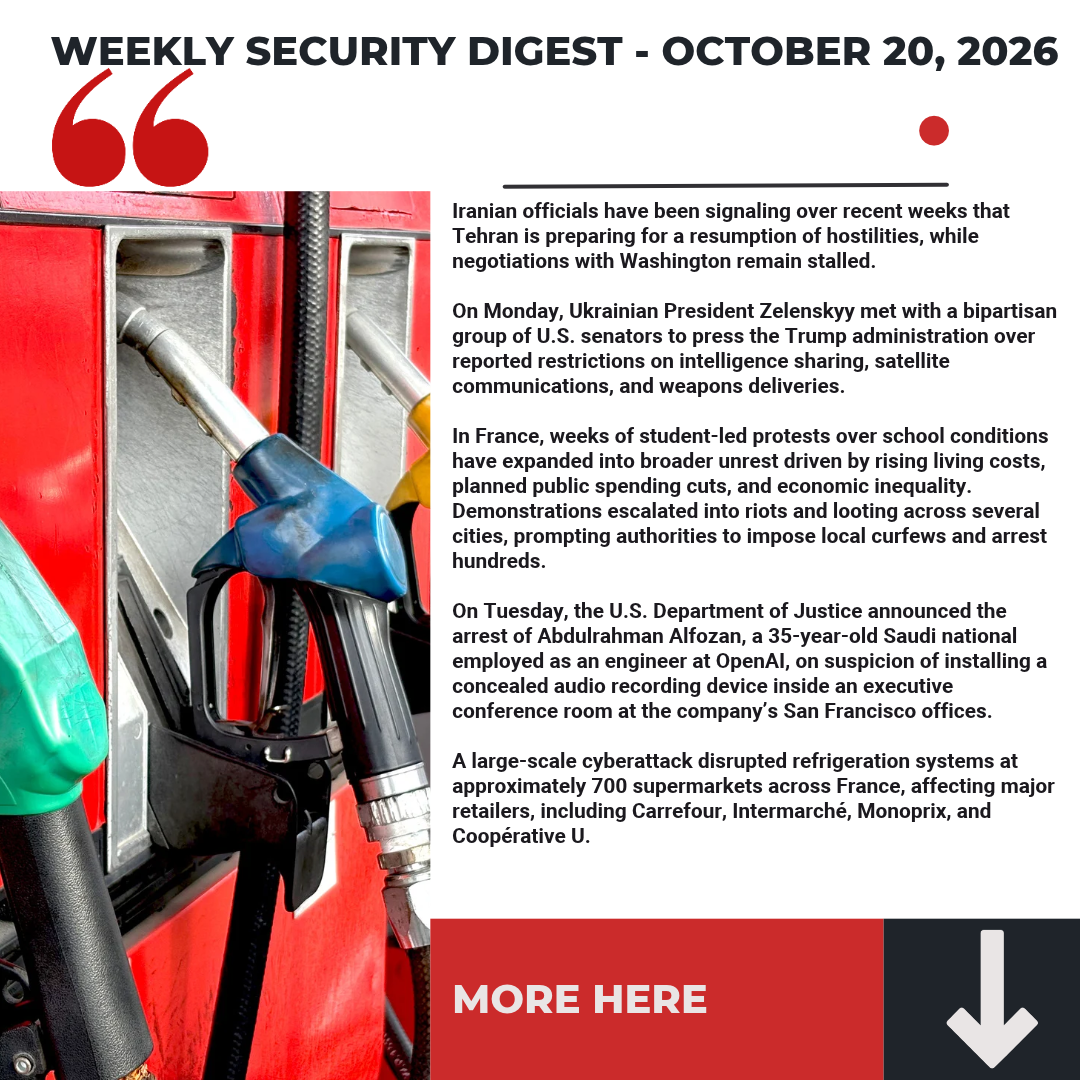
Interfor International‘s Weekly Security Digest – October 20, 2026
Geopolitics. Global Security, & Current Events
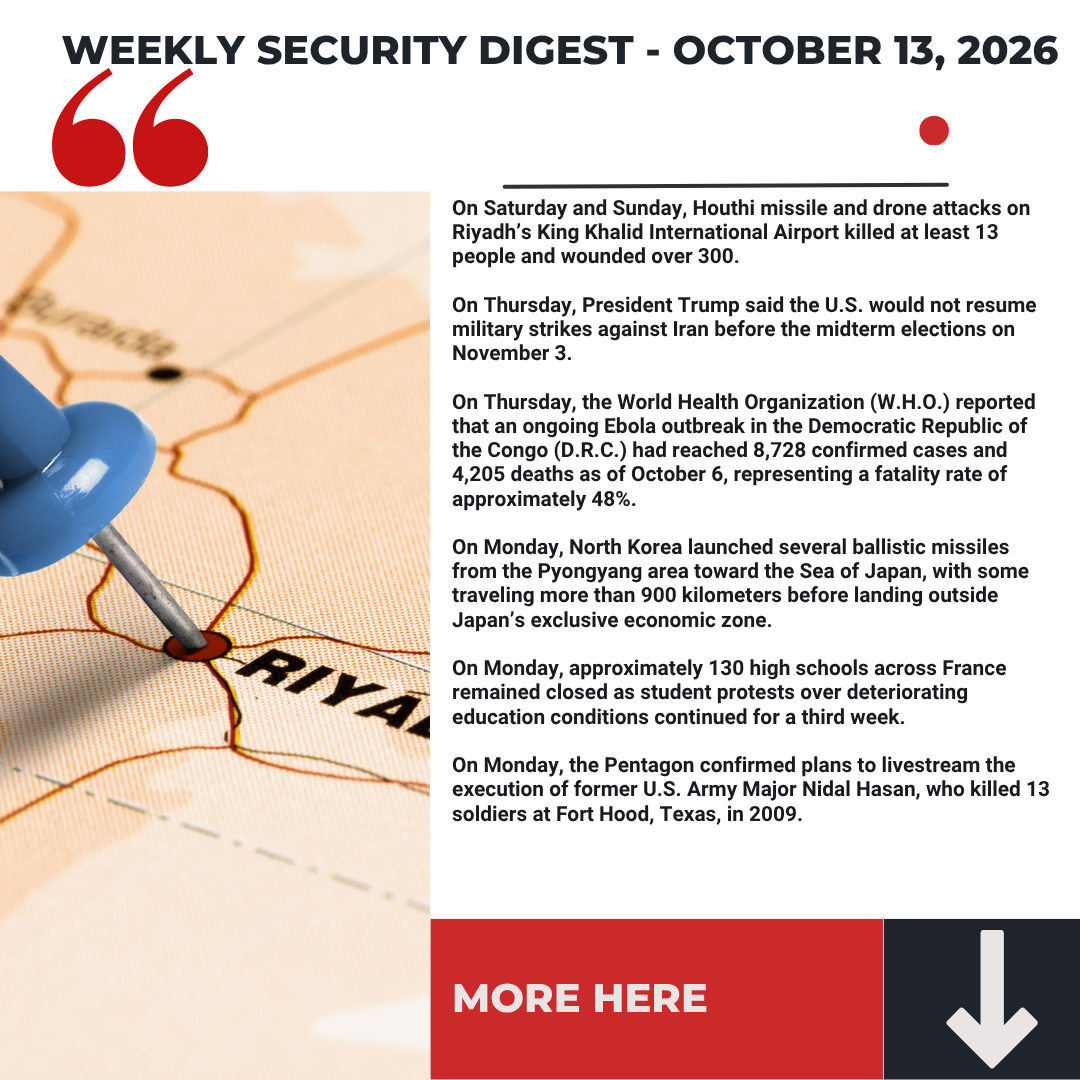
Interfor International‘s Weekly Security Digest – October 13, 2026
Geopolitics. Global Security, & Current Events
Interfor International‘s Weekly Security Digest – October 6, 2026