

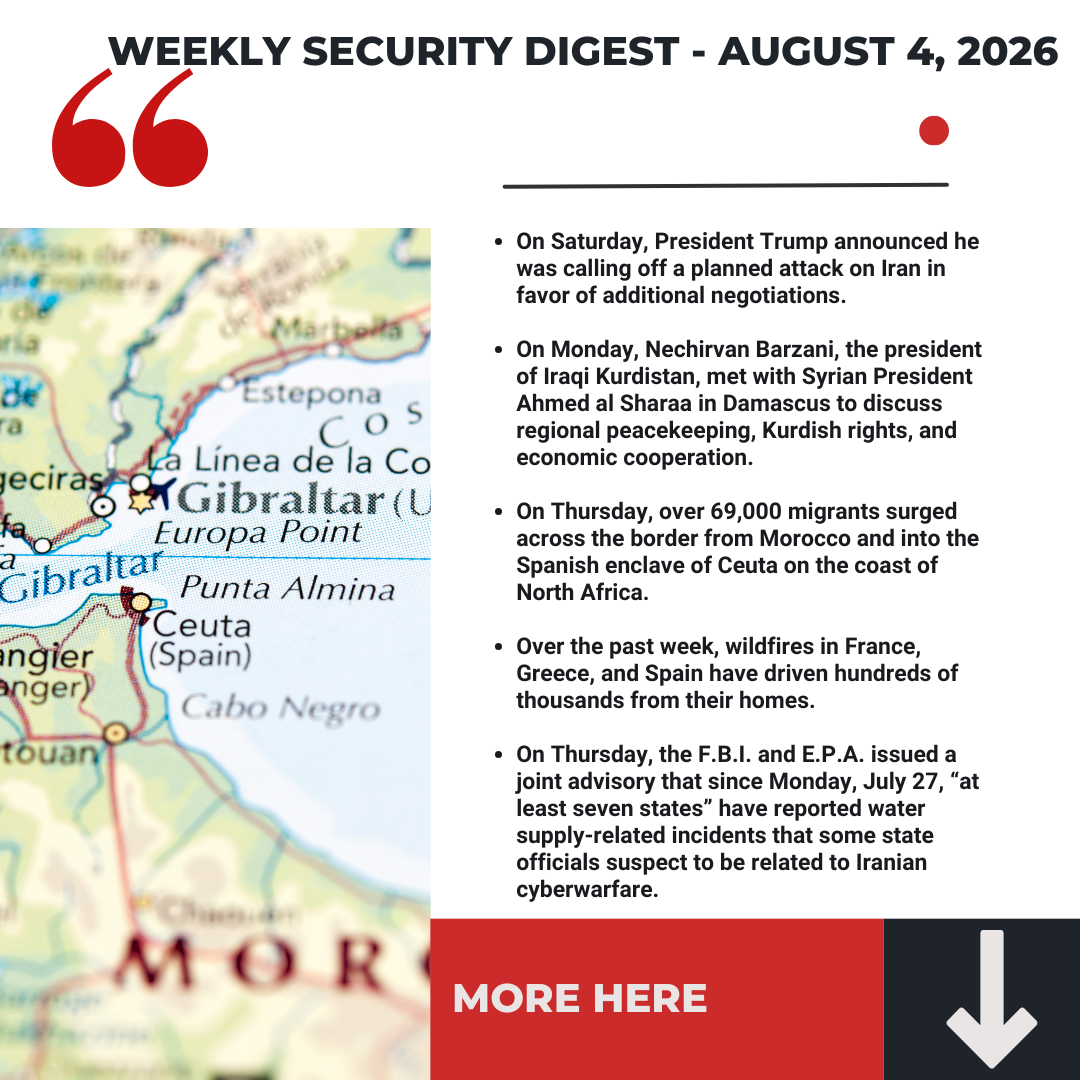
| Middle East → On Saturday, President Trump announced he was calling off a planned attack on Iran in favor of additional negotiations. Trump’s decision followed a call with Saudi Crown Prince Mohammed bin Salman, during which the de facto Saudi leader advocated against escalation. President Trump claimed that direct talks were active and the Strait of Hormuz could open as soon as Tuesday. However, Iranian Foreign Ministry spokesperson Esmail Baghaei denied that the U.S. and Iran were in talks and confirmed only that Iran was negotiating with Oman. The loop we are currently living in, wherein Trump oscillates between escalation and de-escalation against Iran, reflects a lack of good options for the U.S. president. Options for U.S. escalation targeting Iranian energy infrastructure could have provoked devastating retaliation against parallel sites in the Gulf states. At the same time, there is no deal on the table that reestablishes the pre-February 28 status quo in the Strait of Hormuz – free passage without any kind of Iranian “administration” – let alone restrictions on Iran’s nuclear program. As long as the current conditions persist, with no military or diplomatic victory possible at reasonable cost, this cycle between lulls and spikes in hostilities is likely to continue. What remains to be seen is if, this time, Omani, Qatari, or other mediators can propose a creative diplomatic solution that provides at least a longer and more stable ceasefire period. For that to happen, however, the U.S. will demand a fully open Strait and Iran will demand to ship and sell its oil globally with limited or no restrictions. It is worth noting separately that Iran’s rationale has shifted as the current limbo has extended. Operating under a U.S. blockade without the release of frozen funds or the ability to sell its oil, the Islamic Republic sees its economy and its leverage weakening. Therefore, the I.R.G.C. is increasingly willing to escalate, even without clear U.S. provocation, in order to drive up global oil prices and increase pressure on the U.S. to return to some form of deal. An extended no-peace-no-war scenario is seen by some in Tehran as a worst case, which would see the Iranian economy drift further toward collapse, while the Gulf states find new ways to divert oil and other trade around the Strait of Hormuz, gradually stripping Iran of its strategic leverage. → On Monday, Nechirvan Barzani, the president of Iraqi Kurdistan, met with Syrian President Ahmed al Sharaa in Damascus to discuss regional peacekeeping, Kurdish rights, and economic cooperation. This marks Barzani’s first visit to Syria since the fall of Assad in December 2024. President al Sharaa had been working since January to integrate Syria’s Kurdish-led armed force, the Syrian Democratic Forces (S.D.F.), into the national armed forces and to reincorporate S.D.F.-held territory in northern and eastern Syria under state control. International Affairs → On Thursday, over 69,000 migrants surged across the border from Morocco and into the Spanish enclave of Ceuta on the coast of North Africa. The vast majority of migrants retreated back into Morocco within 24 hours, though hundreds remain in makeshift camps. Moroccan authorities claim that the incident resulted from human trafficking networks, misinformation on social media, and reactions to a Spanish ruling on deportation, which largely matches Spain’s official position. The incident has reignited immigration debates in Spain and the E.U. Already, Italy temporarily suspended passport-free travel agreements with Spain, and other European states highlighted the need for increased border security along the Mediterranean. → On Sunday, Brazil’s Workers’ Party announced that President Luiz Inácio Lula da Silva would run for president for the seventh time. Lula will run against conservative Senator Flávio Bolsonaro, son of Brazil’s former president Jair Bolsonaro, who is currently serving time for planning a coup to keep himself in power after losing the 2022 election to Lula. President Trump, Israeli Prime Minister Netanyahu, and Argentinian President Milei have expressed public support for the younger Bolsonaro. → Over the past week, wildfires in France, Greece, and Spain have driven hundreds of thousands from their homes. Emergency services are stretched thin as the fires rage simultaneously. Firefighters contained a wildfire “four times the size of Paris” in the Bordeaux region, and on Sunday two firefighting helicopters collided midair in Greece, killing two crewmembers. The European Forest Fire Information System warned that the risk of additional wildfires remains high across Europe as above-average temperatures continue to hold. → On Monday, the Russian military dropped eight glide bombs on residential areas of Zaporizhzhia, Ukraine, killing one and wounding dozens. The attack prompted President Zelenskyy to again request Patriot air defense systems from allied countries. The Ukrainian military continues to carry out its own long-range drone attacks deep inside Russia, primarily targeting manufacturing hubs, oil refineries, and military sites. → On Wednesday, the Russian Federal Security Service formally charged Telegram founder Pavel Durov with aiding terrorism. The Russian government claims that Durov is responsible for Ukraine’s use of Telegram to conduct intelligence and sabotage operations. The Kremlin has already blocked the use of Telegram in Russia, alongside other messaging apps like WhatsApp. Durov also remains under investigation in France for allowing the platform to be used in illicit activity such as drug and sex trafficking. United States → On Thursday, the F.B.I. and E.P.A. issued a joint advisory that since Monday, July 27, “at least seven states” have reported water supply-related incidents that some state officials suspect to be related to Iranian cyberwarfare. President Trump denied these claims, though other federal officials stated that an investigation was still ongoing. Minnesota and Michigan have publicly confirmed that portions of their water systems were affected, though their water is still safe to drink. The U.S. Cybersecurity and Infrastructure Security Agency recommended that facilities across the nation unplug vulnerable controllers from the internet. |
A Note From Interfor
→ Don Aviv and Jeremy Hurewitz on the recent hostage crisis in California in The Hill.
→ Interfor’s team makes the case that N.A.T.O. faces a subtler threat than invasion.
| Resources: US Department of State Travel Advisories CISA: nation-state cybersecurity threats and other resources for cybersecurity matters. |
To find out more, please reach out to info@interforinternational.com
Related Blog
VIEW ALL
Geopolitics. Global Security, & Current Events
Interfor International‘s Weekly Security Digest – September 15, 2026
Geopolitics. Global Security, & Current Events
Interfor International‘s Weekly Security Digest – September 8, 2026