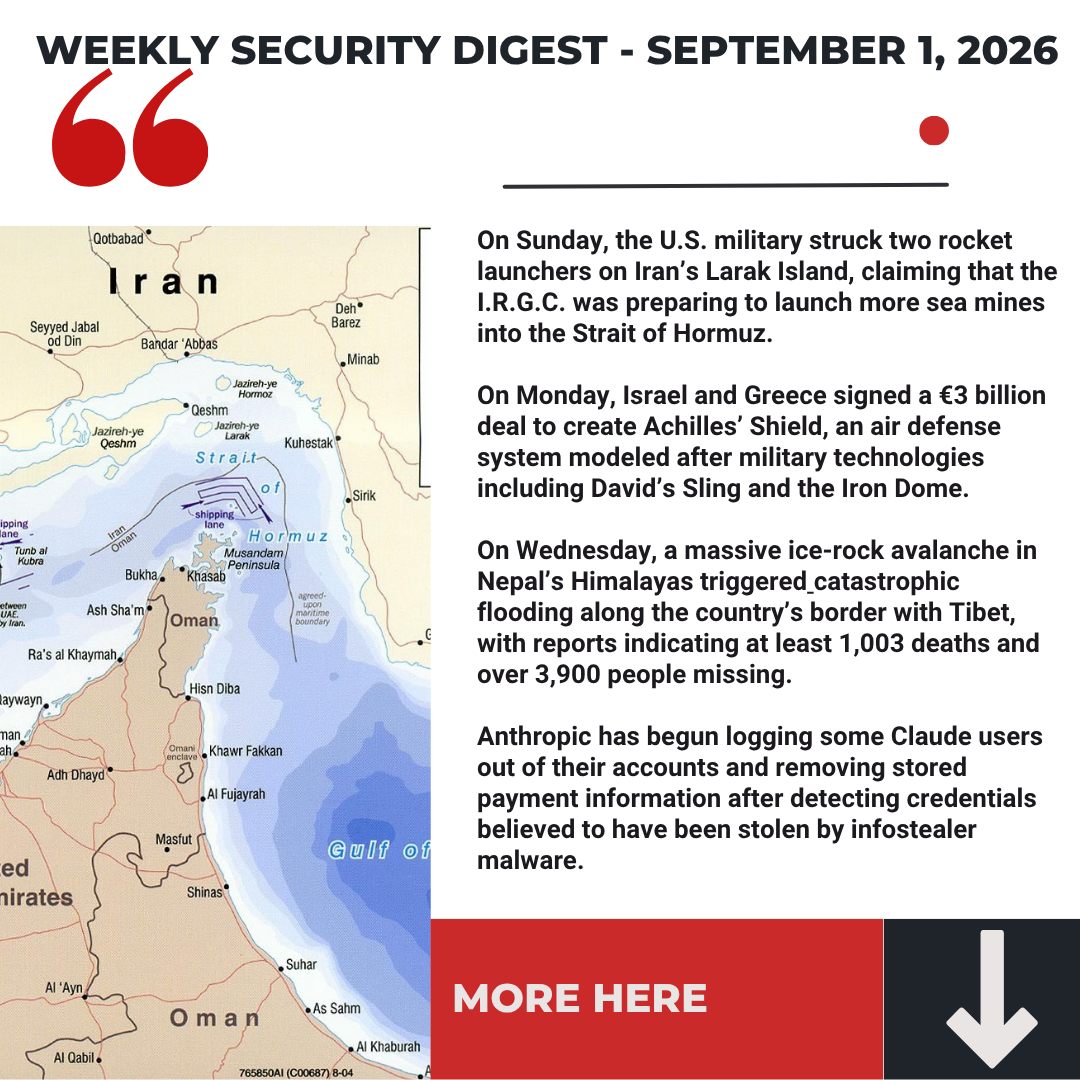



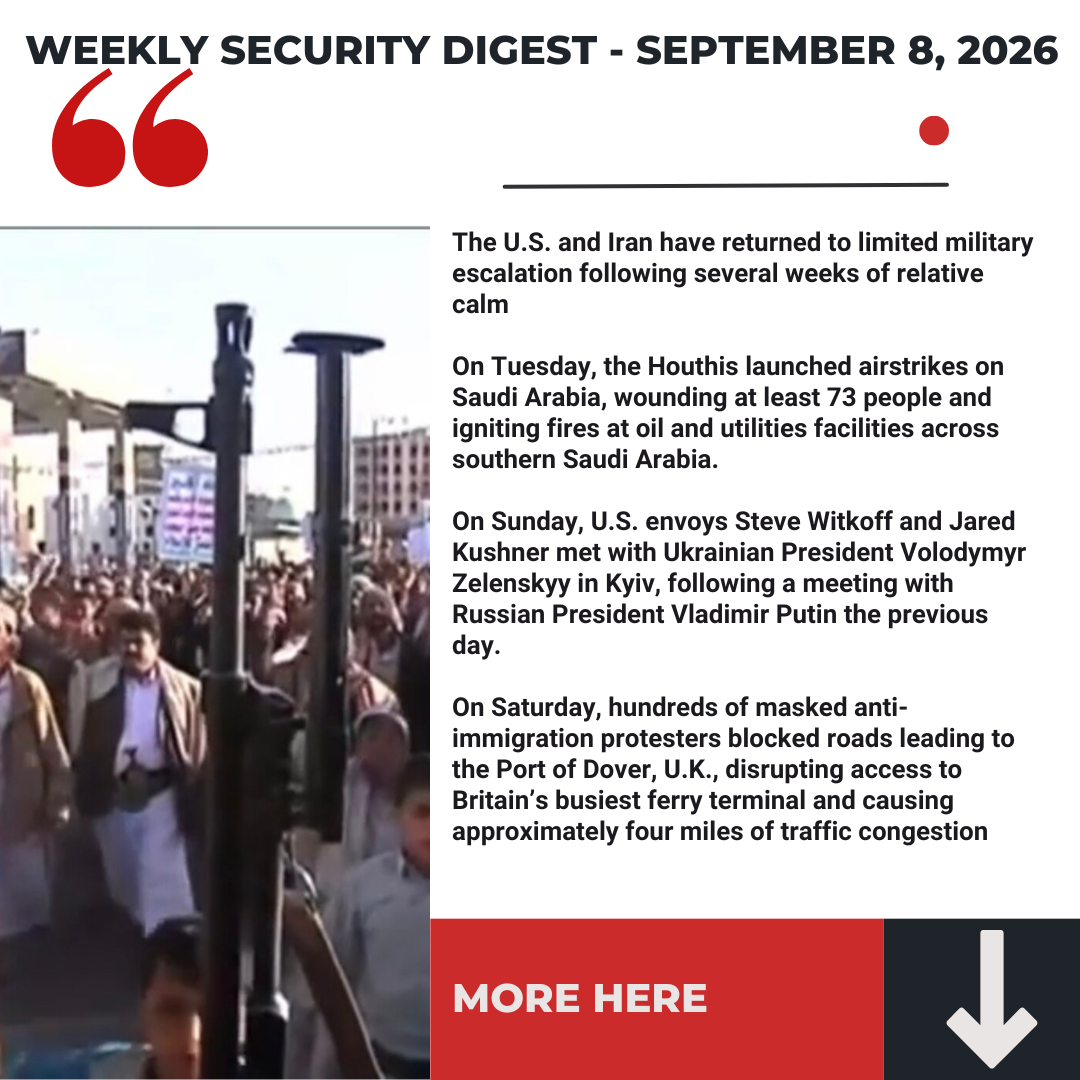
| Middle East → On Friday, the U.S. temporarily paused strikes on Iran while mediators attempt to reach another deal on the Strait of Hormuz. Despite the temporary halt in hostilities, Saudi Arabia, Jordan, and Iraqi Kurdistan reported drone attacks from Iran-aligned groups. Oman, Qatar, and Pakistan are leading mediation efforts. On Tuesday, President Trump will meet with Prime Minister Netanyahu in Washington to discuss the situation in the region.. → Over the past week, Saudi oil infrastructure has taken fire from both Houthi militants in Yemen and, according to the Saudis, Iran-linked militias in Iraq. A drone attack on Monday – for which Saudi Arabia blamed Iraq-based groups – caused “minor damage” to the Kingdom’s Abqaiq processing facility. This follows the Houthis announcing a blockade against Saudi Arabia’s Red Sea ports last week, in an effort to suppress oil exports using those ports to circumvent the Strait of Hormuz. Much remains unclear about the ongoing escalation between Saudi Arabia and Iranian proxies. The Houthis took credit, broadly, for attacks on Saudi oil infrastructure yesterday, alongside Saudi authorities blaming Iraqi militants for the attack. Saudi Arabia’s decision to attribute the attack to Iraqi rather than Houthi (or even Iranian) actors may reflect a deliberate effort to avoid the domestic and regional pressure to escalate the confrontation that would accompany an explicit acknowledgment of a major strike on Abqaiq from those actors. For the moment, however, the Red Sea escalation is still below a threshold that would see the Yemeni civil war and accompanying Saudi air campaign renewed or the Bab al-Mandab fully closed. The Houthis are likely still reluctant to provoke all-out war with the Saudis and their allies in southern Yemen. This could offer an alternative explanation: if the Iraqi groups did, in fact, target Abqaiq, it is possible Iran asked them to do so because the Houthis were reluctant to escalate to that level. In either case, much hinges on the ongoing mediation efforts focused on at least pausing the broader regional conflict. If those efforts fail and the U.S.-Iran confrontation again accelerates, the Saudis could opt to escalate significantly against the Houthis. Their hesitation to do so is likely a sign that they have some faith either that mediation is progressing or that they might be able to reach a separate compromise with the Houthis directly. → Last Wednesday, the U.S. and Saudi Arabia signed a civilian nuclear agreement. President Trump asserted that the deal would neither enable Saudi uranium enrichment nor take effect unless Riyadh joined the Abraham Accords. Critics argue that the agreement goes too far in possibly allowing domestic enrichment and reduces U.S. leverage for normalization with Israel. International Affairs → On Saturday, a van rammed into crowds attending Berlin’s Christopher Street Day Pride celebrations, killing one person and injuring at least 29 others. The suspect, Abdul Ballout, a 21-year-old German national, traveled to Lebanon last year to attempt to join the Islamic State and was convicted there for incitement to religious and sectarian conflict. Ballout fled the scene of Saturday’s attack and was fatally shot by police the following day. Authorities had identified Abdul Ballout as a potential threat, though a German juvenile court released him pending trial in May after assessing that he had “distanced himself” from the terrorist group. → On Saturday, India’s Education Minister Dharmendra Pradhan resigned following weeks of nationwide youth-led protests over alleged examination paper leaks and broader concerns about corruption, unemployment, and government accountability. The resignation marks a rare concession by Prime Minister Narendra Modi’s government, which also agreed to a series of education reforms and other protester demands, prompting organizers to end the demonstrations. → On Monday, a man armed with two kitchen knives stabbed three women in the Porte de Clichy district of Paris. Bystanders and an off-duty police officer subdued the attacker, who reportedly shouted religious slogans during the assault. French counterterrorism authorities are assessing the case, although officials have not yet classified the incident as terrorism and continue to investigate the attacker’s motives, citing possible mental health concerns. → Human Rights Watch recently accused French-British oil company Perenco of exposing communities in the Democratic Republic of Congo to serious environmental and public health risks through waste burning and oil spills at its operations in Kongo Central province. The organization called on the Congolese government to immediately publish the findings of an ongoing environmental audit, alleging that prolonged delays have denied affected communities access to critical information on air, soil, and water pollution, while Perenco denied that its operations caused harmful contamination. |
A Note From Interfor
→ Don Aviv and Sabrina Tan on the increasing threat of cyber attacks in Time Magazine.
→ Interfor’s team makes the case that N.A.T.O. faces a subtler threat than invasion.
| Resources: US Department of State Travel Advisories CISA: nation-state cybersecurity threats and other resources for cybersecurity matters. |
To find out more, please reach out to info@interforinternational.com
Related Blog
VIEW ALL
Geopolitics. Global Security, & Current Events
Interfor International‘s Weekly Security Digest – September 8, 2026

Geopolitics. Global Security, & Current Events
Interfor International‘s Weekly Security Digest – September 1, 2026