

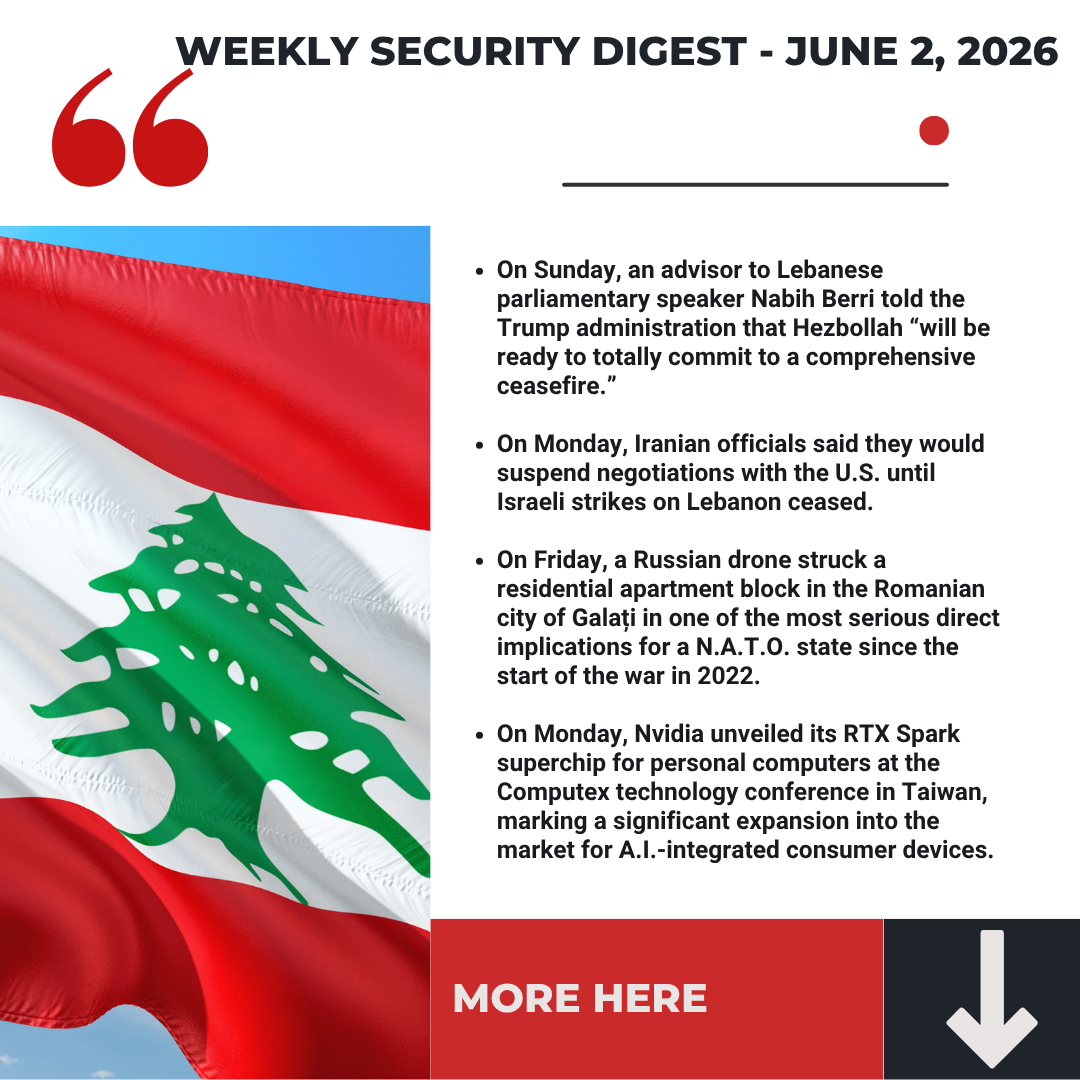
| Middle East → On Sunday, an advisor to Lebanese parliamentary speaker Nabih Berri told the Trump administration that Hezbollah “will be ready to totally commit to a comprehensive ceasefire.” According to Berri’s office, the proposed deal put forward by Secretary Rubio includes an initial halt to strikes on Israel’s north and Beirut, before gradually expanding the ceasefire. Hezbollah continues to launch missiles into Israel’s north, and Israel continues to operate in south Lebanon, with Prime Minister Netanyahu threatening to launch an air campaign on Hezbollah targets in Beirut on Monday. Israeli and Lebanese representatives will meet in Washington on Tuesday. → On Monday, Iranian officials said they would suspend negotiations with the U.S. until Israeli strikes on Lebanon ceased. President Trump and Prime Minister Netanyahu held a call on Monday, during which Trump pressed Netanyahu to refrain from escalating Israeli operations in Lebanon. However, the state of U.S.-Iran negotiations remains tense. I.R.G.C. Quds Force commander Esmail Qaani threatened to use Iran’s proxies to close the Bab al-Mandab strait if Israeli operations in Lebanon were not halted. Each day this past week has brought at least one piece of news indicating a deal could be close, alongside another suggesting the opposite. In the current situation, occasional clashes between the U.S. and Iran around the Strait of Hormuz are not enough to derail the ceasefire, and yet, at the same time, the fundamental differences preventing a comprehensive diplomatic end to the conflict remain unresolved. Still, the leading option on the table is an interim agreement or ceasefire extension that aims to reopen the Strait of Hormuz, while committing to negotiating further on the nuclear issue in the near term. However, even within that limited outcome, the U.S. and Iran are struggling to land a deal that gives both sides what they need politically. The U.S. wants even an initial agreement to commit Iran, even at a high level, to some degree of nuclear compromise. Iran wants to concede as little as possible and, if anything, for the initial agreement to show that the Islamic Republic has made strategic gains through the war. As long as both the U.S. and Iran are trying to win the ceasefire, rather than just end the war, a comprehensive deal is unlikely. An interim or multiphase agreement, in effect an extension of the current ceasefire, remains the likeliest near-term outcome, but a limited resumption of hostilities is still an option for the U.S., particularly as Trump’s impatience with negotiations grows. International Affairs → On Friday, a Russian drone struck a residential apartment block in the Romanian city of Galați in one of the most serious direct implications for a N.A.T.O. state since the start of the war in 2022. The Russian-made Geran-2 (Shahed) drone reportedly diverted from its intended target during a large-scale Russian attack on Ukrainian port infrastructure along the Danube, injuring two civilians and causing significant damage to the building. Romanian authorities responded by closing Russia’s consulate in Constanța, while calling for enhanced N.A.T.O. air defense capabilities along the alliance’s eastern flank. The strike highlights growing concerns about accidental escalation as N.A.T.O. member states must address evolving security challenges coming from Russia. → On Sunday, French authorities detained hundreds of people following violent clashes that erupted during celebrations of Paris Saint-Germain’s Champions League victory. Rioters set vehicles on fire, vandalized businesses and clashed with security forces, injuring over 200, including dozens of police officers. The violence has reignited debate over public order and policing in France, with opposition figures arguing that recurring unrest at major public events reflects broader challenges to state authority and social cohesion. → On Monday, hundreds of women marched in Nairobi to protest rising levels of gender-based violence and demand stronger government action, following a series of high-profile killings that have intensified public concern over women’s safety in Kenya. Demonstrators called for more effective law enforcement, faster judicial processes, and greater accountability from authorities. They argue that existing measures have failed to curb a rise in femicide and other forms of violence against women, with the Federation of Women Lawyers in Kenya reporting approximately 70 cases per week across its offices. Activist organizations warn that failure to formally declare gender-based violence a national crisis could trigger broader nationwide demonstrations, highlighting growing public pressure for more comprehensive policy action. → South African politician and former anti-apartheid activist Marius Fransman applied for refugee status in the U.S., arguing that South Africa’s political trajectory and increasingly polarized debate over race and land reform could expose him to future persecution. Fransman, who has criticized the governing African National Congress, claimed that political discrimination and deteriorating conditions for dissenting voices had made him fear for his safety and long-term prospects in the country. The case comes amid already-strained relations between Washington and Pretoria, as disputes over land reform, race relations, and the Trump administration’s policy of admitting white South African refugees continue to generate diplomatic friction. → On Sunday, Japanese Defense Minister Shinjiro Koizumi rejected Chinese accusations that Tokyo is pursuing “new militarism,” arguing instead that China’s expanding military capabilities and lack of transparency represent a more significant security concern for the region. Speaking at the Shangri-La Dialogue in Singapore, Koizumi defended Japan’s continued increase in defense spending and military modernization under Prime Minister Sanae Takaichi. He emphasized that Tokyo would maintain transparency and remain committed to dialogue. Cyber → On Monday, Nvidia unveiled its RTX Spark superchip for personal computers at the Computex technology conference in Taiwan, marking a significant expansion into the market for A.I.-integrated consumer devices. The chip will power a new generation of Windows-based computers produced by manufacturers including Lenovo, Dell and HP, enabling more advanced A.I. capabilities to run directly on personal devices. The launch comes as Nvidia seeks to extend its dominance beyond data-center infrastructure and into end-user computing. U.S. authorities are simultaneously tightening restrictions on exports of advanced A.I. chips to Chinese firms. |
A Note From Interfor
→ Don Aviv and Jeremy Hurewitz on Pakistan’s involvement in the Iran war for The Hill.
→ Don Aviv and Sabrina Tan on the increasing threat of cyber attacks in Time Magazine.
| Resources: US Department of State Travel Advisories CISA: nation-state cybersecurity threats and other resources for cybersecurity matters. |
To find out more, please reach out to info@interforinternational.com
Related Blog
VIEW ALL
Geopolitics. Global Security, & Current Events
Interfor International‘s Weekly Security Digest – September 15, 2026
Geopolitics. Global Security, & Current Events
Interfor International‘s Weekly Security Digest – September 8, 2026