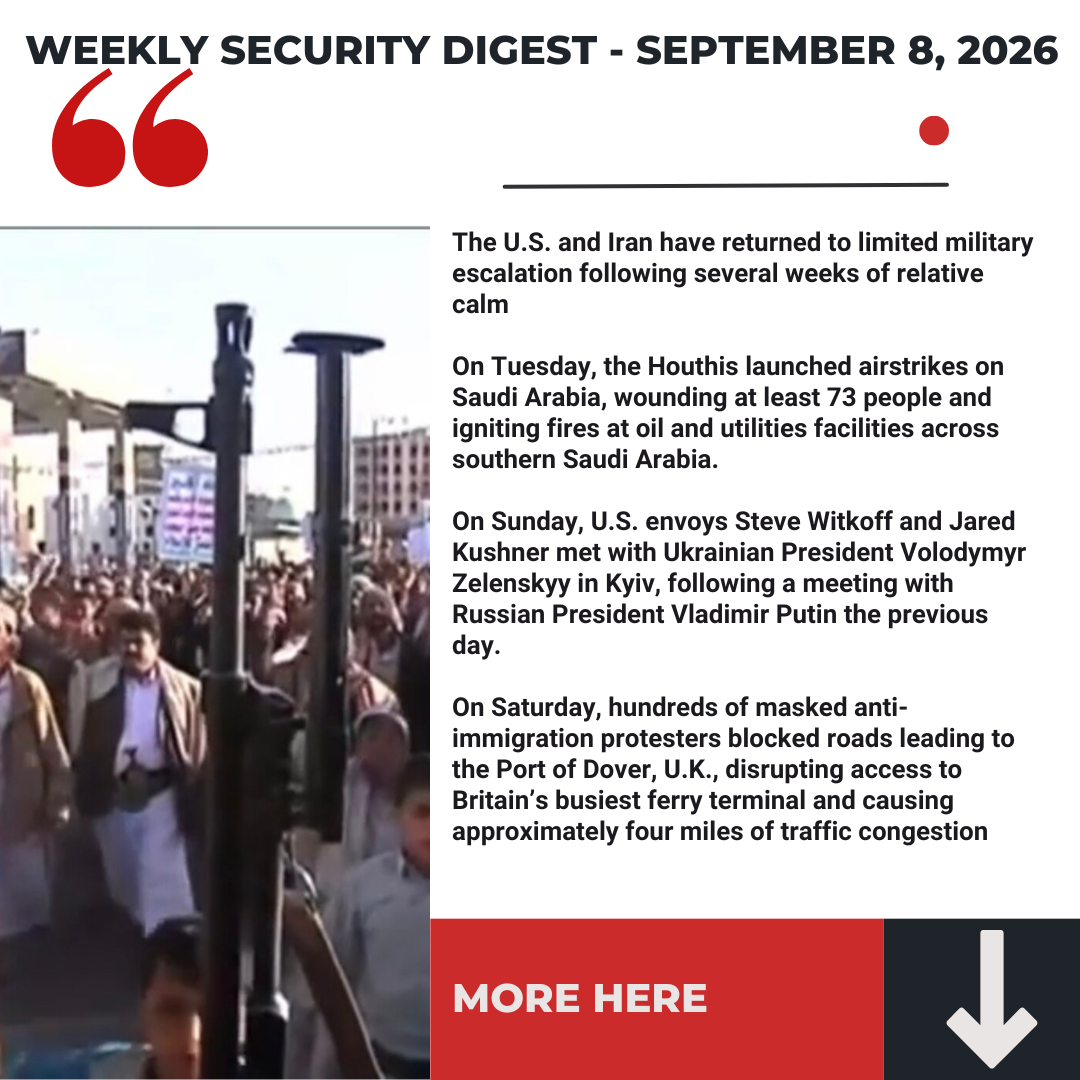


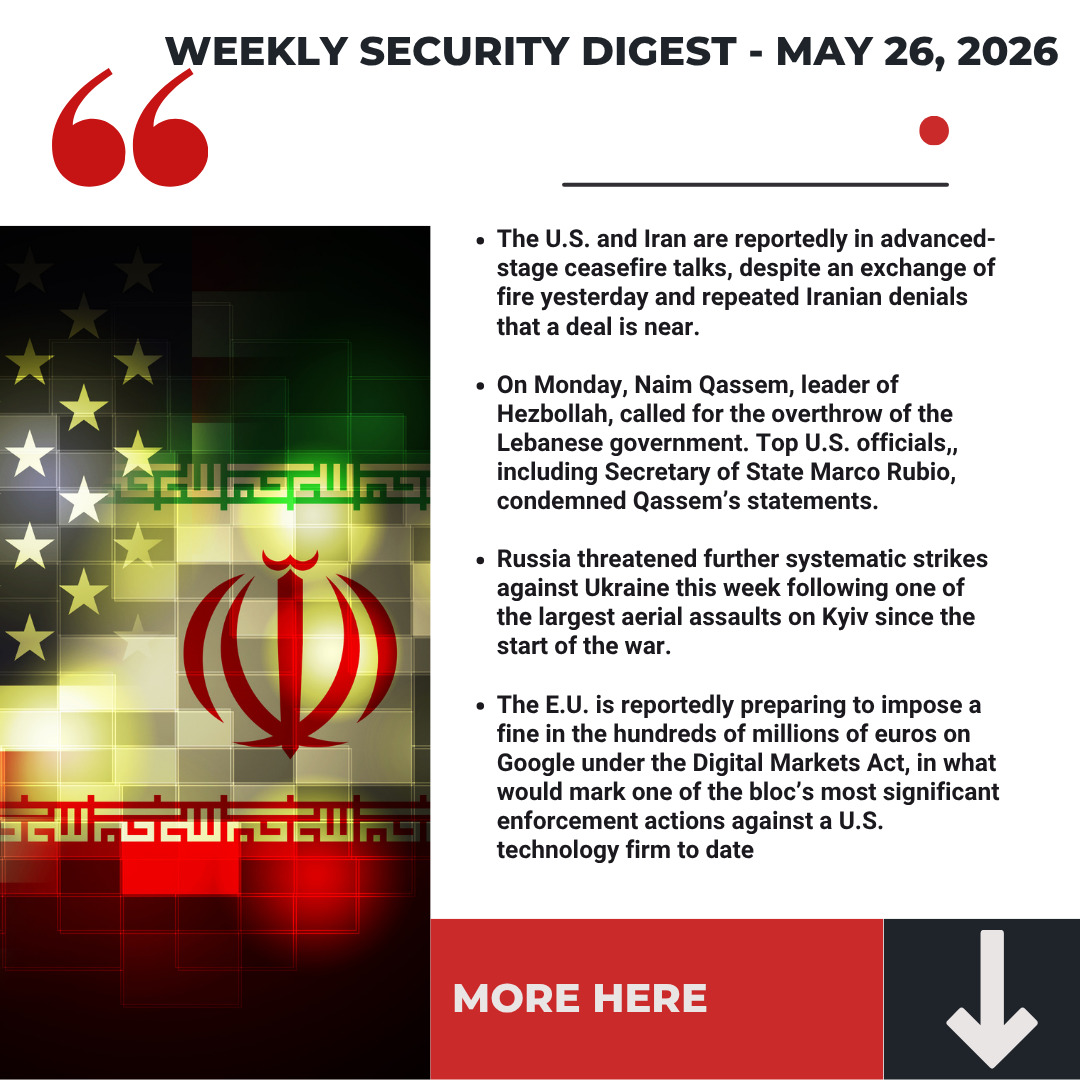
| Middle East → The U.S. and Iran are reportedly in advanced-stage ceasefire talks, despite an exchange of fire yesterday and repeated Iranian denials that a deal is near. The deal would see Iran reopen the Strait of Hormuz in exchange for an end to the U.S. naval blockade, though the talks remain stalled on Iran’s nuclear program. On Saturday, President Trump held a call with regional leaders to discuss the ceasefire. According to several U.S. officials, Trump told regional leaders he expects them to join the Abraham Accords after the war. The request was primarily aimed at Saudi Arabia, which has historically conditioned such a treaty on an irreversible step toward Palestinian statehood. The U.S. Navy conducted strikes on Iranian minelaying boats and missile launchers on Tuesday morning. Iran, in turn, claims to have targeted American drones and fighter jets deployed in the region. Trump continues to show a strong preference for a negotiated end to the war with Iran. Still, however, key issues have not been settled. As we anticipated last week, the deal on the table will first address flows through the Strait of Hormuz, with provisions stipulating that the nuclear issue be addressed on a specific timeframe following the initial ceasefire. It appears that Iran and the U.S. are still working through the language to be included in the initial document related to the nuclear program. Iran would prefer to limit explicit commitments to nuclear concessions for now, which would enable the Islamic Republic’s leadership to more convincingly claim victory domestically. Having asserted that the war was undertaken to prevent Iran from developing a nuclear weapon, Trump faces significant pressure to get expansive nuclear concessions at least hinted at in the initial document. Trump’s sudden request that Arab states join the Abraham Accords is an interesting development. Of the states on the call, the U.A.E. and Bahrain are already part of the Accords, and the U.A.E., notably, was the Gulf state least eager to end the war. Saudi Arabia, Qatar, and Pakistan, however, have all pushed hard for a ceasefire. If this deal is finalized, Trump will be criticized in Israel and on the American right for failing to achieve war aims and conceding too much to Iran. Leveraging the ceasefire to revive the Abraham Accords is Trump’s way of turning a poorly perceived war effort into a victory for his broader foreign policy. Following the Gaza war, public opinion of Israel has declined markedly; perception that Israel dragged the Gulf states into the war with Iran exacerbated this trend. Crown Prince Mohammed bin Salman will almost certainly resist pressure to normalize with Israel in the near term. Broadly, this move from Trump reads like a chess move suggested by Israel and the U.A.E. Netanyahu, highly opposed to ending the war with a weak deal, may have explicitly suggested he “get” ties with Saudi Arabia in exchange for condoning a deal with Iran (in part knowing such a condition would complicate talks). The U.A.E., increasingly aligned with Israel and in open rivalry with Saudi Arabia, sees the revival of the Abraham Accords effort as an opportunity to distinguish itself as a more cooperative U.S. ally than Saudi Arabia or Qatar. → On Monday, Naim Qassem, leader of Hezbollah, called for the overthrow of the Lebanese government. Top U.S. officials,, including Secretary of State Marco Rubio, condemned Qassem’s statements, condemned Qassem’s statements. Despite the ceasefire signed in April, Hezbollah and Israel regularly trade fire in southern Lebanon. The fourth round of direct talks between Israel and the Lebanese government will take place in early June in Washington. International Affairs → Russia threatened further systematic strikes against Ukraine this week following one of the largest aerial assaults on Kyiv since the start of the war. The Russian assault included ballistic and cruise missiles, drones, and a hypersonic Oreshnik missile strike near Bila Tserkva. Moscow stated future attacks would target Ukrainian command centers and drone production facilities, and urged foreign nationals and diplomats to leave the city. Ukrainian officials described the warning as psychological pressure and “shameless blackmail.” They claimed that it reflects Russia’s continued use of coercive signaling alongside intensified missile and drone strikes targeting Kyiv’s civilian infrastructure. Notably, reports suggest Russia may be intentionally taking advantage of reduced U.S. air defense stocks following the war with Iran. If larger air attacks exhaust Ukrainian inventory, resupply of U.S. technology could become complicated, or even force Trump to again reconsider the strategic tradeoffs involved in supporting Ukraine. → The E.U. is reportedly preparing to impose a fine in the hundreds of millions of euros on Google under the Digital Markets Act, in what would mark one of the bloc’s most significant enforcement actions against a U.S. technology firm to date. The investigation centers on allegations that Google unfairly prioritized its own services within search results, reinforcing broader E.U. efforts to curb the market dominance of major technology platforms. The case is likely to further strain transatlantic tensions over digital regulation → On Tuesday, South Korea’s financial regulators announced plans to strengthen oversight of overseas private debt investments amid growing concerns over liquidity risks and exposure to the rapidly expanding global private credit market. Authorities signaled increased scrutiny of domestic institutional investors’ holdings in higher-yield overseas debt products, particularly U.S. private credit funds. Regulators are particularly focused on the concentration of overseas alternative investments among South Korean insurers, pension funds, and asset managers. The government’s concerns that stress in global private credit markets could amplify domestic financial vulnerabilities have prompted these reforms. → On Wednesday, at a Beijing summit, Chinese President Xi Jinping and Russian President Vladimir Putin promoted a “multipolar world order” and opposed perceived U.S.-led global dominance. The leaders also emphasized the depth of the China-Russia strategic partnership. While the talks focused on expanded cooperation across energy, technology, and security sectors, Putin reportedly secured few substantive gains, including no breakthrough on the long-delayed Power of Siberia 2 gas pipeline project. Additionally, the summit highlighted Beijing’s increasingly dominant position within the partnership, as China continues to leverage its diplomatic and economic influence over a more isolated and economically dependent Russia → U.K. scientists at Oxford University announced progress on an experimental Ebola vaccine targeting the rare Bundibugyo strain currently driving an outbreak in the Democratic Republic of Congo. Clinical trials may begin within just two to three months. The vaccine uses the ChAdOx1 platform developed during the Covid-19 pandemic, employing a genetically modified chimpanzee adenovirus to deliver Ebola genetic material and train the immune system to recognize and fight the virus without causing infection. The outbreak has prompted the World Health Organization to raise the domestic risk level to “very high,” amid concerns over rising case numbers, although W.H.O. officials have stated the outbreak is unlikely to develop into a broader global threat → On Monday, Senegalese President Bassirou Diomaye Faye appointed former banking executive Ahmadou Al Aminou Lo as prime minister after dismissing Ousmane Sonko and dissolving the government. The President’s decision follows months of internal tensions within the ruling Pastef movement over governance, political influence, and economic policy direction. The split between the former allies has introduced renewed political uncertainty at a time of mounting economic pressure, including debt restructuring efforts and ongoing negotiations with the International Monetary Fund. |
A Note From Interfor
→ Don Aviv and Jeremy Hurewitz on Pakistan’s involvement in the Iran war for The Hill.
→ Don Aviv and Sabrina Tan on the increasing threat of cyber attacks in Time Magazine.
| Resources: US Department of State Travel Advisories CISA: nation-state cybersecurity threats and other resources for cybersecurity matters. |
To find out more, please reach out to info@interforinternational.com
Related Blog
VIEW ALL
Geopolitics. Global Security, & Current Events
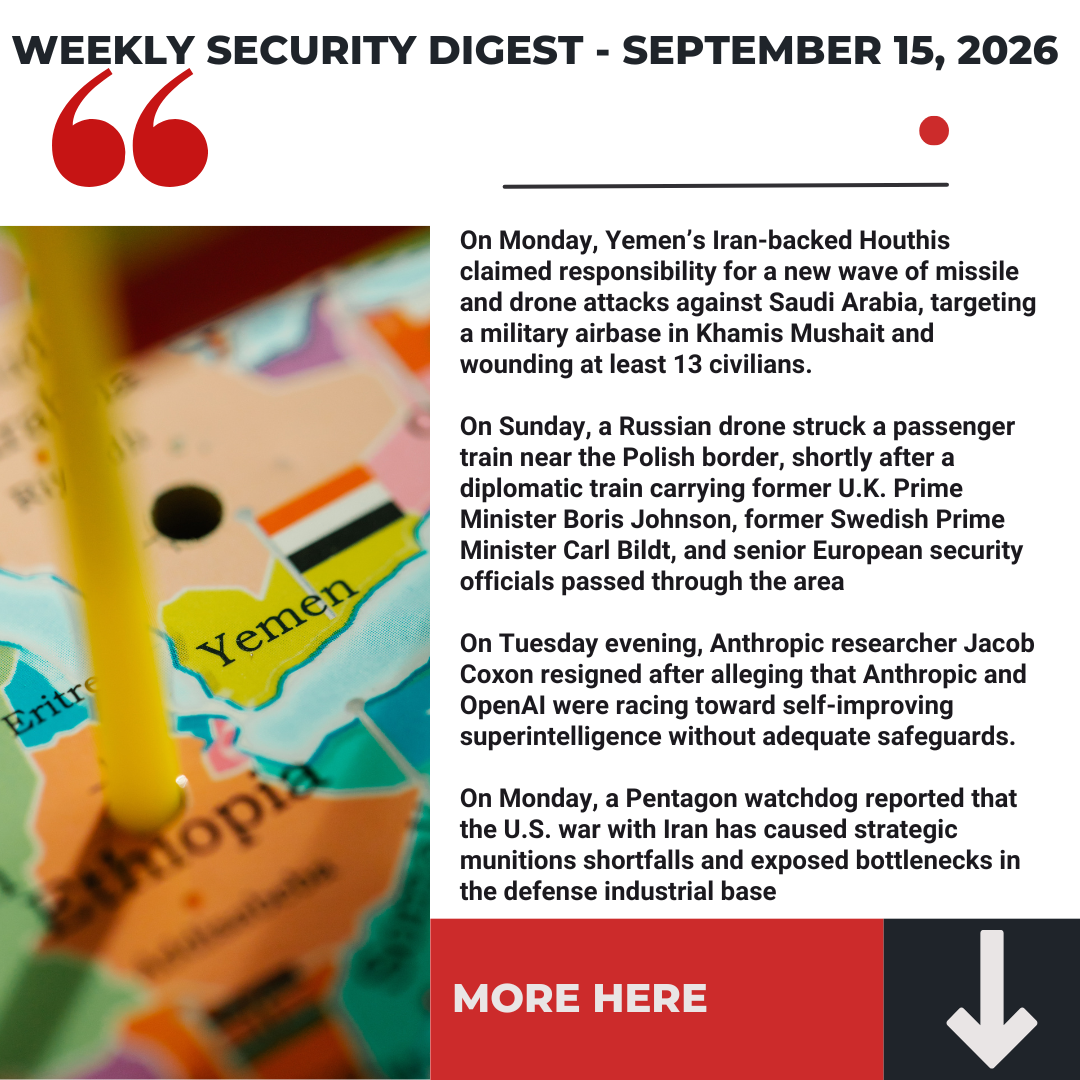
Interfor International‘s Weekly Security Digest – September 15, 2026
Geopolitics. Global Security, & Current Events
Interfor International‘s Weekly Security Digest – September 8, 2026