

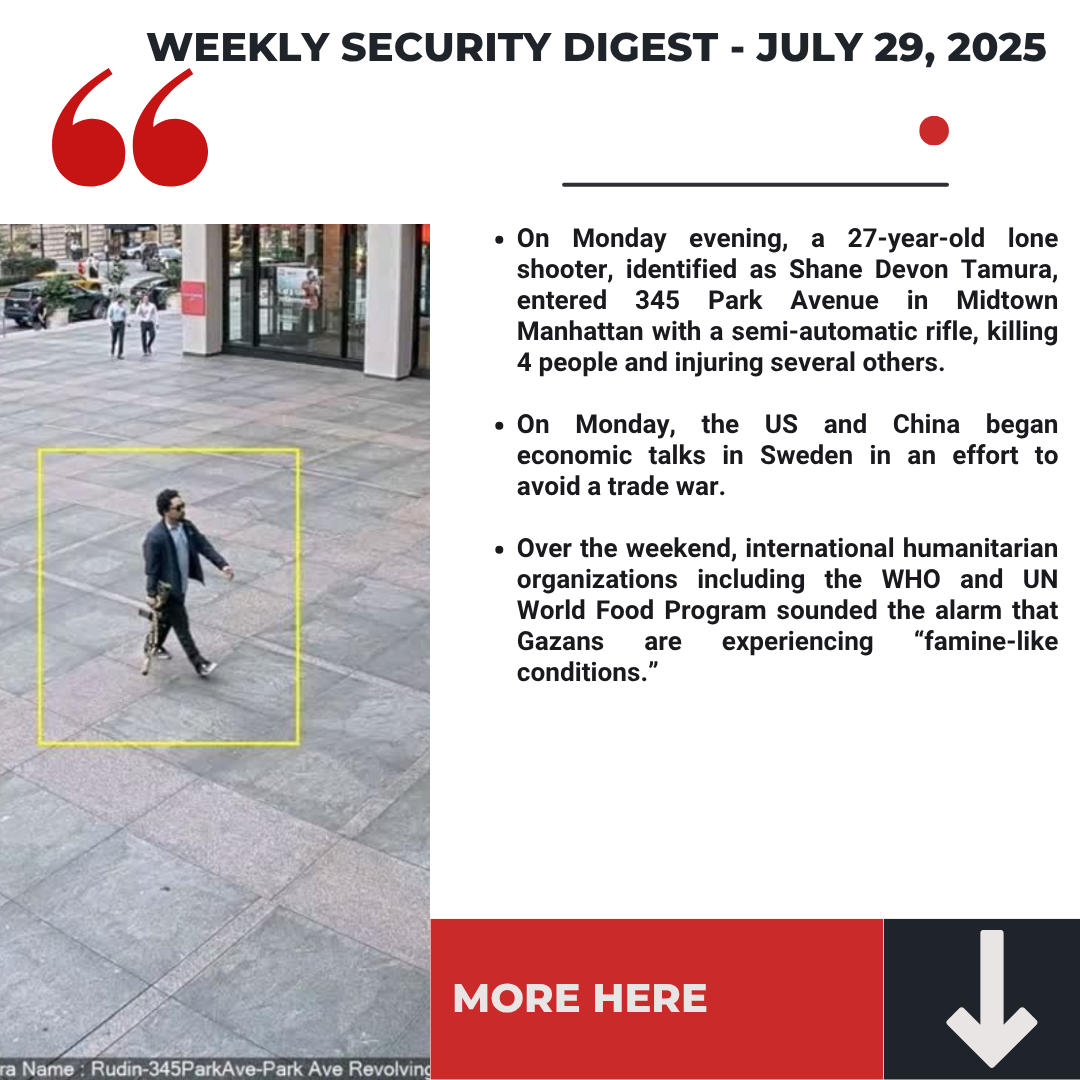
| US → On Monday evening, a 27-year-old lone shooter, identified as Shane Devon Tamura, entered 345 Park Avenue in Midtown Manhattan with a semi-automatic rifle, killing 4 people and injuring several others. Among those killed was an off-duty NYPD officer, a security guard, and two civilians. Early assessments indicate that Tamura was working alone. Police reports indicate that Tamura was carrying a suicide note that blamed the NFL for neurological issues he had experienced, citing chronic traumatic encephalopathy (CTE) from his high school football career. At this time, Tamura’s attack appears to be personally motivated. While there’s no widespread direct comparison published between Tamura and Luigi Mangione, who murdered the United Healthcare CEO in December 2024, to date, similar themes of anti‑institutional anger, mental health issues, and online valorization of violence are being noted in discussions around Tamura, echoing the earlier Mangione discourse. Interfor’s team is actively monitoring the situation and subsequent reactions. While lone shooter events such as these are nearly impossible to predict, this is a key example of the importance of having a well-developed, practiced physical security routine in place at all work environments. Keep an eye on the Interfor International Blog for more details on our assessment of this incident. → On Monday morning, July 28, a gunman opened fire near the valet area of the Grand Sierra Resort in Reno, killing three people and wounding several others, including a security guard and bystanders. The suspect, whose motive remains unknown, was shot and critically wounded by responding officers before being taken into custody. Police arrived within minutes, a swift response credited with preventing further loss of life. International Affairs → On Monday, the US and China began economic talks in Sweden in an effort to avoid a trade war. These meetings are another iteration of earlier bilateral talks, which resulted in short-term deals in May and June to push off tariff implementation. → On Sunday, at least 21 people were killed in an Islamic State-backed attack on a church in eastern Congo. Early reporters indicate that the Allied Democratic Force (ADF) was responsible for the massacre, marking the latest of several attacks by the militant group in recent months. The ADF operates in the Uganda-Congo border area and is known for targeting civilians. It declared its support for IS in 2018 and subsequently became an official affiliate, though it has been operating as a militant group in Congo since the 1990s. → Over the weekend several countries in Southern Europe experienced widespread wildfires. In northwest Turkey, nearly 2,000 people were forced to flee their homes on Sunday. In Greece, wildfires spread across Athens, Kryoneri, and other areas. The fires appear to be caused by unusually high temperatures, dry conditions, and wind. The surge in natural disasters comes amid an ICJ ruling last week, which called on states to take additional steps to address the climate crisis. → On Thursday, Thai and Cambodian militaries began violently clashing on the border, with both ground troops and airstrikes employed. Hundreds of thousands of civilians were reportedly displaced by the conflict. Each nation accused the other of starting the conflict, claiming that civilians were purposefully put in harm’s way. Over the last several days, Thai and Cambodian military and civilian officials have held a series of meetings in which they agreed to de-escalate the violent border conflict on Tuesday. This the latest episode in longtime tensions between the two states, at least in part due to disputed claims over a temple dating to the Khmer Empire. Middle East → Over the weekend, international humanitarian organizations including the WHO and UN World Food Program sounded the alarm that Gazans are experiencing “famine-like conditions.” Subsequently, Israel announced on Sunday that it would pause military operations in the Strip for 10 hours per day to facilitate greater aid distribution. However, in the same announcement, Prime Minister Netanyahu reiterated that Hamas benefits from enhancing the “perception” of a humanitarian crisis. President Trump and Prime Minister Keir Starmer have expressed a commitment to helping establish additional aid centers, though did not provide specifics. The food crisis in Gaza is creating tension between Trump and Netanyahu. Netanyahu continues to walk a tightrope between occasionally heeding global and US pressure on humanitarian issues and appeasing the right flank of his coalition, which explicitly opposes aid delivery. We are closely watching the Trump-Netanyahu dynamic. Any frustration Trump feels toward Netanyahu on the aid crisis could carry over into discussions around the Gaza ceasefire and US policy toward Iran. → US Envoy Steve Witkoff said last week that despite the US decision to recall its team from Doha, he was still committed to diplomatic efforts, while also expressing support for Israeli operations to suppress Hamas. Egyptian and Qatari partners are reportedly still working to revive negotiations. Domestically, recent polling shows that the majority of Israelis are supportive of a ceasefire that includes the release of all remaining hostages. → On Monday, President Trump claimed that any attempt to rebuild the Iranian nuclear program would provoke more US strikes. Iran’s Foreign Minister Abbas Araghchi responded on X, claiming that further US or Israeli aggression would cause Iran to react “in a more decisive manner.” This comes days after Iran reportedly signaled it would re-engage in nuclear talks with the US if several conditions were met, including the right to enrich uranium “in line with its legitimate needs.” Iran is likely attempting to demonstrate some degree of cooperation to the US and Europe in order to avoid the triggering of the 2015 JCPOA’s “snapback” mechanism. If employed, it would re-impose multi-lateral sanctions on Iran from 10 years ago. Cyber → On July 28, a cyberattack on Russia’s state-owned flag carrier Aeroflot caused widespread disruption, forcing the cancellation of over 100 flights and delaying dozens more at Moscow’s Sheremetyevo Airport. The pro‑Ukraine hacking group Silent Crow, along with the Belarus Cyber‑Partisans, took responsibility, claiming they infiltrated Aeroflot’s network for nearly a year, destroyed around 7,000 servers, and compromised sensitive passenger and internal data. Russia’s Prosecutor General has opened a criminal investigation, and the Kremlin described the incident as “quite alarming.” |
| Resources: US Department of State Travel Advisories CISA: nation-state cybersecurity threats and other resources for cybersecurity matters. Check out our newly enhanced media hub. See our most recent talk on the rise of ideological violence in the United States and how corporate security professionals are meeting the challenge, featuring former Director of the U.S. Secret Service, Mark Sullivan. Our latest analysis looks at the Israel-Iran conflict; beyond the headlines. See also our second interview with Tom Hardin, one of the most active informants in securities fraud history. |
To find out more, please reach out to info@interforinternational.com
Related Blog
VIEW ALL
Geopolitics. Global Security, & Current Events
Interfor International‘s Weekly Security Digest – October 6, 2026
Geopolitics. Global Security, & Current Events
Interfor International‘s Weekly Security Digest – September 29, 2026
Geopolitics. Global Security, & Current Events
Interfor International‘s Weekly Security Digest – September 22, 2026