

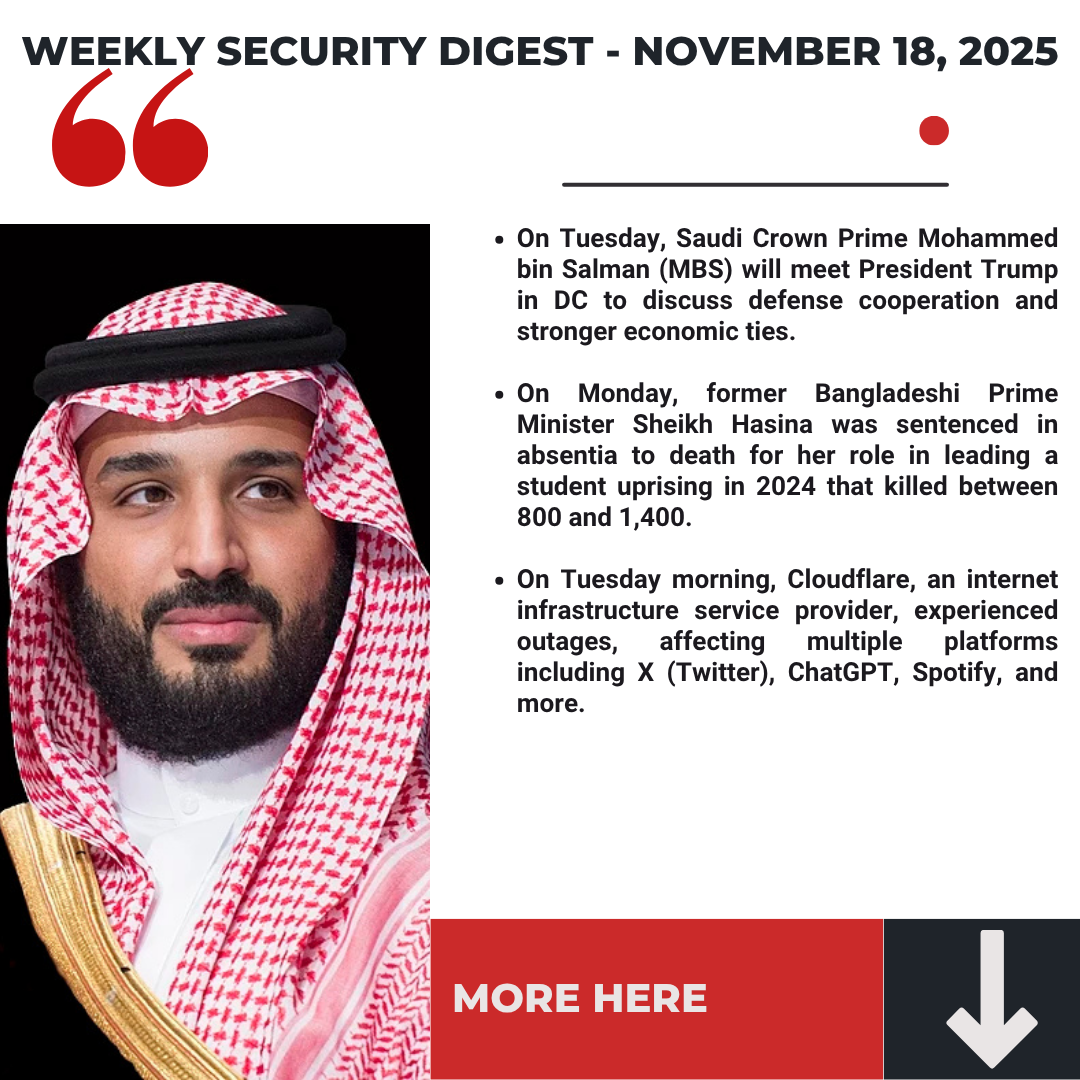
| Middle East → On Tuesday, Saudi Crown Prince Mohammed bin Salman (MBS) will meet President Trump in DC to discuss defense cooperation and stronger economic ties. President Trump is expected to sign a deal for the sale of F-35 aircrafts to KSA, which the US is hoping will come with Saudi movement on normalization with Israel. For their part, the Saudis want to see a pathway toward Palestinian statehood before they normalize with Israel. Also on the Saudis’ wishlist for MBS’s visit is a security deal, similar to the one Trump signed with the Qataris in September. The Saudis are unlikely to agree to normalization with Israel in the immediate term, following the war in Gaza, which has increased anti-Israel sentiment in the Kingdom. Trump is looking for as much movement on normalization as he can get, however. There is some chance that Trump will either show frustration with MBS if he says no to moving toward normalization, or that he will put even more US money and support on the table in exchange for progress on normalization. Before the Gaza war, the Saudis were interested in US support for a civilian nuclear capability in exchange for normalizing with Israel. We expect MBS to bring the nuclear issue back to the forefront. The Saudis want to be a leading provider of AI infrastructure, which will increase their domestic demand for electric power. At the same time, MBS wants to continue to fund his ambitious economic development agenda, for which he needs to continue exporting oil, rather than using it to power Saudi-based data centers. Nuclear power would go a long way toward addressing that gap, while also assuaging Saudi concerns about Iran’s nuclear capability. → On Monday, the UNSC approved a resolution to implement the International Stabilization Force (ISF) and its oversight body, the Board of Peace, in Gaza as part of President Trump’s 20-point peace plan. With international approval, the US and partner countries will theoretically be able to govern and rebuild Gaza over the next two years, beginning as soon as January. Hamas objected to the plan due to its insistence on disarmament of non-state groups. International Affairs → On Monday, former Bangladeshi Prime Minister Sheikh Hasina was sentenced in absentia to death for her role in leading a student uprising in 2024 that killed between 800 and 1,400. Hasina, who fled to India following the protests, claims that the court is unjustly portraying the civilian deaths as premeditated. Over the past several days, there have been several dozen arson attacks in Bangladesh and calls for additional protests by Hasina’s Awami League party. The interim government, led by Nobel Peace Prize laureate Muhammad Yunus, has increased state police presence in Dhaka and announced new elections in February 2026. The Awami League will not be allowed to participate. → On Monday, the British government announced several major immigration policy changes. Under the new regulations, refugee status will be temporary, admitted refugees must wait 20 years before applying for permanent residency, and visa bans will be imposed on countries who decline to repatriate migrants who illegally enter the UK. Specifically, Angola, Namibia, and the Democratic Republic of Congo were threatened with an immigration bar if they do not cooperate with these new policies. → Japanese Prime Minister Sanae Takaichi’s pro-Taiwan remarks earlier this month sparked several retaliatory moves from China, raising concerns that the bilateral relationship may be threatened if Taikichi continues to advocate for Taiwanese sovereignty. China issued an advisory dissuading its citizens from traveling to Japan, threatening the tourism industry, and on Sunday, Chinese coast guard vessels allegedly entered Japanese waters without permission. Japanese officials are reportedly attempting to deescalate the situation, though many are concerned that China could restrict key imports. → On Saturday, demonstrators gathered in more than 50 Mexican cities to protest corruption and crime. President Claudia Sheinbaum’s administration has criticized the protests as paid for and organized by her opposition; however, recent polling suggests that, amid sustained cartel violence, these topics remain a top concern for many voters. → On Monday, Ukrainian President Zelenskyy and French President Macron signed a letter of intent committing up to 100 French Rafale aircrafts as well as other air defense systems to Ukraine by 2035. However, there is not yet a firm plan for financing the arms transfer. French authorities are reportedly pushing to fund it with a combination of EU programs and frozen Russian assets, though this requires the full support of the EU. Cyber → On Tuesday morning, Cloudflare, an internet infrastructure service provider, experienced outages, affecting multiple platforms including X (Twitter), ChatGPT, Spotify, and more. The company is currently working to resolve the issue. This outage comes just one month after Amazon Web Services crashed, prompting rising concerns about overreliance on a small group of technology companies to power everyday systems. → Last week, Anthropic flagged what it claims is the first fully automated cyberattack. The incident, carried out by suspected Chinese state hackers, targeted technology firms, banks, chemical manufacturers, and government agencies using a hacking platform, Claude Code. The hackers appear to have used AI models to draft and perfect cyberattack strategies, raising serious concerns about cybersecurity and national security. |
| Resources: US Department of State Travel Advisories CISA: nation-state cybersecurity threats and other resources for cybersecurity matters. Our latest blog post examining data security on social media. |
To find out more, please reach out to info@interforinternational.com
Related Blog
VIEW ALL
Geopolitics. Global Security, & Current Events
Interfor International‘s Weekly Security Digest – September 15, 2026
Geopolitics. Global Security, & Current Events
Interfor International‘s Weekly Security Digest – September 8, 2026