

Middle East
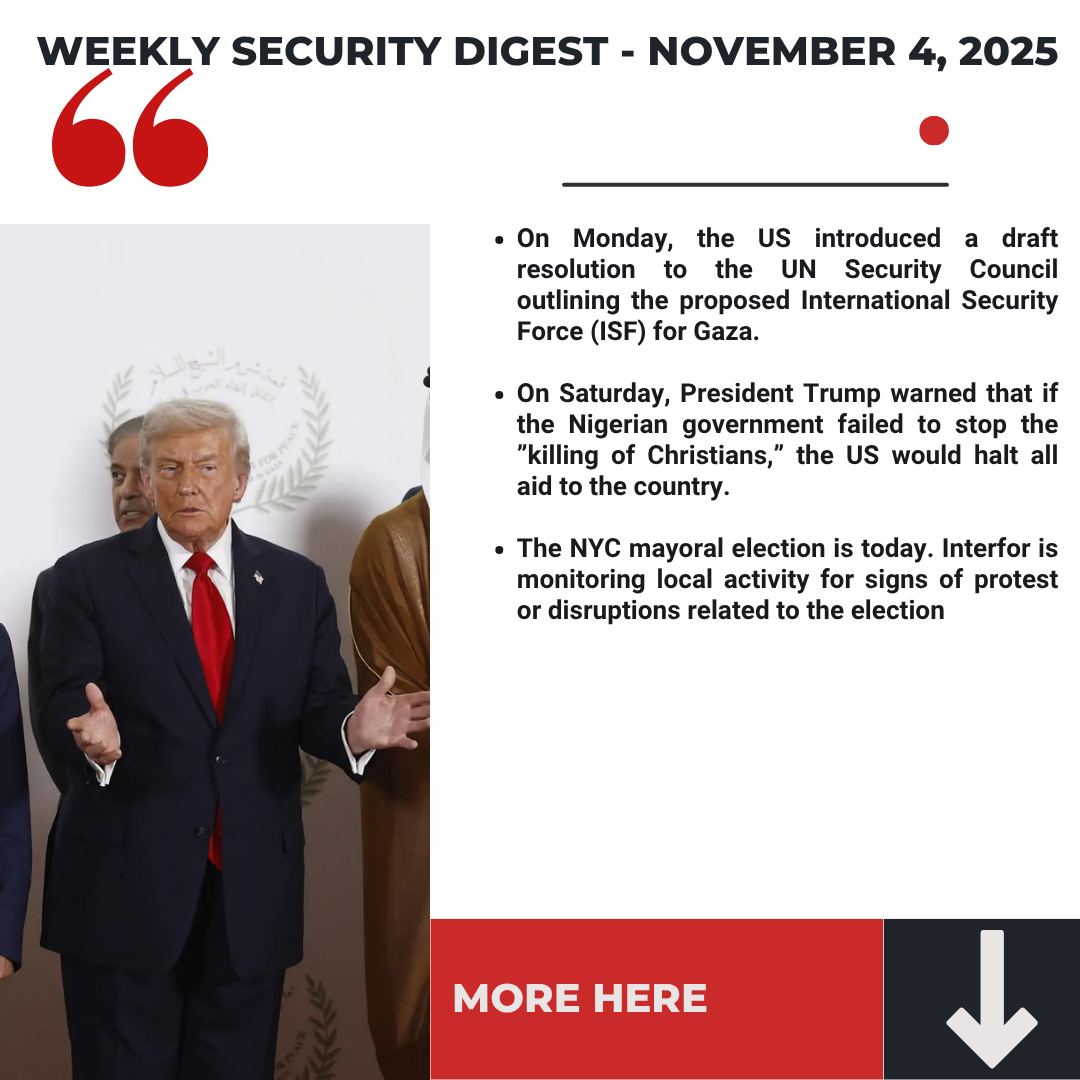
→ On Monday, the US introduced a draft resolution to the UN Security Council outlining the proposed International Security Force (ISF) for Gaza. The proposal gives the US and other key partners the authority to “govern Gaza and provide security through the end of 2027.” The plan tasks the ISF with demilitarizing Gaza by facilitating the disarmament of groups such as Hamas and Palestinian Islamic Jihad. ISF countries are also to form a “Board of Peace” to oversee Gaza while the Palestinian Authority undergoes a series of reforms.
Regional stakeholders remain skeptical about the implementation of Trump’s plan. The disarmament of Hamas, in particular, would be a complex endeavor that the group is highly unlikely to undertake voluntarily. That fact may complicate efforts to onboard nations to the ISF, given the high likelihood of violent clashes with Hamas in the event the ISF prioritizes disarmament. Theoretically the ISF could instead choose to act more as a peacekeeper force and avoid confrontation, though the US insists that will not be the case.
Netanyahu’s government has yet to approve an eventual handoff of Gaza to the Palestinian Authority, but the Israelis seem to be comfortable with the state of play because so many obstacles to the Trump plan’s success remain. For example, the deal could very well collapse if the US fails to put together an “implementation force” willing to confront Hamas. It could also collapse if the ISF arrives and finds itself in full-scale conflict with Hamas. Broadly, it seems as though much more remains to be negotiated before we can truly consider Trump’s plan to be progressing.
International Affairs
→ President Trump played down the possibility of war with Venezuela in an interview on Sunday, following criticism of recent military actions in the Caribbean. Over the past several weeks, the US Navy has launched over 15 strikes on boats which allegedly belong to drug cartels. At least 65 people have been killed in the strikes. In Washington, several members of Congress have criticized the Trump administration for a lack of transparency with Congress. In response, Secretary Rubio is scheduled to brief a segment of Congress on Wednesday on ongoing operations in the Caribbean.
→ Last week, the Sudanese paramilitary group Rapid Support Forces (RSF) captured El Fasher in Western Darfur. During RSF’s invasion of El Fasher, militia members reportedly conducted mass executions of civilians and widespread sexual violence, with many civilians reportedly still being held against their will by RSF. Thousands attempted to flee the city amid a communications blackout, though many remain unaccounted for. The UN and other international aid groups are accusing RSF of genocide and calling for international relief and an arms embargo on Sudan.
Widespread reports accuse the UAE of supporting the RSF via provision of arms (the UAE continues to deny these reports). This pits the UAE against its neighbors Saudi Arabia and Qatar, both of which support the Sudanese Armed Forces (SAF). Reports also suggest that the UAE has been the primary blocker to progress in the US-led diplomatic process aimed at ending the Sudan conflict.
If the situation in Sudan continues to deteriorate following the RSF’s operation in El Fasher, the US-UAE relationship could encounter rare turbulence. We might see the Trump administration pressure the UAE to withdraw its support for the RSF and return to the negotiating table.
→ On Saturday, President Trump warned that if the Nigerian government failed to stop the ”killing of Christians,” the US would halt all aid to the country. Kimiebi Ebienfa, a spokesperson for the Nigerian Ministry of Foreign Affairs, expressed their commitment to protecting all religious groups in the country. However, Nigeria has long faced conflict with extremist group, Boko Haram, an Islamic State affiliate group. Despite Nigeria’s assurances, President Trump indicated this weekend that the Pentagon was preparing for potential military action in Nigeria.
→ On Sunday, Canada and the Philippines signed a defense agreement to increase combat drills and bilateral security alliances to deter Chinese regional aggression. The agreement entails joint military training, information sharing, and emergency coordination. The Philippines already has similar agreements with the US and Australia. Under President Ferdinand Marcos Jr, such agreements have been a key priority. Marcos has also cultivated security cooperation with Japan and New Zealand.
→ On Monday, Peru broke diplomatic relations with Mexico. The decision was reportedly prompted by Mexico’s decision to grant asylum to former Peruvian Prime Minister Betssy Chávez, who is under investigation for a coup attempt. Chávez currently faces up to 25 years in prison in Peru.
US
→ The NYC mayoral election is today. Interfor is monitoring local activity for signs of protest or disruptions related to the election.
To find out more, please reach out to info@interforinternational.com
Related Blog
VIEW ALLInterfor International‘s Weekly Security Digest – October 13, 2026
Interfor International‘s Weekly Security Digest – October 6, 2026
Interfor International‘s Weekly Security Digest – September 29, 2026