

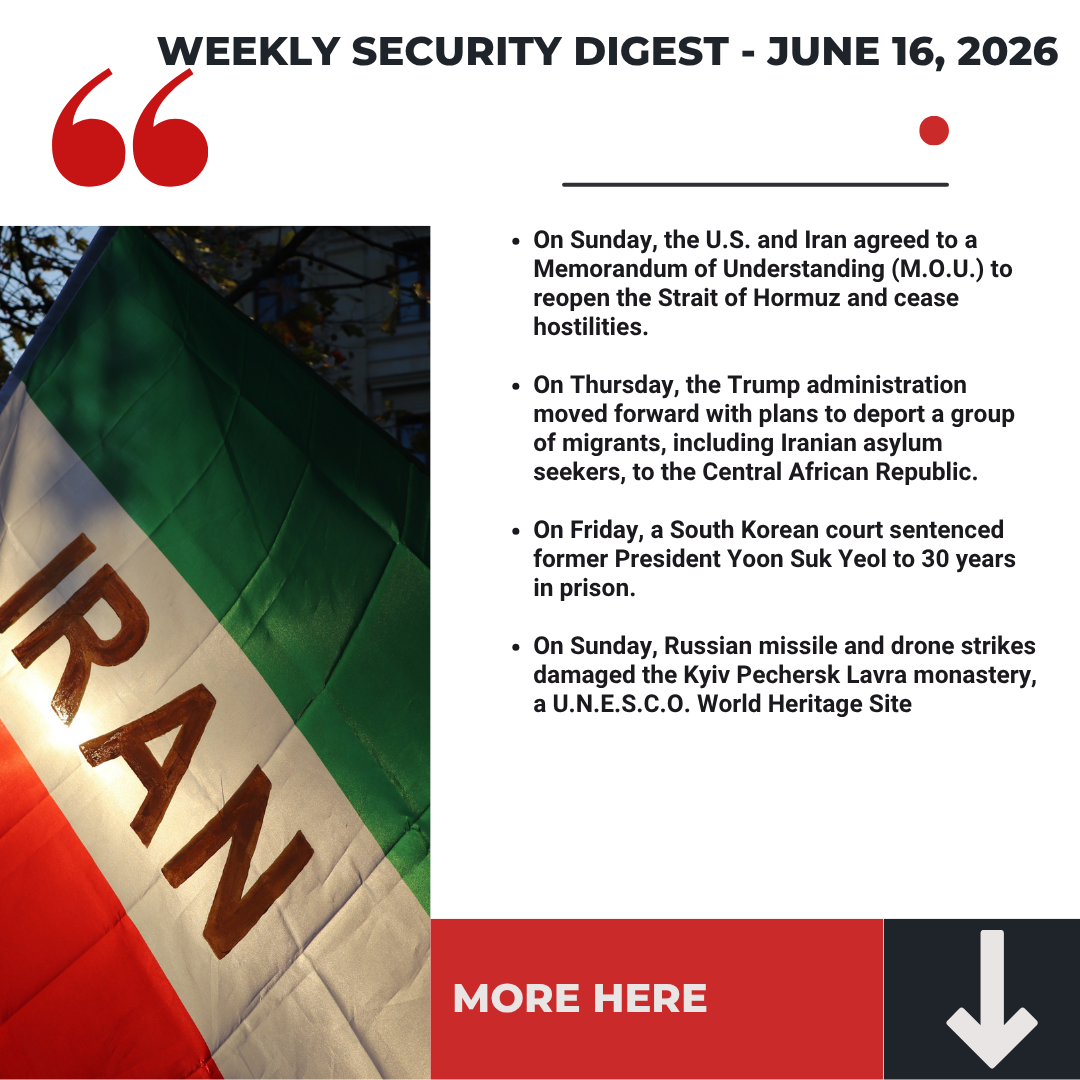
| Middle East → On Sunday, the U.S. and Iran agreed to a Memorandum of Understanding (M.O.U.) to reopen the Strait of Hormuz and cease hostilities. The official signing is scheduled for Friday in Geneva, initiating a 60-day period for negotiations on the nuclear issue. American and Iranian messaging on the terms of the M.O.U. has been somewhat conflicting, raising questions about the level of control Iran will retain over the Strait, how much and when frozen Iranian assets will be released, and what will happen should nuclear negotiations fail. Additionally, the M.O.U. reportedly includes Lebanon as well, despite Israel not being a party to the deal. Israeli Defense Minister Katz asserted that the deal will not prevent Israel from responding to hostile attacks from Iran or its proxies. Rumors of the M.O.U.’s contents point to limited Iranian concessions. Trump is likely to face extreme criticism from the right, left, and all of Israel. Nevertheless, the agreement reflects the wishes of the Gulf states and other mediators for a swift end to the conflict, with or without a clear U.S. victory. Qatar has been credited as the key mediator, with Trump expressing thanks to Sheikh Tamim earlier today at the G7 meeting in France. Looking ahead, we are focused on two things: 1. How Israel will treat the emerging deal. If this deal is as limited in scope and detail as expected, Israeli frustration will reach a peak. Moreover, Prime Minister Netanyahu will be widely viewed as having failed in his grand quest to enhance Israel’s security by dealing a decisive blow to the Iranian regime. All of this is made even more tense given the upcoming Israeli election. Our expectation is that Israel will continue to challenge the deal incrementally, likely starting with continued operations in southern Lebanon. 2. How quickly the Strait will reopen and to what extent Iran hopes to continue to exert control. It is somewhat likely that the U.S. and Iran differ on expectations around the Strait and that we will see limited clashes again in the Strait as tankers attempt to pass through before Iran is ready to relinquish control. Iran’s reluctance will either come from a differing view of the agreement – for example, an insistence that shipments still need to coordinate with the I.R.G.C. – or from an Iranian perception that the U.S. has yet to fulfill its commitments under the deal, commitments that Iran believes should precede restored traffic through the Strait. Finally, the U.S. and Iran are unlikely to reach a full nuclear accord within the allotted 60 days. One or more extensions of this agreement is highly likely, but it is worth noting that talks could partially or fully collapse due to a lack of progress. As in prior processes, this risk might be exacerbated by inflammatory comments aimed at domestic constituencies in the U.S. and Iran, respectively. International Affairs → On Tuesday, a 30-year-old Sudanese refugee carried out a knife attack in north Belfast that left a man hospitalized with serious injuries. Authorities charged the alleged attacker with attempted murder and related offenses. The incident triggered protests that quickly escalated into riots across Northern Ireland and Scotland, during which masked groups vandalized or set fire to homes, businesses, and vehicles, forcing some immigrant families to flee their neighborhoods. The unrest has become a flashpoint in broader debates over immigration, community relations, and public security. → On Thursday, the Trump administration moved forward with plans to deport a group of migrants, including Iranian asylum seekers, to the Central African Republic. Their deportation is under updated U.S. third-country resettlement laws designed to accelerate removals when deportation to a migrant’s home country is legally restricted. The group reportedly included Iranian women who had received legal protections after U.S. courts found they faced credible risks of persecution in Iran. Human rights advocates criticized the policy, arguing that deportees are being sent to a country plagued by chronic instability, armed violence, and weak state institutions despite having no legal status or support networks there. → On Friday, a South Korean court sentenced former President Yoon Suk Yeol to 30 years in prison. The sentence follows a months-long legal case in which the court determined that Yoon ordered military drones to fly over Pyongyang in 2024 to provoke North Korea and create a pretext for his subsequent declaration of martial law. The court convicted Yoon and former Defense Minister Kim Yong Hyun of abuse of power and aiding an adversary, concluding that the operation sought to manufacture a national security crisis while exposing sensitive military capabilities. The ruling adds to a growing list of convictions against the ousted president, who is already serving a life sentence for his role in the failed martial law attempt that triggered South Korea’s most serious political crisis in decades. → On Sunday, Russian missile and drone strikes damaged the Kyiv Pechersk Lavra monastery, a U.N.E.S.C.O. World Heritage Site. Ukrainian officials said the attack formed part of a broader overnight barrage involving more than 600 drones and 70 missiles that killed at least 11 people and caused damage across multiple cities. President Volodymyr Zelenskyy accused Russia of deliberately targeting a symbol of Ukrainian identity. Moscow denied responsibility and claimed the damage may have been caused by Ukrainian air defenses. → On Monday, an Oslo court sentenced Marius Borg Høiby, the son of Crown Princess Mette-Marit and stepson of Norway’s heir apparent, Crown Prince Haakon, to four years in prison. Høiby was found guilty on 34 charges, including two counts of rape, assault, threats, and violations of restraining orders, following a high-profile trial that attracted intense scrutiny across Norway. Prosecutors sought a lengthier sentence, but Høiby denied the most serious allegations and is expected to appeal the verdict. The case has become one of the most consequential scandals to affect Norway’s royal family in recent decades and comes amid renewed scrutiny of Crown Princess Mette-Marit following reports about her past association with convicted sex offender Jeffrey Epstein. Both scandals have added to broader reputational pressures facing the monarchy. → At the G7 summit in France on Monday, U.K. Prime Minister Keir Starmer announced a new sanctions package targeting Russia’s “shadow fleet” of oil and liquefied natural gas tankers, financial institutions, and military procurement networks. Starmer aims to further constrain Moscow’s ability to fund the war in Ukraine. Starmer also pledged approximately £210 million in additional energy support for Kyiv, including a deal to supply enriched uranium through U.K.-owned Urenco to support Ukraine’s nuclear energy sector. The measures come amid renewed efforts by Western leaders to maintain pressure on Russia as concerns grow over waning international support for Ukraine and continued Russian strikes on civilian infrastructure. → On Monday, the Australian Government suspended K.P.M.G. from bidding on new federal government contracts for three months. Authorities are currently investigating allegations that the accounting firm misused confidential client information to secure audit work and commercial advantages. The scandal has already prompted the resignation of several senior executives and triggered investigations by regulators, parliamentary committees, and anti-corruption authorities. Government data show federal spending on new contracts with the Big Four has already declined significantly in the wake of previous scandals, raising questions about the future influence of major consulting firms in government decision-making and oversight. → On Tuesday, South Africa marked the 50th anniversary of the 1976 Soweto uprising, when police killed more than 200 students protesting the apartheid government’s decision to impose Afrikaans as a language of instruction in Black schools. The demonstrations became a turning point in the anti-apartheid struggle, galvanizing domestic resistance and intensifying international pressure on the white minority government. Commemorations took place across the country as political leaders, survivors, and activists reflected on the legacy of the uprising and the role of young people in South Africa’s liberation movement. |
A Note From Interfor
→ Don Aviv and Jeremy Hurewitz on Pakistan’s involvement in the Iran war for The Hill.
→ Don Aviv and Sabrina Tan on the increasing threat of cyber attacks in Time Magazine.
| Resources: US Department of State Travel Advisories CISA: nation-state cybersecurity threats and other resources for cybersecurity matters. |
To find out more, please reach out to info@interforinternational.com
Related Blog
VIEW ALL
Geopolitics. Global Security, & Current Events
Interfor International‘s Weekly Security Digest – September 15, 2026
Geopolitics. Global Security, & Current Events
Interfor International‘s Weekly Security Digest – September 8, 2026