


| Middle East → Vice President JD Vance arrived in Israel on Tuesday morning to bolster efforts to maintain the ceasefire agreement. On Sunday, two IDF soldiers were killed by a Hamas ambush in Gaza, on the Israeli side of the ceasefire line. The IDF subsequently initiated a string of airstrikes, killing at least 45 according to Gazan health authorities. The first stage of the ceasefire is still in process, with Hamas required to release the remaining 15 deceased hostages. While the Trump team intends to push the deal forward into Phase 2, there are several obstacles in the way, namely Hamas’ refusal to disarm and conflicting plans for the future governance of Gaza. The Trump team is highly invested in maintaining and progressing the ceasefire, but rumors are emerging that Prime Minister Netanyahu is interested in resuming military operations against Hamas. As of now, Interfor assesses that the ceasefire will hold but will struggle to progress to later phases, leaving a Hamas presence in Gaza and preserving the likelihood of future rounds of Hamas-Israel conflict in the Strip. We are continuing to watch the Trump-Netanyahu relationship as an indicator of what is to come in Gaza, Israel, and the wider region. Over the past week, Trump and Netanyahu have directly and by proxy pushed competing narratives surrounding how the ceasefire came to fruition. Trump’s team, alongside most major US media outlets, claim that Israel’s failed strike on Hamas in Doha created leverage for President Trump to exert over Netanyahu, effectively forcing a reluctant Israeli PM to finally accept a deal. This narrative insinuates that Netanyahu had been a blocker to the deal previously, which is problematic for Netanyahu’s political prospects in Israel, where many already blame him for delaying a deal that would have returned more living hostages if signed earlier. Netanyahu and his proxies have over the last week aggressive pushed an alternative narrative, arguing that the ceasefire was only made possible due to the excess pressure Hamas and Qatar felt following the Doha strike. From our perspective, this argument is a tough sell, but it appears to be achieving some uptake in Israel. International Affairs → On Monday, several EU ministers signed onto a proposal to gradually phase out Russian oil imports by 2028. The proposal is still being negotiated before a final vote is taken. The EU has already dramatically decreased its reliance on Russian oil due to the Ukraine war. The draft language of the proposal currently includes exceptions for landlocked member states including Slovakia and Hungary, which are more reliant on Russian imports. → Sanae Takaichi was elected as Japan’s first female prime minister on Tuesday. Takaichi is considered to lean conservative, with many voters criticizing her support for continued male-only imperial succession and her opposition to same-sex marriage. She is also expected to meet with Chinese and South Korean counterparts soon, both of whom may be wary of her “hawkish and nationalistic views.” Her first real challenge, however, will be stabilizing Japan’s economy, which has seen runaway prices on staple goods for much of 2025. → On Monday, President Trump and Australian Prime Minister Anthony Albanese announced a bilateral agreement to initiate a multi-billion dollar project to extract rare earths from Australia. The agreement potentially offers a way to lessen China’s leverage in ongoing tariff tensions. Two mines will be established in the next six months, according to the agreement, which are respectively expected to contribute 5% of rare earths and 10% of metal to global supply. → On Tuesday, Ukrainian President Zelenskyy accused Russian President Putin of “stalling” diplomatic talks to end the war. Several European leaders joined Zelenskyy, claiming that they would use billions in frozen Russian assets to aid Ukraine’s war effort if no progress was made. One of the core issues in ongoing peace talks is land. Russia currently occupies approximately 20% of Ukraine but Kyiv has strongly opposed ceding any territory to Russia. Cyber → On Monday, Amazon Web Services crashed, disrupting internet use around the world and interrupting a variety of cloud-dependent services such as Asana, Snapchat, Salesforce, Netflix, and more. Amazon reportedly blames the domain name system. The outage, which lasted for about 12 hours, highlights the reliance of much of the world on just a few companies for internet infrastructure. |
| Resources: US Department of State Travel Advisories CISA: nation-state cybersecurity threats and other resources for cybersecurity matters. Our latest blog post examining data security on social media. |
To find out more, please reach out to info@interforinternational.com
Related Blog
VIEW ALL
Geopolitics. Global Security, & Current Events
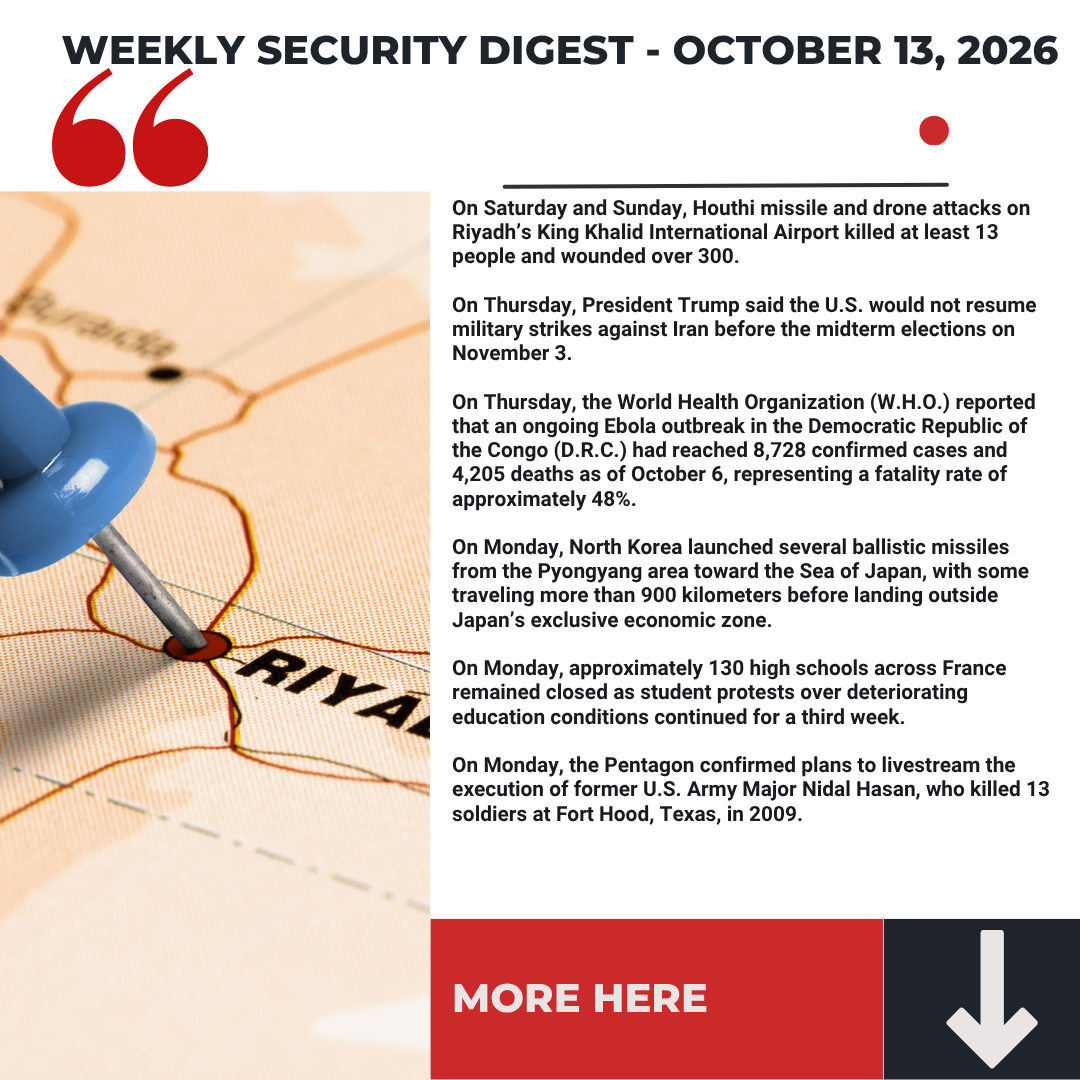
Interfor International‘s Weekly Security Digest – October 13, 2026
Geopolitics. Global Security, & Current Events
Interfor International‘s Weekly Security Digest – October 6, 2026

Geopolitics. Global Security, & Current Events
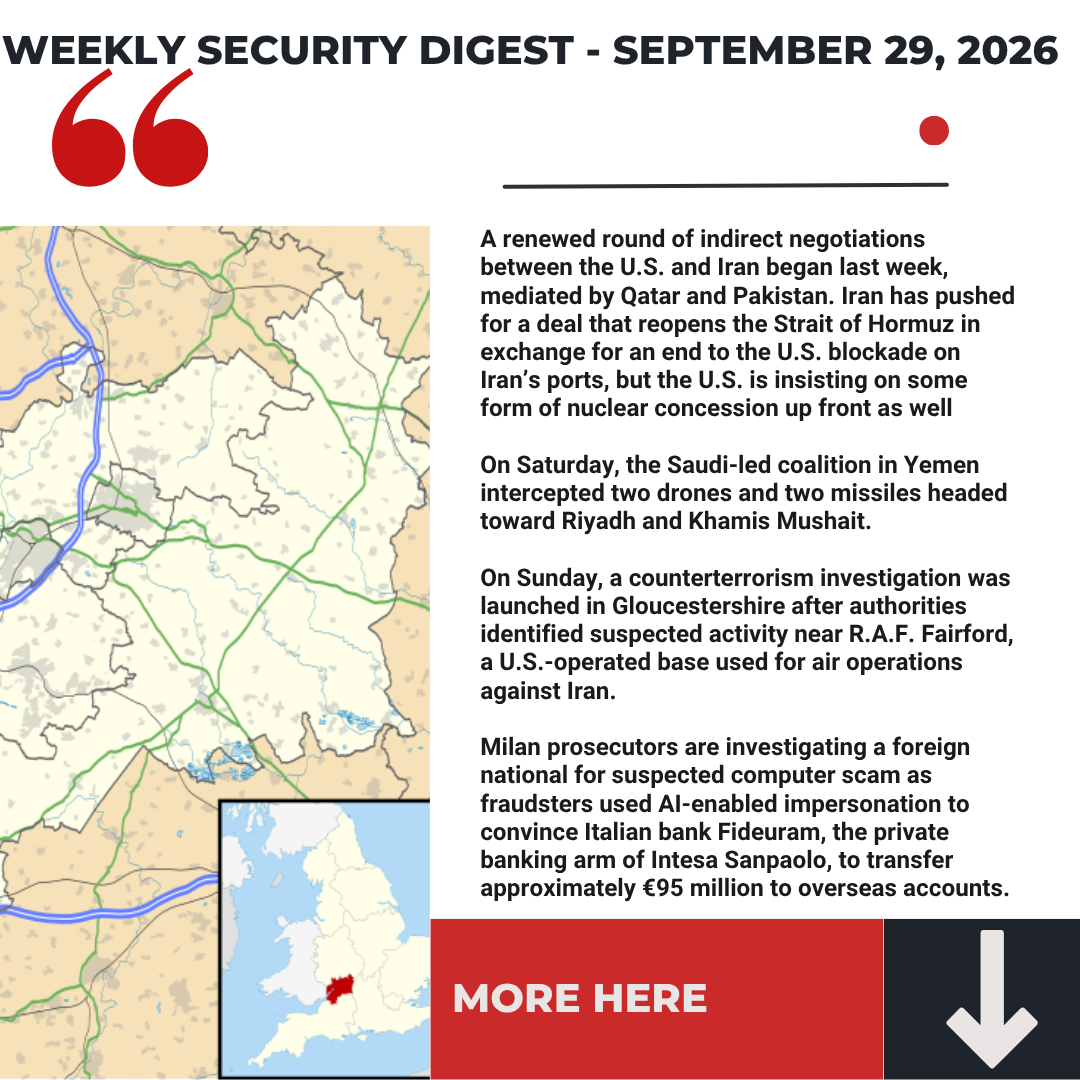
Interfor International‘s Weekly Security Digest – September 29, 2026