


President Tayyip Erdogan has long tried to position Turkey as a regional power. Looking at the dramatic chain of events the Middle East has seen since October 2023, where has Turkey gained and lost influence, and how has its foreign policy changed?
Jump to part 2
Turkish policy toward Israel
Turkey continues to loudly oppose Israel, criticizing the Jewish state’s conduct in the Gaza war, declining to refer to Hamas as a terror group, etc. Erdogan wants to be seen as a moral leader for Muslims around the world who support the Palestinian cause. Despite domestic support for his anti-Israel stance, Erdogan has not achieved the pan-Muslim leadership role he seeks.
Notably, at various points in the last two years Turkey has suggested itself as a destination for Hamas’s leadership, in the event Qatar opts to expel the group. This relocation remains unlikely for several reasons:
- Hamas leadership would be significantly more vulnerable to Israeli assassination attempts in Turkey. Qatar is a small, highly secure state, where any high-profile acts of violence would be considered norm-breaking. Moreover, Qatar’s status as a US-chosen mediator means that an assassination on Qatari soil would risk a major diplomatic crisis.
- Turkey is a large, sprawling country, with comparatively low levels of state surveillance, where both random and targeted acts of violence are relatively common. Israel could very likely kill Hamas leaders in Turkey without leaving an obvious trail.
- Separate from assassination risk, on a diplomatic level the US places far more trust in Qatar as a mediator than it would in Erdogan. Qatar prioritizes enhancing its relationship with the US as a core component of its foreign policy. Erdogan, on the other hand, sometimes supports US interests but just as often works against them, in a constant pursuit of maximum regional and global influence, with or without the US as a key long-term partner.
As far as actual policy is concerned, Turkey has cut off diplomatic ties and trade with Israel. Beyond rhetoric, Turkey exercises limited influence in Israeli-Palestinian affairs due to minimal strategic stakes in the conflict.
- Unlike Jordan and Lebanon, it does not host a large number of Palestinian refugees.
- Unlike Egypt, it does not share a border with Israel and Gaza.
- Unlike Qatar, it does not host Hamas.
- Unlike Saudi Arabia, it does not have religious authority it can use to influence Palestinian Muslims.
- Unlike the UAE, it does not have a strong economy and massive state wealth to deploy to rebuild Gaza (nor nearly as strong a partnership with the US).
- Unlike all of these countries, Turkey does not have an Arab identity nor is it Arabic speaking.
However, just in the last two weeks, Turkey has been mentioned as another mediator, alongside Egypt and Qatar, pushing Hamas for concessions to facilitate a ceasefire in Gaza. It still seems unlikely that Turkey would get credit if a ceasefire were achieved; nevertheless, reports suggest Turkey is again jockeying for a role in the talks, hoping to be globally perceived as an influential actor in defusing the conflict.
Turkey’s position on US/Israel-Iran confrontation
Despite positioning itself as a potential mediator, Turkey did not end up playing a key role in the US/Israel-Iran confrontation. Instead the US continues to work through Oman, Qatar (who received primary credit for mediating the ceasefire), the UAE, and Saudi Arabia.
From the US perspective, all of these states are seen as close enough to Iran to mediate a crisis, but – other than truly neutral Oman – somewhat more invested in their ties to the US. While Trump and Erdogan occasionally appear to have a sort of “aspiring strong man” rapport, the US foreign policy establishment generally views Erdogan as pursuing ulterior motives in regional scenarios.
Part two
Turkey’s influence in Syria
Turkey’s primary regional success lies in supporting the establishment of Hay’at Tahrir al-Sham (HTS) and Ahmed al-Sharaa at the helm of post-Assad Syria. Turkey’s decade-long cultivation of HTS and predecessor groups positions it favorably in post-Assad Syria, where it hopes to:
- At least limit and at most eliminate the strength of armed Kurdish factions in Northern Syria;
- Shape Syrian foreign policy to its advantage, ideally having the new Syrian government line up alongside Turkey on key priorities;
- Seize economic opportunities related to the country’s reconstruction and development;
- Counterbalance US, Iranian, and other outside influence in the region;
- More broadly move toward greater regional influence, ideally influencing a range of Muslim-majority nations to form a sort of neo-Ottoman axis.
However, other players, like the US and Israel, are exercising their own influence in the new Syria, which often runs partially-to-completely counter to Turkey’s interests there.
Israeli operations in Syria
Israel has taken an aggressive stance when it comes to defending the Druze minority, concentrated in southern Syria, from Sunni-led violence, even targeting the Syrian Ministry of Defense with airstrikes last month following attacks on the Druze in Suweida. In all likelihood, beyond just protecting the Druze, Prime Minister Netanyahu seeks to delay al Sharaa’s consolidation of power, given Israel’s apprehension around having a former jihadist leading a neighboring government.
The US in Syria
For the last decade, the US has been providing support to Syria’s Kurds, on the back of an already strong US relationship with Iraq’s Kurds. The establishment view in the US remains insistent that Syria’s Kurds – residing in the country’s north along Turkey’s border – be protected and, ideally, would be allowed to maintain some political power. Both regional autonomy and favorable integration into the new government have been floated as solutions.
However, it is worth noting that during his first term President Trump balked at defending Syria’s Kurds from Turkish aggression. If Turkey were to step in and help the new Syrian government pacify the Syrian Democratic Forces, the Kurdish-led, US-supported armed group in north and east Syria, Trump may or may not strenuously object.
Turkey, the Kurds, and Syria
For its part, Turkey has combatted its own Kurdish insurgency for decades and does not wish to see an armed Kurdish faction on its border. In service of that objective, Erdogan would have been satisfied to see the new Syrian government go to extreme and violent lengths to mitigate the Kurdish threat to Turkey from northern Syria. The US has successfully lobbied against this, offering the removal of sanctions, a Trump-al Sharaa meeting, and other effective support as carrots in exchange for HTS integrating, rather than purging, Kurdish influence.
Alongside all of this, Erdogan is pursuing a peace process with the PKK, Turkey’s Kurdish insurgency. Erdogan is partially interested in reconciling with Turkey’s Kurds as a means of draining Kurdish support for his primary political opposition, the Republican People’s Party, and protecting his hold on power.
Since the violence in Suweida, new challenges have arisen in the Syrian government’s efforts to come to terms with and integrate the country’s Kurds. This makes an armed confrontation with the Kurds, which Turkey might be inclined to join, more likely; however, that conflict would threaten Erdogan’s reconciliation with the PKK and the resulting political victory.
GCC investment in Syria
Lastly, deep-pocketed rivals for the new Syrian government’s affection have emerged, with Saudi Arabia, Qatar, and the UAE all announcing major investments in Syria. While Turkey might have been HTS’s primary backer in the lead up to Assad’s fall, it cannot compete with the Gulf states’ ability to deploy capital and technology to rebuild Syria.
Overall, yes the rise of HTS in Syria increases Turkey’s regional influence, but significant competition limits Erdogan’s broader neo-Ottoman ambitions.
Interesting in speaking with Interfor Academy about Turkey or another geopolitical question? Email us at Academy@interfor.international
To find out more, please reach out to info@interforinternational.com
Related Blog
VIEW ALLInterfor International‘s Weekly Security Digest – October 6, 2026
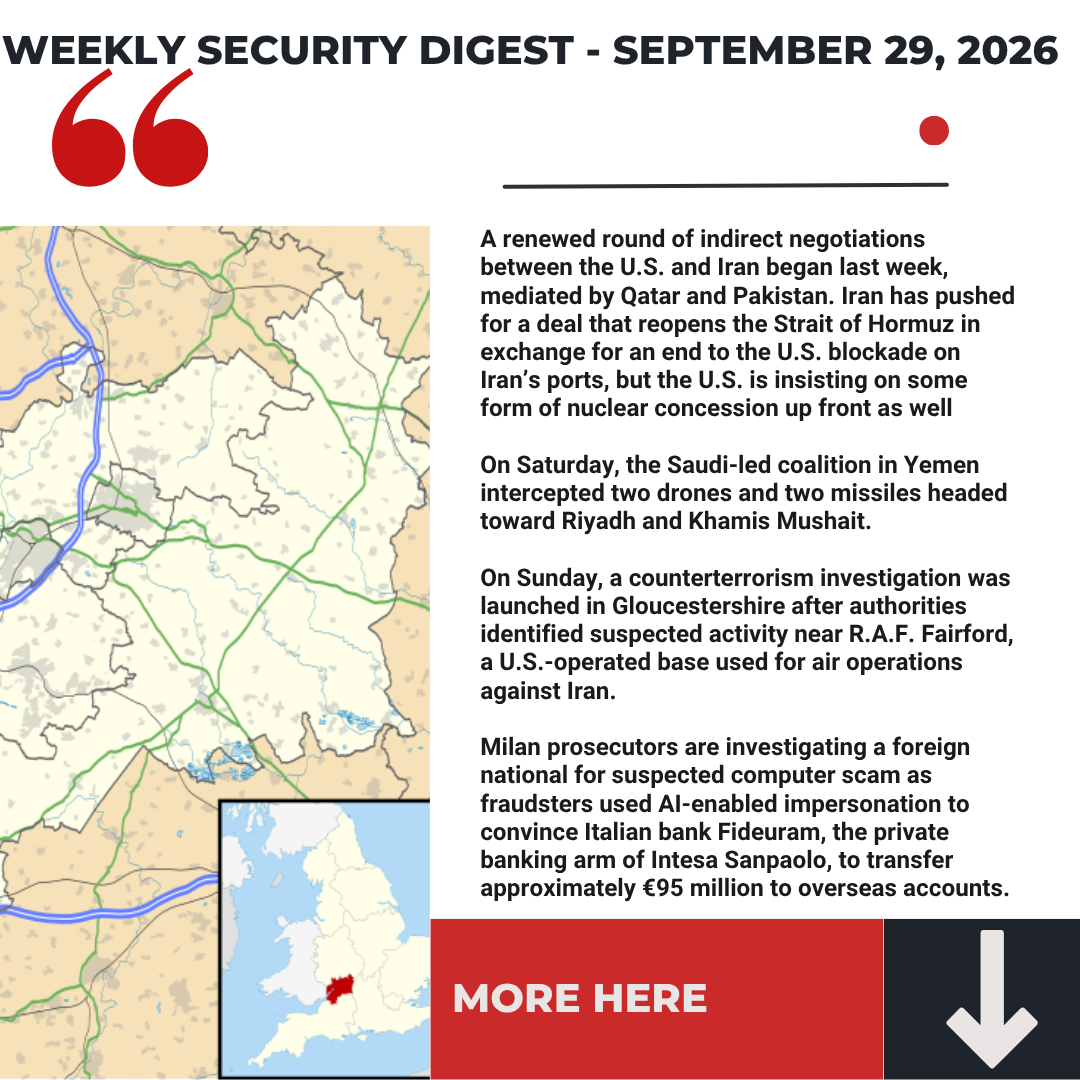
Interfor International‘s Weekly Security Digest – September 29, 2026
Interfor International‘s Weekly Security Digest – September 22, 2026